|
"A new diet pill made from an African cactus is getting a lot of attention because those who've tried it say it takes away your hunger." ABC-7 Los Angeles, talking about Hoodia |
Hoodia herbal pills helps fight obesity
|
|
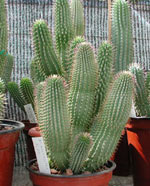
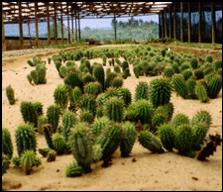
Hoodia gordonii, "Whoo De AH", is the botanical name for a leafless, spiky succulent plant that grows throughout the semi-arid areas of Southern Africa primarily the Kalahari desert. The San (local inhabitants) have rationally used Hoodia stems to stave off hunger and thirst when on long journeys, as it acts as an appetite suppressant. Hoodia Gordonii was discovered and used by the San tribe from the Kalahari, South Africa, since prehistoric times. They chewed the bitter Hoodia plant twice a day to suppress hunger and thirst during long hunting trips. This plant contains the miracle molecule p57 that was recently translated into a obesity cure. Scientists at the South African Center for Scientific and Industrial Research were the first to successfully prove that Hoodia contains a miracle molecule that suppresses the appetite. Later, a human clinical trial was conducted by scientists in Leicester England. A group of morbidly obese men and women participated. Half the group were given Hoodia and half were given a placebo. At the end of 15 days, the group on Hoodia had reduced their food intake by 1000 calories a day. Given the average daily diet is around 2200 calories, this was a stunning success. Laboratory experiments show animals automatically restrict their food intake when taking hoodia orally. Rats, a species that will eat anything from meat and plants to indigestible fiber, lowered their dietary calorie intake to a degree that made them get thin when fed comparative amounts of hoodia. It basically tricks the brain into thinking that you're full. The chemical constituents in Hoodia work within the satiety center by releasing a chemical compound similar to glucose but much stronger. The hypothalamus in the brain receives this signal as an indication that enough food has been consumed and this in turn stunts the appetite. The hypothalamus receives signal as an indication that enough food has been consumed and this in turn stunts the appetite. This pure organic Hoodia, contains a miracle molecule that, in effect, fools the brain into believing you are full, and even stops you from thinking about food. So you've bought a supply of hoodia, and now you want to know how to use it. To cover this, There are experience in using hoodia for weight loss. The optimal way is taking hoodia tincture every morning and afternoon. Easy enough, right? For most people, the real weight loss challenge has relatively to do with dieting, exercise, supplements, or how many calories you burn in the gym. The real challenge is controlling their hunger drive. People who are trying to lose weight seem to share the exact same problem. They have trouble getting their appetite under control. Hoodia gordonii, it seems, could make that much easier. Because overcoming your own hunger drive seems almost impossible unless you get some help. When you eat hoodia, the saying goes, your hunger will simply be gone -- gone -- for around six hours. During those six hours, you won't crave anything. You really won't want to eat at all. The food still smells good, as usual, and they taste the same if you eat them, but you don't want to eat them! At least that's what the hoodia advocates claim will happen. Consuming hoodia is surprisingly simple: slice off a piece of the succulent, peel off the thorns, and just start chewing on it. You don't even need to swallow it. The taste is rather bitter by most Americans' palettes, but after several minutes of chewing, you've already started absorbing the chemical. Guess what? Your hunger is vanishing with each passing moment. The San Tribesmen, the original discovers of the plant, also say it makes you feel stronger, more energetic, and more focused. Nobody complains of any side effects whatsoever, and the plant has been chewed for literally thousand of years by various generations of the San, with no ill effects known whatsoever. Hoodia pills are my life saver. I have a thyroid problem and this causes depression and weight gain. These pills take my hunger away so I can get back into shape and they make me happy, nice "side effect" ;-) Now my Doctor is taking them too! M S (Germany). Hooray for Hoodia! I lost 5 lbs in eleven days. Three family members including myself have learnt a great deal about Hoodia. It appears that the San tribe did not reveal all, especially the benefits for men, if you know what I mean - S.A - (USA) To be eligible for export to the USA and all other nations, Hoodia farmers must obtain a C.I.T.E.S. certificate which is issued on a per export-shipment basis. The Hoodia Gordonii plant originated in the southwestern part of Africa and grows best in the semi-arid areas of South Africa primarily the Kalahari. In its native habitat it is extremely difficulty to identify because it looks similar to succulents of the same family of which there are many. Only an experienced botanist or as the case in South Africa with Hoodia Gordonii a San people can identify the plant prior to it's blooming. The Hoodia is an all-natural, herbal dietary supplement and there are no know adverse side effects relating to its use. No Caffeine. No Ephedra. So Hoodia is safe for us. There are no known reported side effects to using Hoodia Gordonii that have been reported to date. Hoodia was eaten as a fresh food by the San tribe for thousands of years with zero side effects. The pure Hoodia that contains appetite suppressant qualities is only grown in one specific region in South Africa. If the Hoodia is from China, USA or any other part of the world and is not accompanied by a South African Government Certificate of Authenticity, the product is inferior and ineffective. The pure 100% Hoodia that is imported direct from South Africa is very expensive and hard to acquire. Any Hoodia products being sold at cheap prices are not the real thing and will not work. Also, Hoodia products claiming to contain large amounts of pure Hoodia in each pill are either making false claims or have dramatically diluted the product with fillers. The fact is an average person would likely become sick if they consumed more than 800mgs of real Hoodia at any one time. Hoodia Gordonii is a plant - a leafless succulent. Not a Cactus nor a Herb. In South Africa Hoodia Gordonii is classified as a foodstuff, which is testimony to how safe the product really is. So buying hoodia is very difficult. It's expensive. And, naturally, there are a lot of fakes on the market. Even now, there are only a few hundred acres of hoodia growing on commercial farms, and the plant is highly susceptible to being wiped out by rather mysterious conditions.
Job search useful information
|