by Chris Malicki
from
Scope magazine of the Royal Astronomical Society of Canada – Toronto
Centre
December
1999;
also published in The Journal of the Royal Astronomical Society of
Cananda
February
2000
Volume 94 Number 1
One of the most
dramatic
astronomical events is a total eclipse of the sun where the disc of the
moon totally covers the sun and for a few splendid minutes, the outer
atmosphere,
or corona of our local star becomes visible. Two other large
objects
can also pass between the sun and earth, namely the inner planets
Mercury
and Venus. The last transit of Venus occurred in the year 1882 and
there
is probably no person living today who witnessed it. Mercury, on
the other hand transits the sun approximately 13 times per
century.
My wife Liz and I had already experienced 8 total, and 3 annular
eclipses
of the sun but never a transit. So, when I received the 1999 Observer’s
Handbook one year ago, and saw that a transit of Mercury would occur on
November 15, I decided that we would have to see it.
The only problem
was that the event was visible primarily from the Pacific Ocean and
late
in the afternoon in the western portion of North America. Our home in
Mississauga
would witness the transit under an extremely low sun before sunset,
with
a difficult horizon. The only option was to travel west. We wanted to
stay
in Canada and drive there and back in one day (we have to work, after
all).
The obvious choice was Point Pelee National Park near Windsor. There,
the
sun would be 4 degrees higher during the transit, and we had a perfect
southwest horizon over Lake Erie as the sun sank. It would be a race
with
the sunset to see it.
On the morning of
November 15, as we drove form Mississauga, the sky was completely
overcast.
We were disheartened when we found it was pouring rain in London.
However,
as we approached Chatham, less than 100 km from Pt. Pelee, the sky
began
to clear up in the west. Clouds later began to roll in again, but
fortunately
a huge clear area moved towards the western sky where the sun would be
visible in the late afternoon.
We were located
at the southern tip of Point Pelee Natl. Park in Lake Erie at lat.42deg
N, long. 82deg 32min W. We are the southernmost observers on mainland
Canada
to observe the event, and probably all of Canada (unless one of the 230
residents on Pelee Island was watching). We observed with Eugene
and
Cherna Kowalsky from Michigan, and Mike Doson from the local area.Two
members
of the Niagara Centre RASC, Denis and Darrell began to set up scopes
near
our car and declared that the sky would be clear for the event.
They were right.
I set my Celestron 8 and solar filter and observed at 71x and 133x. Ten
minutes before Mercury touched the sun’s limb, the sun entered a huge
clear
area and stayed in the clear with only a few minor clouds till sunset.
Four minutes after
the predicted external ingress (Mercury touching the sun’s limb) I was
able to spot a dark indentation in the predicted place near the north
pole
of the sun. The planet rapidly entered the sun’s disc and
separated
from the edge of the sun as a “black drop” at 4:22:36p.m.. For the next
glorious 40 minutes we could see the planet move its way across the
extreme
NE part of the sun. The disc of Mercury was very obvious and much
blacker
than the VERY numerous and large sunspots. We were able to follow
Mercury
on the solar disc till 5:00 p.m., when it was halfway off the sun’s
disc,
and only minutes before sunset.
It was a wonderful
event to witness especially with the uncertain November weather. We
certainly
were ecstatic to see our first, and hopefully not last transit.
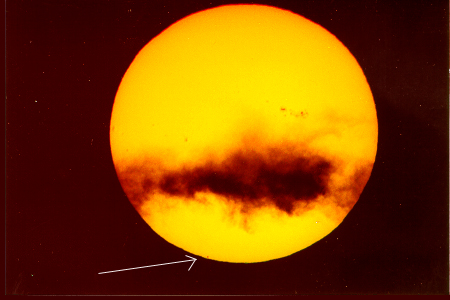
Celestron 8
with
solar filter at prime focus at 16:45 EST (21:45UT).
1/250sec. ASA100
Arrow points
to Mercury.
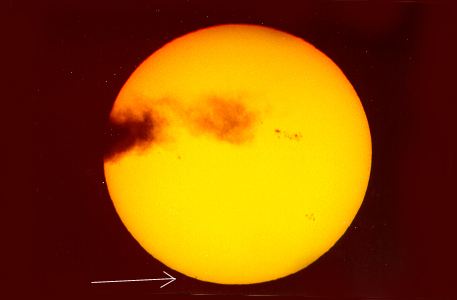
Celestron 8
with
solar filter at prime focus at 16:45 EST (21:45UT).
1/250sec. ASA100
Arrow points
to Mercury.