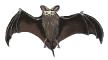
click here to hear bats A long time ago, people used to think bats were birds without feathers. But now we know that there is no such thing as a featherless bird. We know that bats are mammals, just like people.
They are considered mammals because:
• bats are warm blooded
• bats nurse their babies with milk
• bats have fur
But bats are very special mammals. They are the only mammals that can fly (without an airplane!) Flying squirrels are mammals too, but they don't really fly. They jump from high in a tree and glide through the air like a kite. Bats flap their wings and fly like a bird.
When most of us think of bats, the Vampire Bat is one of the first to come to mind. Vampire bats don't really turn into Count Dracula though, they rarely bite people and they rarely kill their prey.
Vampire bats prey mainly on cows, horses and other large mammals. They make a small wound with their razor-sharp teeth then they lick up the blood. Each bat only drinks about an ounce of blood each night.
Although Vampire Bats may be the ones most commonly remembered, there are many other kinds of bats. Bats can be found in most parts of the world -- forests, deserts, jungles and cities! There are close to 1,000 different species of bats. With all of these different bats, it's not surprising that they don't eat all the same thing.
A lot of bats, including the flying fox bat, eat fruit. Although some of these bats are pests to people who own orchards, they play an important roll in nature. The fruit bats spread the seeds of the fruit they eat -- they are responsible for scattering up to 95% of the seeds needed for new trees in tropical rain forests.
There are also a number of bats who eat insects, fish, frogs and small animals. Meat eating bats fly out at night to hunt for their food when many of the other predators are fast asleep.
Bats feed at night (they are "nocturnal") and spend the day sleeping in caves or in tree tops. The place where a bat sleeps is called its "roost".
Bats hang upside down from their roosts when they sleep.
Although some bats roost in groups of only one or two, for the most part bats are very sociable animals. They usually sleep together in huge groups.
Some caves may be home to thousands of bats. The largest bat colony in the world is in Bracken Cave, Texas. During the summer, this cave is home to as many as 20 million Mexican free-tailed bats. That's a LOT of bats!
Bats smell, hear, taste, feel and see just like people do. The term "blind as a bat" isn't really accurate. Bats have perfectly good eyes for seeing in the daylight. The problem is, they do most of their hunting at night!
Instead of relying on their sense of sight for night-time vision, bats make rapid high-pitched squeaks called "ultrasounds". These sounds are too high for most people to hear. If these sounds hit something, they bounce back -- sort of like when you hear your echo in a mountain or a bathroom when you shout. The bat hears the echo and can tell where the object is. This is called "echolocation". Not every species of bat is able to echolocate, but most can.
Bats have the best hearing of all land mammals. They often have huge ears compared to the rest of the body.
Scientists have found evidence that bats have existed for 50 million years. Some scientists believe it may have been even longer.
The earliest “fossils” (old bones) of bats that we've found look very much like the skeletons of bats today. This tells us that bats haven't changed much over the years.
 The Multiple Bat