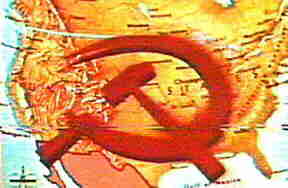
American
Perceptions
of Stalin’s Ambitions
In 1945, nearly three decades after the 1917 revolution in the old czarist empire, there was only one other communist country in the world besides the Soviet Union. That country was Outer Mongolia. By the spring of 1948, the USSR had created a wide tier of communist allies in eastern Europe that it would eventually militarize as the Warsaw Pact nations.
At the same time in China, the forces of Mao Zedong were winning huge battles against the US-backed armies of Chiang Kai-shek. Realists in the capitalist world knew very well what they were seeing: the communization of the world’s most populous country.
Mao entered Beijing at an early date, formally creating the People’s Republic of China on 1 October 1949. In the summer of 1950, the communist North Koreans attacked anti-communist South Korea and almost succeeded in conquering the entire Korean peninsula.
Stalin appeared to have set a worldwide Marxist offensive into motion, and capitalism seemed to be losing its power with horrifying speed.
Already in 1949, the Soviets had successfully tested their first atomic bomb, and the atomic monopoly that many informed Americans had expected to endure for at least ten years after the bombing of Hiroshima in August of 1945 had suddenly disappeared.
At the same time, the Soviet air force acquired the TU-4, a long-range bomber based on the design of the Boeing B-29 that was capable of delivering nuclear weapons to the continental United States. The outlook was grim as the US began to rearm in earnest.
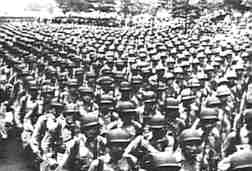
US Army Parade,
Washington DC, early 1950s
In fact, the entire situation was a terrifying dream come true. The US was now facing an adversary who would soon have the ability to do what Hitler could only dream of: kill millions of Americans in their own homes.
To the first US Secretary of Defense, James Forrestal (served 1947-49), Joseph Stalin was far more than the head of a huge nation-state. In Forrestal’s eyes, Stalin’s chief role was to serve as the high priest of a messianic political religion that was spreading across the globe like wildfire. Tormented by anxieties, Forrestal convinced himself that the entire world would fall to communist aggression within a very few years.
In the spring of 1947, while still Secretary of the Navy, Forrestal had summarized his fears in a memo to President Truman: "Of the strategic battlegrounds of the present struggle, we have already lost Poland, Yugoslavia, Romania, Bulgaria, and a number of others; Greece is in imminent peril; after Greece, France and Italy, Great Britain, South America, and ourselves."
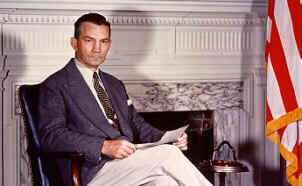
James V.
Forrestal
as Secretary of the Navy, 1945
Feeling like a voice crying in the wilderness, Forrestal did all he could to awaken the US to its peril and prepare its armed forces for a third world war. Despite his overwrought analysis of the world situation, his appointment by President Truman to head the new Department of Defense was approved by Congress, and he became Secretary of Defense in September of 1947.
He was soon describing his new job as "too big for any one man." Sadly, it was too big for James Forrestal. When he closed his office door at the Pentagon for the last time on 28 March 1949, he was a physical and mental wreck. The president had eased him out of the job with great tact, but Forrestal had not been provided with the medical care that he obviously needed. He committed suicide less than two months later.
President Truman would later record of this period that "many good people actually believed that we were in imminent danger of being taken over by the communists." Joseph McCarthy, the rightwing Republican senator from Wisconsin, was one of those who rose to prominence by playing on America’s fears of a communist world superstate.
Stalin’s postwar policies were a political godsend for the ambitious McCarthy. "I am firmly convinced," he wrote in a letter to one of his constituents, "that Stalin is no more bluffing in his promise to take over the entire world than was Hitler when he proclaimed his plans of world domination in Mein Kampf."
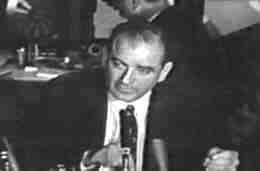
Joseph McCarthy
at US Senate Hearing, 1951
Such a statement was standard fare for the times. What made McCarthy really notorious — and set off a long crisis in the American political system — was the senator’s claim in the winter of 1950 that the US State Department was "thoroughly infested with communists" who were working overtime to insure an early worldwide victory for Stalin and his ideological allies.
McCarthy was a man who could only thrive by exploiting the deep-rooted sense of insecurity caused by the unsettling rumors of imminent hostilities that characterized the first years of the Cold War.
It was no accident that he achieved fame and influence a few months after the Russians announced their acquisition of the atomic bomb. Would not this event mark the beginning of the end for the United States and the rest of the Free World? That was what the American people were instinctively asking themselves in the McCarthy era. They feared that Stalin would use the ultimate weapon to make the ultimate conquest — the conquest of all earth.
© 1998 by Larry Hedrick. All rights reserved.
Return to Contents Page for The Marxists Were Coming