
Lenin Strives
for a Communist Planet
Lenin called World War I "the war to decide whether the British or the German vultures are to rule the world." In his eyes, the slaughter in the trenches exposed capitalism as a bloodthirsty monster that was far more eager to boost the profits of munitions dealers than to save the lives of its proletarian sons.
What brought hardcore communists to power in Russia was not so much a classic uprising of the masses as a coup d'etat against the short-lived government led by Alexander Kerensky, a would-be reformer who was far, far less radical than Lenin. Kerensky had achieved power after the czar abdicated on 15 March 1917.
Especially compared to the civil war that followed, the communist coup ("the October Revolution" of 1917) was a remarkably bloodless affair. Only a relative handful of bolshevik troops were needed to drive Kerensky’s forces from the major public buildings of what was then the Russian capital, Petrograd (St. Petersburg, which in the heyday of the Soviet Union would be called Leningrad).
In contrast to Marx, Lenin had always preached that the proletariat needed to be closely guided by a communist elite in order to insure the revolution’s success. He was completely convinced that he deserved to be first among equals in the ranks of this elite.
Once in power, he ruled Russia with a rod of iron, yet he was never the country’s president or prime minister. His highest official position, which he held beginning in 1917, was chairman of the Council of People’s Commissars. The Western press, falling back on more familiar categories, usually identified him as "the bolshevik premier."
Whatever he was called, Lenin’s charisma, intelligence, and ruthlessness had made him the unquestioned leader of one of the most radical political movements in modern history.
His own theories were used to justify his assumption of wide-ranging powers, for he had written that Russia’s relatively backward condition made it impossible to achieve communism without creating a authoritarian state led by "the dictatorship of the proletariat."
The nations looked on in awe as his absolutist government assumed unprecedented control of the country, nationalizing Russia’s businesses and banks, factories and railroads, farms and churches.
Not since the era of Napoleon had the world encountered such a bold spirit, and people who knew history realized that Lenin’s program for a globe-girdling order of socialist utopias dwarfed even Bonaparte’s wildest schemes. The capitalists had reason to be concerned, and many were thoroughly terrified of the communist specter.
Lenin and his cohorts chose to abandon the last seat of the czarist administration in the coastal city of Petrograd and seek a more secure refuge in the old inland capital of Moscow. Beginning in March 1918 (the same month in which he made peace with Kaiser Wilhelm II’s Germany), Lenin could usually be found in a famous old building in the Kremlin that had once housed czardom’s High Court of Chancery.
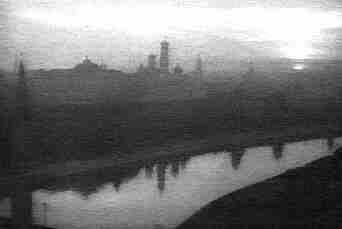
Moscow, the
Soviet Union's
Second and Final Capital
"There now sits Lenin," observed one American visitor, "short-built and staunch-built, gray-eyed and bald-headed and tranquil. He wears a woolen shirt and a suit of clothes bought, one would think, many years ago, and last pressed shortly afterwards."
The Soviet dictator’s position was far from secure, for the old czarist empire teemed with his enemies. There were people who believed in the restoration of the monarchy, and people who believed that Russia needed no central government at all, and people of every persuasion in between.
Still at war with Germany and the other Central Powers, the British and French governments were dead-set on supporting these anti-communists, who, being opposed to the "Reds," were given the name of "Whites." Britain and France nourished desperate hopes that the Whites would overwhelm the new communist regime and bring Russia back into the conflict against the Central Powers.
Enthusiasm for the White cause also thrived in the United States, which had gone to war with Germany on 6 April 1917. President Woodrow Wilson was himself reluctant to send US troops into Russia to help the Whites, but the Allied Supreme War Council kept pressuring Wilson for American troops.
Finally the president agreed, ordering US expeditions to head for both northern Russia and Far Eastern Siberia.
Both of these forces, totaling 13,000 troops, ended up skirmishing with bolshevik soldiers, but they played only a minor role in the Allied intervention in Russia. Their presence, however, inspired a firestorm of anti-American propaganda from Lenin’s government.
Other capitalist nations were far more active in the attempt to strangle communism in its cradle. By the end of 1918, White armies across Russia were being supported by 170,000 troops from Britain, France, Czechoslovakia, Japan, Italy, Greece, and Serbia, as well as the 13,000 from the United States.
During August of that year, Lenin sent a long message to American workers calling his country "a besieged fortress" and stating that he was "waiting for the other detachments of the world socialist revolution to come to our relief."
The civil war between the Reds and the Whites raged on and, as 1919 progressed, the view from the Kremlin became ever more discouraging. A Western naval blockade and the warring chaos of the country had brought famine, and famine had brought epidemics of typhus, typhoid, and cholera.

Russian Girl
Dying of Starvation, 1919
President Wilson withdrew American troops from Russia in June and July of 1919, but the White armies, still backed by Britain and France, were harrowing this earthly hell and capturing city after city. Foreign invaders made gains as well, with Poles advancing through the Ukraine from the west and the Finns descending from the north.
The bolsheviks were engaged in hostilities on no fewer than 14 fronts along a 5000-mile line of battle. How Lenin and his comrades kept their nerve through this extended crisis is anyone’s guess.
In October of 1919, one White army drew close enough to Moscow to make out the domes of the Kremlin, and another actually entered the suburbs of Petrograd. For consolation, Lenin could look for a time to central Europe, where parts of Germany, Czechoslovakia, and Hungary had experienced Marxist revolutions and become workers’ republics during the spring and summer.
As a true believer, Lenin expected every European country to overthrow capitalism soon, but none of the leftist regimes except his own was destined to survive. And even Lenin had taught that Soviet communism would fail unless supported by successful proletarian revolutions in the world beyond Russia.
In these desperate days for bolshevism, it was Leon Trotsky’s military genius that proved to be the salvation of Lenin’s new state.
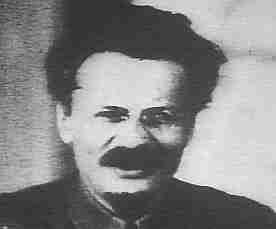
Leon Trotsky,
Commissar of the Armies
As Commissar of the Armies, Trotsky descended on battlefront after battlefront in an armored train that soon become a legend. Time and again he found the Red forces in disarray, and time and again he turned the situation around. From a faltering force of 100,000, he built the Red Army into a juggernaut numbering 5 million.
Lenin never donned a uniform and had no direct experience of military life, but he did offer Trotsky some excellent advice on the conduct of the civil war. The two of them worked well together, and they did an excellent job in ferreting out the weak spots in the uncoordinated efforts of the various White armies.
By November of 1920, three years after the fall of Alexander Kerensky, the Whites were defeated. But victory was achieved at a horrendous cost. The scope of the tragedy is suggested by the fact that Russia’s (as against the Soviet Union’s) population, totaling 171 million in 1914, fell to 132 million by 1921.
The health of Vladimir Ilich Lenin went to pieces during his years as the Soviet leader. From the end of 1920 he complained of headaches, fatigue, and insomnia. Toward the middle of 1922, at the age of 52, he suffered his first crippling stroke. The second came that December, and the third, striking him in March 1923, ended his public career. The last killed him on 21 January 1924.
Lenin’s 17- and 18-hour days — and the tremendous strain of running a massive revolution — had been to much for him. Overestimating the strength of his constitution, he had worked himself to death, leaving behind a huge communist regime that would prove helpless in the face of Stalinist terror.
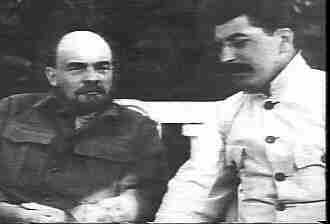
Lenin and Stalin
in the early 1920s
© 1998 by Larry Hedrick. All rights reserved.
Return to Contents Page for The Marxists Were Coming