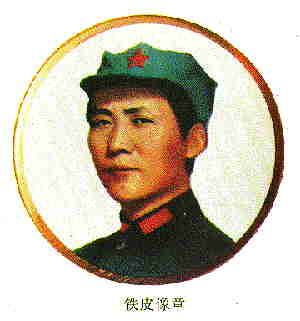
Chairman Mao’s Madcap Revolution
For sheer numbers of people involved, Mao Zedong’s revolution in China was far and away the greatest event in political history. Worldwide, Marxists celebrated the fact that so much of the planet had been "liberated" from capitalism when Mao proclaimed the People's Republic of China in October of 1949.
With most of the vast spaces of the great Eurasian landmass under communist rule, could the rest of the world be long in embracing socialism?
In the capitalist West, a terrible sense of despair set in when Mao (1893-1976) hailed Stalin as "the teacher of the world revolution and best friend of the Chinese people." It had been less than five years since people in New York and London and Paris were celebrating the successive victories over the Axis powers. Now, as the 1940s came to a close, it almost seemed as if World War II had been lost, not won.
But concealed behind the façade of communist unity lay China’s own nightmare: Mao’s real relationship with Stalin, who treated him more like an underling than a chief of state.
Mao was exasperated by Stalin’s arrogant moves, which included stripping Manchuria of its Japanese-built industries in 1945 and 1946, thereby severely impeding China’s postwar recovery. Mao would eventually admit that extracting foreign aid from the Soviets possessed all the charms of "taking meat from the mouth of a tiger."
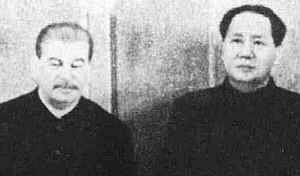
Stalin and Mao
in Moscow,
14 February 1950
Although the Chinese revolution closely mimicked its Soviet predecessor until Stalin’s death, the Russians tended to see Mao as an "agrarian reformer" whose programs had little to do with real Marxism-Leninism.
After all, the great Lenin himself decreed that "only the industrial proletariat can liberate the toiling masses in the countryside," a process that had not occurred in China, where Mao’s peasant armies had made all the difference. Following Lenin's lead, Stalin had always considered Chinese Marxism to be suspect, and he had consistently supported the Nationalist cause of Chiang Kai-shek over Mao’s.
In general, Marxists in the West have looked upon peasants as small-scale capitalists who happen to be operating in a rural environment. When Mao made them central to the Chinese revolution, he inadvertently fathered a major Marxist heresy.
Beijing answered Moscow’s doubts about his orthodoxy by denying that the peasant origins of the Chinese revolution did anything to undermine its authority. What really mattered was that Mao had raised Marxism into "a higher and completely new stage."
When Moscow remained skeptical, Mao was not surprised. The Soviets had, after all, ignored the greatest task facing socialism: to create a new morality for the entire population.
Mao believed that the people could be made to forget their selfish needs and serve the communist state with full hearts and fervent faith, making it possible to construct an earthly paradise.
"I have witnessed," Mao said, "the tremendous energy of the masses. On this foundation it is possible to accomplish any task whatsoever." Later the Maoist state would call Mao’s thoughts "a spiritual atomic bomb" against which even America’s nuclear weapons were bound to fail.
Chinese propaganda claimed that if proletarians worldwide carefully studied "the little red book" (Quotations from Chairman Mao Zedong), they would be capable of overcoming US imperialism and fulfilling their greatest ambitions. Including the conquest (or, if you will, the "liberation") of all earth.
It was one of Mao’s key generals, Comrade Lin Biao, who revealed what became known among rightwing circles in the West as the "Red Chinese Battle Plan." Lin was a little man with dark bushy eyebrows whom Mao wanted to become his successor at one point.

Mao and Lin Biao in Beijing, 1967
While head of the People’s Liberation Army (PLA), Lin wrote that "the Chinese Revolution won nation-wide victory through the encirclement of the cities from the rural areas and the final capture of the cities."
Lin went on to predict that the Maoist strategy that had liberated China would serve as a model for the worldwide triumph of communism. "When we consider the entire globe," Lin wrote, "North America and western Europe can be called the cities of the world, and Asia, Africa, and Latin America constitute the rural areas of the world."
"For various reasons" the workers in the industrialized West had yet to overthrow their capitalist masters, but "the people’s revolutionary movement in Asia, Africa, and Latin America has been growing vigorously."
According to Lin, it wasn’t difficult to predict how Marxism was going to make itself triumphant everywhere on the planet: the success of the "people’s war" that won the Chinese revolution was going to be played out again on a global scale.
"Everything is divisible. And so is this colossus of US imperialism. It can be split up and defeated. The peoples of Asia, Africa, Latin America, and other regions can destroy it piece by piece, some striking at its head and others at its feet."
American imperialism, concluded Lin, was well advised to regard people’s war as a mortal danger. Though "the US imperialists and their lackeys" would resist with might and main, people’s war was going to finish off capitalism and communize every society on earth.
Behind each of Lin’s specific words in his blueprint for world revolution were the original ideas of the chairman of the Chinese Communist Party.
If this Maoist rhetoric helped push the US into the military disaster of Vietnam, it did nothing to reduce tensions between China and the Soviet Union. The successors of Stalin — men like Khrushchev and Brezhnev — were disgruntled that the Maoists had taken it upon themselves to publicize their own peculiar take on the world revolution.
Moscow had served as the Rome of communism since 1917, and here was China obviously striving to replace the Russian capital of the world with Beijing. Time and again the Soviets and the Chinese clashed over the doctrines, strategy, and tactics that would bring capitalism to an early end and, in Soviet eyes, Mao’s contributions were both unrealistic and dangerous.
A particular discrepancy lay in their view of nuclear weapons. Mao claimed to be utterly unfazed by the thought of losing millions of his people in an all-out war with the US. Nuclear weapons could never decide the world’s fate, he said. Only people’s war would be decisive.
At the very worst, World War III might kill half of the world’s population. "The other half," Mao predicted, "would remain." And these "victors would very swiftly create on the ruins of imperialism a civilization thousands of times higher than the capitalist system."
This was quite a new wrinkle. Mao was the only major Cold War leader to claim that a universal socialist utopia would arise from the ashes of a nuclear war. Fortunately, it was a vision that he was never able to popularize, except among the most fanatical of his followers.
To the mind of Khrushchev, Mao’s visions were a formula for the wildest kind of "adventurism." Though he and his Russian colleagues still had every intention of making socialism globally supreme, they believed that pressing the US too hard would result in an international catastrophe. For the time being, the creation of nuclear arsenals meant that capitalism and communism would have to coexist peacefully or perish in the same hellish holocaust. To preach otherwise, as Mao did, was madness.
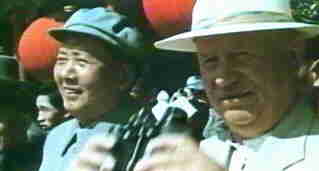
Mao and Khrushchev in Beijing, late 1950s
In the Chinese nuclear program could be found proof that Mao did not scorn nuclear weapons as much as he claimed. In fact he cried out with great joy when Chinese scientists exploded their first A-bomb in October 1964.
In June 1967, the Chinese dropped their first H-bomb from a Hong 6 bomber, a feat that was greeted throughout China with the same welcome accorded to the first A-bomb: with fireworks and gongs and drums and frenzied cries of "Long Live Chairman Mao!"
The source of this glee is easy to understand. The Chinese had been colonized, intimidated, and put upon by Japan and the West for decades. Now, at long last, they had the technology to hold their own in the world.
To enhance their country’s capabilities, Chinese scientists worked to perfect a series of nuclear-tipped missiles that would reach, progressively, American military bases in Japan, the Philippines, Guam, Hawaii, and the continental United States. In 1969, targets in the USSR were added to Mao’s nuclear hit list.
If Mao increased anxieties in both the Soviet Union and the West, he also created chaos at home, for his belief in "permanent revolution" meant that his harried people would never be left in peace. They were treated to a succession of centrally controlled campaigns that sought to obliterate all vestiges of Chinese feudalism and capitalism.
The price that was paid for this pursuit of ideological purity was the crippling of the national economy and the coming of famine. Nothing could have possibly brought capitalist practices back into favor in China more quickly than the absurdities of Mao’s ideological rule.
The greatest and most destructive of his campaigns against his own people began in 1966 and was called the Great Proletarian Cultural Revolution. It opened with huge, electrifying rallies like those staged by the Nazis in Germany before World War II.
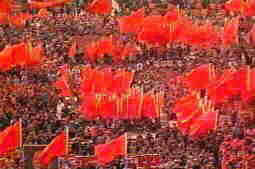
Showing the Red
Flag
at Cultural Revolution Rally
The Cultural Revolution soon got out of hand and threatened to reduce the country to civil war. Mao was seeking to purge his own party’s huge bureaucracy and purify Chinese Marxism, but the overwhelming result of his great push was to turn the People’s Republic into an ideological madhouse.
Mao’s cult of personality came into play with a vengeance. Printing presses churned out 740 million copies of Quotations from Chairman Mao Zedong. His portrait was enshrined throughout the vast nation, and individual Chinese began and ended their day by bowing to his image and reciting his thoughts.
In ways that remind us of Germany’s worship of Hitler, Mao became a living god. He was both the Lenin and Stalin of the Chinese Revolution, and sacred vows to serve the people were made in his name.
The masses in China were treated to a daily menu of the most outrageous exaggerations, including the claim that Mao had become "the greatest leader of the world’s people" because "over 90 percent of the human race" held him in the highest esteem.
The Beijing Review trumpeted that Mao’s thoughts were cherished "everywhere, from the embattled jungles of Southeast Asia to the rugged Andes, from the southern tip of Africa to Iceland near the Arctic Circle." In sum, "the sun never sets on the word of Chairman Mao."
But it was often difficult to prove to rampaging Red Guards that Mao’s light shone in one’s own heart. For the average Chinese, political survival came down to knowing when to shout which slogan — and woe to the comrade who was cursing the Soviet Union when he should have been condemning the United States.
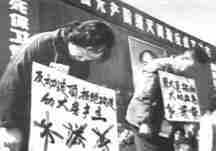
Public Abuse of
"Reactionaries"
during Cultural Revolution
After months of confusion, it gradually emerged that the chief external target of the Cultural Revolution was in fact the USSR, which in Mao’s view had betrayed communism and become imperialist in its own right.
Mao continued to be a champion of world revolution, but he also realized that the failure of US efforts to stem communism in Vietnam and the countries around it would probably prevent a return of American military forces to the mainland of Asia during the remainder of the 20th century. Accordingly, his worries about the US had largely evaporated.
The Soviets were a very different story. As the inheritors of czarist imperialism, they were sitting on millions of square miles of territory that Mao, reviving the territorial claims of China’s last dynasty, believed to be his own. In the vocabulary of Maoist propaganda, the Marxist rulers of Russia had become "the new czars."
During the late 1960s, as Soviet and Chinese troops engaged in large-scale clashes along their 6000-mile common border, it looked as though a very bloody and excruciating war between the two communist giants might be sparked off at any time. In this emergency situation, both parties hoped to win the sympathy of the Americans.
Despite all the pretensions of the Marxists, the balance of power was once again held by the capitalists in Washington, D.C.
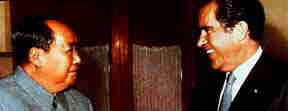
Mao and US
President Richard Nixon
in Beijing, 21 February 1972
© 1998 by Larry Hedrick. All rights reserved.
Return to Contents Page for The Marxists Were Coming