
Stalin Expands the Soviet Empire
When Joseph Stalin (1879-1953) consolidated his power after the death of Lenin, he became the absolute master of 180 million people of 170 nationalities who inhabited one-sixth of the world’s landmass.
An American journalist named Eugene Lyons rightly observed that Stalin’s policies acted on the Soviet empire with all the benevolence of molten lava. Lyons’ voice was heard in the West, but so were the voices of many others who had a very different story to tell.
With the capitalist world sunk in economic depression during the 1930s, and with unemployment soaring over 25 percent in many places, it seemed natural to suppose that Marx’s day had come — and that Stalin’s Russia was the place where the grass grew greener.

Stalinist Propaganda Poster
from the 1930s
Soviet propaganda inspired naive trust when it claimed that the USSR was advancing in nine-league boots toward the socialist paradise, blazing a path that all people were bound to follow. In fact, the Soviet Union of the 1930s was a place of famine and despair, of repression and enslavement.
As bad as capitalist reality could be after the Great Crash of 1929, it had no horrors to compare with the nightmare regime of Joseph Stalin.
Life under the Soviet dictator was so dismal that many of his people volunteered to join the Nazis in a crusade against communism when German armies invaded the USSR in 1941. Believing that Slavic peoples were subhuman and deserving of nothing better than death, Hitler threw away this opportunity for massive reinforcements by waging a campaign of annihilation against Soviet civilians as well as Soviet soldiers.
By the time Germany was driven out of Soviet territory, millions of Stalin’s people had perished. Over 1700 towns had been destroyed, as well as some 70,000 villages. Twenty-five million Soviet citizens were left without adequate housing. The figures were staggering, the country on its knees.
Through the closing years of World War II, President Franklin Delano Roosevelt of the United States supposed that Stalin had experienced enough war to last him for several lifetimes, and he expected the communist dictator to join in the effort to insure peace after the fall of the Axis powers. In particular, FDR believed that "Four Policemen" — the US, the USSR, Britain, and China — would work in harmony to control the new United Nations and maintain international order in the postwar world.
FDR died in April of 1945, and Vice President Harry S. Truman (1884-1972) was elevated to the presidency. For many American diplomats, the passing of Roosevelt was a relief, especially when Truman proved that he, for one, held no illusions about Stalin.
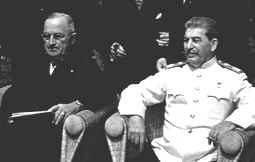
Truman and
Stalin
at Potsdam Conference, July 1945
An early test of Truman’s resolve would come in Iran, which in 1941 had been saved from falling into the German sphere by the arrival of both Soviet and British troops. The terms of this joint occupation had been defined in advance by Stalin and Churchill. There had been a clear understanding that all foreign forces would leave the country early in the postwar period, and the British had departed on schedule.
Not so the Soviets. "There is a very dangerous situation developing in Iran," was Truman’s judgment in March 1946. "The Russians are refusing to take their troops out and this may lead to war."
The president’s concern was only natural. The Soviet army of occupation — 30,000 strong in northern Iran — was perfectly positioned to replace the non-communist government in Teheran. Worse still, it seemed poised to invade Turkey, Iraq, Syria, and Saudi Arabia.
Keenly aware of the need to safeguard the region’s oil reserves, Truman prepared to drive Stalin back. At the beginning of 1946, the president had said that he was "tired of babying the Soviets" and would henceforth treat them to "an iron fist and strong language." In this case, strong language was enough to make Stalin remove his troops within days.
Understandably, Stalin would not be driven back so easily from the countries that Hitler had used as a springboard for attacking the USSR.
As he maneuvered to create a belt of communist governments in eastern Europe, Stalin aroused intense American suspicions about the extent of his ambitions. Didn’t Marxism forthrightly promise an end to capitalism everywhere? Wasn’t it entirely in Stalin’s interest to speed the coming of global revolution? And hadn’t he begun a new struggle for global dominance — even before the fall of Hitler's Berlin?
In Europe, the postwar ground rules were clear to Stalin and, he thought, should have been clear to all: The future of each European country would depend upon the Allied power or powers most responsible for its liberation from the Nazis.
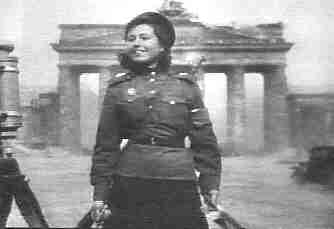
Soviet Soldier
Directing Traffic
in Postwar Berlin
Countries occupied by the Red Army would adopt socialism, full stop. The Russian dictator would obviously not fulfill his promise, made to Roosevelt and Churchill in February of 1945, to let the people of eastern Europe decide their own fate.
The US ambassador in Moscow, Averell Harriman, told Truman that Soviet actions amounted to a "barbarian invasion of Europe." Few voices of authority in the West cared to contradict such a perception, which was reenforced by Churchill’s famous "Iron Curtain" speech at Fulton, Missouri, in the winter of 1946.
There was also concern about the growing prestige of the communist parties who were willing to play the game of democratic politics in Western Europe. In 1946, one-fourth of the French and one-third of the Italian electorate voted for communist candidates.
Patriotic communists had been among the most active antifascists in the French and Italian undergrounds, and the populations of both countries were suffering from severe poverty in the wake of World War II. It wasn’t so very difficult to imagine that the socialist road to economic recovery might be far faster than the capitalist.
Persuasive leftwing politicians in the West argued that the world would be laboring in the new dark ages of fascist totalitarianism if Stalin hadn’t used communist centralized planning to industrialize backward Russia in the 1930s, when the capitalist world was sunk in depression.
By this account, it was communism far more than capitalism that had defeated the technologically advanced forces of Adolf Hitler. Since the whole world owed a tremendous debt to Stalin, it was only logical to follow his lead.
When it came to relations between the US and USSR, the events of 1947 were decisive, determining the outlines of the bipolar world to come.
In March, the president announced what came to be called the Truman Doctrine, a solemn pledge to stop Stalinist expansion, beginning, if Congress voted its assent, with $300 million in aid for Greece, which was threatened by a Marxist insurgency, and $100 million for Turkey, which shared a rugged, militarized frontier with Russia and controlled access from the Black Sea to the Mediterranean.
Congress did vote in favor of the aid, and Truman signed the package into law on 22 May 1947.
In June, Secretary of State George C. Marshall told the graduating class of Harvard University that the administration had developed a plan for reconstructing the war-shattered economies of Europe, which were threatening to collapse completely. Even the Soviets were invited to share in the large influx of American capital.
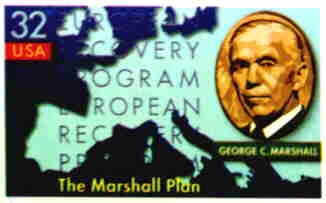
US Stamp
Commemorating George C. Marshall's
European Recovery Program
Stalin’s response centered on what the Americans were offering those eastern European states that were still under Russian occupation. Inevitably, the Soviet dictator would see the Marshall Plan as a direct challenge to his sphere of influence, and he responded by tightening the screws on eastern Europe.
As 1947 went on, Hungarian communists operating under the orders of Stalin took control of the government in Budapest, and relations between the US and USSR became increasingly bitter.
Before the year was out, Stalin had significantly bolstered Marxist power in Poland, Bulgaria, East Germany, and Romania. In February of 1948, orders from the Soviet dictator reduced Czechoslovakia to a satellite, effectively completing the communization of eastern Europe.
Daunted by this consolidation of Soviet power in eastern Europe, Secretary of State Marshall warned that western Europe was also in danger from communist subversion. Far more frightening was the possibility that Stalin would follow his subjugation of eastern Europe by sending the Red Army west.
© 1998 by Larry Hedrick. All rights reserved.
Return to Contents Page for The Marxists Were Coming