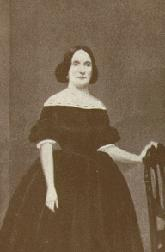
Mary Boykin Miller Chestnut was born March 31, 1823 in Stateboro, South Carolina, eldest child of Mary Boykin and Stephen Decatur Miller, who had served as U.S. congressman and senator and in 1826 was elected governor of South Carolina as a proponent of nullification. Educated first at home and in Camden schools, Mary Miller was sent at 13 to a French boarding school in Charleston, where she remained for two years broken by a six-month stay on her father's cotton plantation in frontier Mississippi. In 1838 Miller died and Mary returned to Camden. On April 23, 1840 she married James Chestnut, Jr. (1815-85), only surviving son of one of South Carolina's largest landowners.
Chestnut spent most of the next 20 years in Camden and at Mulberry, her husband's family plantation. When James was elected to the Senate in 1858, his wife accompanied him to Washington where friendships were begun with many politicians who would become the leading figures of the Confederacy, among them Varina and Jefferson Davis. Following Lincoln's election, James Chestnut returned to South Carolina to participate in the drafting of an ordinance of secession and subsequently served in the Provisional Congress of the Confederate States of America. He served as aide to General P.G.T. Beauregard and President Jefferson Davis, and he achieved the rank of general. During the war, Mary accompanied her husband to Charleston, Montgomery, Columbia, and Richmond, her drawing room always serving as a salon for the Confederate elite. From February 1861 to July 1865 she recorded her experiences in a series of diaries, which became the principal source materials for her famous portrait of the Confederacy.
Following the war, the Chestnuts returned to Camden and worked unsuccessfully to extricate themselves from heavy debts. After a first abortive attempt in the 1870s to smooth the diaries into publishable form, Mary Chestnut tried her hand at fiction. She completed but never published three novels, then in the early 1880s expanded and extensively revised her diaries into the book now known as Mary Chestnut's Civil War (first published in truncated and poorly edited versions in 1905 and 1949 as A Diary From Dixie.
Although unfinished at the time of her death on November 22, 1886, Mary Chestnut's Civil War is generally acknowledged today as the finest literary work of the Confederacy. Spiced by the author's sharp intelligence, irreverent wit, and keen sense of irony and metaphorical vision, it uses a diary format to evoke a full, accurate picture of the South in civil war. Chestnut's book, valued as a rich historical source, owes much of its fascination to its juxtaposition of the loves and griefs of individuals against vast social upheaval and much of its power to the contrasts and continuities drawn between the antebellum world and a war-torn country.