
YOUR WATCH BECOMES A COMPASS
Do you know that you can use your watch as a compass on a sunny day? Look at the watch which is on your hand and point the hour-hand* in the direction of the sun, as you see in the picture. Imagine a line which runs from the centre of the watch through a point half-way between the hour-hand and number one. This line will point south.If you know astronomy a little, you will understand why this works. In the northern half of the earth, the sun is in the south at noon. In our country the real noon is one o'clock. If at that time we point the hour-hand at the sun, the hour-hand and number one will point south. That is why you must imagine a line which will run from the centre of the watch through a point half-way between the hour-hand and number one. It will point south. If you are in the southern part of our planet, you must point number 12 at the sun. (The angle between this number and the hour-hand will then show north.) The line which you can imagine between number twelve and the hour-hand will then show north.
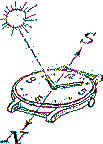
* point the hour-hand — направьте часовую стрелку
A PLANETARIUM OUT OF A CYLINDRICAL BOX
You can make a planetarium with the help of a cylindrical cardboard box.* The box will show beautiful pictures of stars on the wall. You can take a book on astronomy and copy the group of stars which you want to study on a sheet of paper. Then you must put your picture face down on the outside bottom of the box.* Then you take a nail and make holes through the box at each mark. You can do that because you see the marks of stars through the paper. The holes will make a picture of the group of stars as you will see it in the mirror, but the picture will be right when it is on the wall. Now you may open your planetarium. You take your box into a dark room and put an electric torch* into the open end. It is better when the torch shines on the side of the box and not directly on the holes. Then you will get a large picture of the group of stars on the wall. If you want, you may turn the box to study the group of stars from different positions.
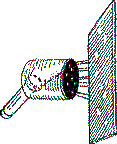
* a cardboard box — коробочка из картона
* face down on the outside bottom of the box — лицевой стороной на наружную часть дна коробки
* an electric torch — электрический фонарик
AN EXPERIMENT WITH A COIN
How many times does the earth rotate during one trip round the sun? If we want to answer this question, we must first know from what place we are looking. As seen* from the sun, the earth makes 365'/4 turns. But as seen from a star (which is, as you know, very, very far away), the earth rotates 366'/4 times. So the day as seen from the star is a little shorter than the day as seen from the sun. You can explain this with the help of the following simple experiment. Put two five-kopek coins * on your table. They must touch each other, as shown in the picture. You hold the lower coin with your left finger and rotate the other coin round it. The two coins must always touch each other. Now, how many turns has the coin made when it comes back to the place where it began its trip? The answer will surprise you. It is not one, but two. As seen from the central coin, the other coin rotates only once, but you are far away. That is why you see two turns.
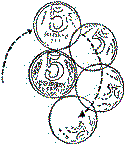
* As seen — зд. Как было бы видн
* a five-kopek coin — пятикопеечная монета