
CATCH THE POSTCARD
Hold a postcard in your left hand, as you see in the picture; your right hand is ready to catch the postcard, but the fingers are not touching it. If you let the postcard go,* you'll find it easy to catch it with your right hand before it falls down. Now see if your classmate can catch the postcard when you let it go. Let him hold his fingers on each side of the postcard, as you did before. Let the postcard go. His fingers will not catch it. You can repeat this as often as you want. He will not catch the postcard.
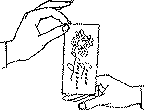
You can catch the postcard because your brain can send "let it go" and "catch" signals * to your two hands at the same moment. But when you hold the postcard for your classmate to catch, his brain must first see that the postcard is falling, then send a "catch" signal to his fingers. This takes more time. That is why your friend cannot catch it.
* If you let the postcard go — Если вы отпустите (почтовую) открытку
* "let it go" and "catch" signals — сигналы "отпусти" и "лови"
PULSE DETECTOR *
There are many machines which cost hundreds of roubles that show the beating of our hearts. This pulse detector which costs less than a kopek will help you to watch the beating of your heart very well. Put a thumb-tack into the base of a large match and put it on your hand on the place where you can feel the pulse, when your arm is resting on a table. The head of the match will move a little there and back with each beating of your heart.
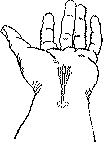
* Pulse Detector — Измеритель частоты биения пульса
IT IS VERY DIFFICULT TO LEARN TO WRITE
Now, when you have learned to write and draw pictures, you may think that it is very easy to do all that. But it is very difficult for a little child. He has not yet built up all the reflexes that could tell him how to move his hand to draw or write correctly. If you want to feel like a child and understand his problem, the problem how to make his hand and eyes work together, here is an interesting way to do that. Put this page on your table and put a mirror in front of the picture. Now raise your left hand and hold it over the picture in such a way that you cannot see it; you can only see its reflection in the mirror. Take a pencil in your right hand and put it at the place START. Now look only in the mirror and try to draw a line from START to FINISH, but you mustn't go over the borders.*
* to go over the borders — заходить за линии (границы)
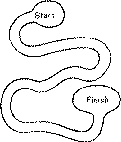
It isn't easy because your reflexes don't work so well when you see a reversed image.* So now you will understand that it is very difficult for a child when he begins to learn to write or draw pictures. You have felt it like a child.
* a reversed image — зеркальное изображение
ONE OR TWO POINTS?
Take a hairpin and open its points until they are four centimetres away from each other. Ask your friend to close his eyes and tell you if you are pressing one or two points of the hairpin against his arm. He will find with surprise that he can't tell you that correctly. When you are pressing two points, he will feel them as one point. Now close the hairpin until its points are only two millimetres away from each other. Put the points on your friend's finger-tips* and ask him the same question. Now he will be right. He will tell you correctly if you are pressing one or two points of the hairpin against his finger-tips. This simple experiment shows that different parts of the body feel the points of pressure * in a different way. You can, if you want, find out which parts of the body feel the points of pressure better and which feel them worse.
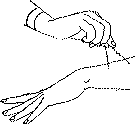
* finger-tips — кончики пальцев
* the points of pressure — точки прикосновения
A FLOWER OF TWO COLOURS
When flowers grow, water from the earth goes up through the roots and stem and into the flowers and leaves. It is easy to demonstrate the process by the following experiment. You fill two glasses with water. Then colour the water in one glass red with the help of some food colouring.*Now carefully divide the stem of a beautiful white flower into two parts. Put half the stem in one glass, the other half in the other glass, as you see in the picture. After a few hours you will find that one side of the flower has become red. You may be sure that everybody will look at your flower of two colours with surprise.
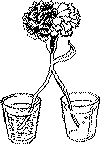
* colour the water in one glass red with the help of some food colouring — подкрасьте воду в одном стакане в красный цвет с помощью какого-либо пищевого красителя