THREE DRINKING GLASSES
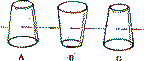
Here is an interesting mathematical trick you can play on your friends. Put three drinking glasses in a row on the table. The glass which is in the centre must stand with its right side up * and the two other glasses are standing upside-down.*The task is to turn two glasses at a time and to put them all right side up in three moves.* At first you show your friends how to do it. Take glasses A and B, one in each hand, and turn them over at the same time. Do the same with glasses A and C, then repeat with A and B. Now all the three glasses are standing right side up. Before your friend tries to do the same you turn the central glass upside-down; the two other glasses are standing with their right sides up. Your friend must not notice that you have changed the positions. Then you ask him to put them all right side up in three moves, as you have done it. He will not notice that the glasses are standing in a different way. You began when two glasses were standing upside-down and one glass right side up; now two are standing right side up and one upside-down. The trick is that from this new position he will not be able to do it. Your friends will try it many times before somebody notices the trick.
* right side up — в обычном положении
* upside-down — вверх дном
* in three moves — в три приемаA GAME OF CIRCLES AND CROSSES
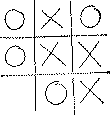
Most of you know this mathematical game, of course. You and your friend draw crosses and circles on a sheet of paper. You do it one after another. The first pupil who gets three marks in a row wins. But do you know that you can play this game another way and it will become more interesting? You must try to make your friend win.* If you get your three marks in a row, you don't win—you lose! It is more difficult to play this game the other way. The second pupil can always win if he plays the right way), but he may not win if the first pupil begins with his mark in the centre. Then, if the first pupil always takes a place on the other side of his friend's mark, nobody will win, as in the game which you see in the picture. If your friend does not know the secret which we have explained, you must play each time so as to leave him the greatest number of ways to win. You may try a few games and you will see how interesting it is to play the game this way.
* to make your friend win — сделать так, чтобы ваш друг выиграл
TIE THE HANDS OF TWO PEOPLE
Here is an interesting game to show at a birthday party. Divide your friends into pairs. Each pair ties a piece of rope on their hands, the two ropes go round each other, as shown.
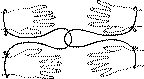
The first pair which separates gets a prize. Of course, they must not cut or untie the rope. You can separate if you pass the centre of one rope under the rope around your friend's hand, then you must pass the rope over his fingers, then pass the centre back under the rope again.
CAN YOU TIE A KNOT? *
Put a piece of rope on the table. Ask anybody to take one end in each hand and tie a knot. Your friend must not let go *of any end. It seems imposible, but you can do it easily. The trick is to fold your arms * first and then pick up the rope, as shown in the picture. When you unfold your arms, you will find your knot in the centre of the rope.
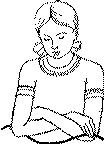
* to tie a knot — завязать узел
* to let go — отпустить
* to fold your arms — сложить руки
THE THREE CARDS
In some games you have more chances to win than you think you have. Imagine you have three cards: one is black on two sides (BB), one is white on two sides (WW), and one is black on one side and white on the other (BW). You put them in a hat, then take out a card and put it on the table. What are the chances that the other side will be the same as the upper side? If the upper side is black, you will perhaps think in the following way: "This can't be the WW card. So, it may be the BB or the BW. The chances are the same." But the chances are not the same. There are two chances that the other side is black too, and only one chance that the other side is white. There are three possible answers, not two, as you thought. If the upper side is black, it may be that:
1) you see the black side of the BW card;
2) it is one of the sides of the BB;
3) it is the other side of the BB.
So you see that there are two chances that the other side is black too, and only one chance that it is white.
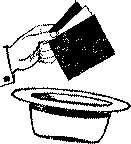
CAN YOU TRISECT AN ANGLE? *
Two thousand years ago people who studied mathematics tried to trisect an angle with the help of a compass and a ruler. They could not do it. Today you or your teacher of mathematics can prove that it is possible.
You can make a simple instrument which trisects an angle correctly. Here is how you can do it. You cut a piece of card board as shown in Picture 1. It is the instrument which you will use to trisect an angle.
* to trisect an angle — разделить угол на 3 равные части
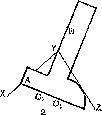
Put your instrument on the angle XYZ so that point A is on one side of the angle, side В of your instrument goes through point Y, and the circle part of the instrument touches the side YZ (Picture 2). Then you make points on the paper at С and D (C1D1) and draw lines YC1 and YD1. So you have trisected the angle! If the angle is very acute and you cannot put your instrument on it, you can always make the angle two times larger, trisect it and then divide each angle into two parts. So you have trisected the acute angle. If you know mathematics very well, you will prove why your instrument trisects the angle.
AN EXPERIMENT WITH TWO CIRCLES
Here is an interesting experiment which you can carry out when you are playing with your friends. Take a piece of card-board and cut two circles: a large circle and a small one. The small circle must have a diameter one-third that of the large circle. Then put the smaller cardboard circle on the larger circle, mark a point * on the smaller circle and roll the circle round the inside rim * of the larger circle. On the larger circle you mark the way which your point makes when the smaller circle rolls inside the larger circle. So you will get a triangle of three curved lines, as shown in Picture 1.


Now ask your friends what figure they will get if the smaller circle has a diameter one-half that of the larger circle (Picture 2), They will give different answers. Then you find out whose answer was right. You cut the third cardboard circle of the size you were discussing and repeat the experiment. The answer will surprise all of you. The way which the point makes now is the diameter of the larger circle!
* mark a point — поставьте точку
* the inside rim — внутренний край
FIND THE CENTRE OF A CIRCLE
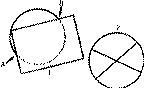
Your teacher of mathematics has taught you how to find the centre of a circle. It takes some time. Here is a simple method. Put the corner of a sheet of paper on the circumference of the circle (Picture), then mark points A and В where the sides of the paper cross the circle. You may be sure that points A and В mark the ends of a diameter. Draw it. Then repeat this process at a different place to get another diameter (Picture 2). You will find the centre where the two lines cross.
HOW TO DRAW AN ELLIPSE
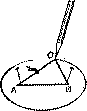
You know that it is easy to draw a circle with a compass. But do you know how to draw an ellipse? Here is an easy way. You stick two pins in a sheet of paper, then tie a piece of string into a circle and put it over the pins. Next you make the string tight * with your pencil, as shown in the picture. You move the pencil round the pins. It will draw a good ellipse. This method demonstrates the most important fact about an elipse: the lines which you draw from the two centres to any point on the ellipse always have the same sum. In your ellipse the pins are the centres, and the lines of the strings AC and ВС are the two lines to the same point on the ellipse. As the line AB always stays the same, the sum of AC and ВС must always be the same too when your pencil is drawing the ellipse. If you move the pins nearer together, you will find that the form of your ellipse changes. When the two centres come together, you will have a circle.
* you make the string tight — натягиваете веревочку
PROVE THAT THE SUM OF ALL THE ANGLES OF A TRIANGLE IS 180 deg;
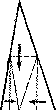
Do you remember how your teacher of geometry taught you to prove that the sum of all the angles of a triangle is 180 deg;? Yes, of course, you do. But it is interesting to prove it in the following way. Cut a triangle out of a piece of paper . If you fold over the corners,* as shown in the picture, you can easily make the three angles fit together to form a 180° angle at the base of the triangle.
* If you fold over the corners — Если вы загнете углы
YOU CAN PUSH A COIN THROUHG A SMALLER HOLE
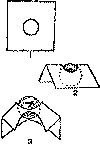
Do you know that you can push a coin through a smaller hole? Here is how you can do it. You put a kopek coin * on a small piece of paper, then you draw a line round it with a pencil and cut out a hole, as you see in Picture 1. Now the task is to push a three-kopek coin * through this hole. You must not tear the paper. You fold the paper across the hole * when a part of the coin is in the hole, as shown in Picture 2. It is now very easy to push the coin through the hole, as you see in Picture 3. You may use other coins too. For example, you can cut out a hole with the help of a ten-kopek coin and push a twenty-kopek coin through this hole. The trick always works when the circumference of the hole is a little longer than two diameters of the coin which you want to push through the hole.
* a kopek coin — копеечная монета
* a three-kopek coin — трехкопеечная монета
* You fold the paper across the hole — Вы складываете бумагу так, чтобы линия сгиба проходила через центр отверстия
HOW LONG IS THE DIAGONAL OF A SQUARE?
You know that one side of a triangle cannot be longer than the two other sides. But with the help of these four pictures you can prove that the diagonal of a square is as long as its two sides! You draw a square 10x10 centimetres. Then you draw a zigzag line * from point A to point B. Each part of the zigzag line is two and a half centimetres long, as shown in Picture.


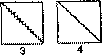
So your zigzag line is 20 centimetres long; it is as long as two sides of the square. Then you draw the same square again and the zigzag line, as shown in Picture 2. But this time each part of the zigzag line is only two centimetres long. Your line is 20 centimetres long, as it was before. The zigzag line is always 20 centimetres long. The parts of the line become smaller and smaller, as shown in Pictures 3 and 4, but the zigzag line is still 20 centimetres long. At last the parts become so small that the zigzag line becomes a straight line. But it will be 20 centimetres long! Now that you have proved it, can you explain the mistake? The explanation is this. The parts of the zigzag line become smaller and smaller, but they never disappear. In other words, the zigzag line will never become a straight line.
* a zigzag fine—зигзагообразная линия
SHORT BRIDGES
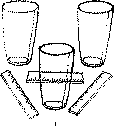
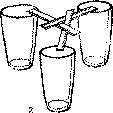
Here are three drinking glasses and three rulers. The glasses are standing in such a way that the distance between any two glasses is longer than the ruler {Picture 1). Imagine that each glass is an island and each ruler is a bridge. With the help of these short bridges you must join all the three islands with one another. Of course, you must not move the glasses; they are islands, and you can't move islands! So, can you join them with one another? If you can't, Picture 2 will show you how you can build the bridges.
THE PYTHAGOREAN THEOREM *
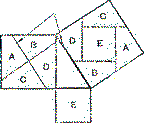
According to the famous Pythagorean theorem the square on the hypotenuse of a right-angled * triangle equals the sum of the squares on the other two sides. Here is a very unusual way to prove this theorem. First draw the squares on the two shorter sides of any right-angled triangle. Divide the square on the larger of these sides into four parts by two lines at right angles to each other and crossing at the centre of the square. One of these lines is parallel to the hypotenuse of the triangle. Now cut out the small square and (he four parts of the larger one. You will find that these five pieces will fit together to form the square on the hypotenuse! Now, when you have done that, can you prove it mathematically?
Parallel
* The Pythagorean Theorem — Теорема Пифагора
* right-angled — прямоугольный
HOW MANY MATCHES ARE THERE IN YOUR HAND?
Take any number you like. For example, you have taken 387. Now add 3+8+7=18. Then 387—18=369. You can divide 369 by 9. If you take another number and do the same, you will also find that at the end you will be able to divide the number which you get by 9. This interesting fact will help you to tell how many matches your friend has in his hand. And this is how you can do it. Put some 21—25 matches in front of him. Then stand far away and don't look at him. Tell him to do the following.
1. He must take any number of matches from1 to 10 and put them in his bag.
2. Then he must count how many matches there are in front of him and add the two figures of this number. For example: if the counts 16 matches, 1+6=7. So he must take 7 more matches and put them in his bag.
3. At the end he must take any number of matches and hide them in his hand.
Then you come up to him and tell him the number of matches he is hiding in his hand. The secret is that after he has put the matches in his bag the second time, there are always nine matches in front of him. So you count how many matches are in front of him and nine minus that number will tell you how many matches he has in his hand.
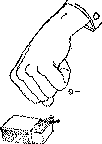
9-3=6
A TRICK WITH DICE
The fact that the sum of the numbers on the opposite sides of a die is always seven explains many unusual mathematical tricks with dice. Here is one of the best. Turn round when somebody throws three dice. Ask him;
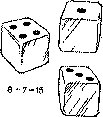
1) to add all the three numbers;
2) to take one die and add the number on the bottom face* to the number which he has already counted;
3) to throw the same die again and add again the number it shows on top.
Now turn round and tell your friends that you can't know which of the three dice they threw again. Take all the dice, shake them in your hand a moment and then tell the correct sum. How do you know? That is simple. You must add the numbers on the top faces* of the three dice before you take them in your hand, and add seven. If you think a little, you will understand why this works.
* on the bottom face — на нижней грани
* on the top faces — на верхних гранях
THE WONDERFUL WINDOW
Ask your friend to write down any number of three figures in which the difference between the first and last figures is two or more than two. Imagine he has written 317. Tell him to change the places of the first and the third figures.
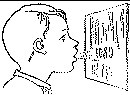
Then he must subtract the smaller number from the larger (713—317= =396). At last he must change the places of the figures in this answer and add them to the answer (693+396=1089)."Now, if you breathe on the glass of that window," you say to him, "you will see the answer on the glass." When he breathes on the glass, he will see number 1089 on the window.The secret is very simple: the answer is always 1089. Before you do the trick, put some detergent * in a glass of water, then put your finger in the water and write with it 1089 on the window. Nobody can see the writing when it is dry, but when somebody breathes on the glass the place where your finger touched the glass will not become darker.
* detergent — зд. мыльный (стиральный) порошок
QUICK ADDITION
Anybody can learn to count fast if he knows the secret of the following trick. Ask your friend to write any five-figure number * on the blackboard. Then you write your five-figure number under it. You choose your figures so that each one with the figure above it will make nine. For example: His number: 45 623 Your number: 54 376
* five-figure number — пятизначное число
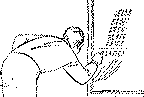
Tell your friend to put a third five-figure number under your number. Then you write a fourth number in the same way. After he has written the fifth number, you draw a line under it and quickly write the sum. You may even write it from left to right! How do you do it? You subtract two from the fifth number and put 2 in front of your answer. For example: if the fifth number is 48 765, the sum will be 248 763.
AN INTERESTING WAY TO MULTIPLY NUMBERS
Here is an interesting way to multiply numbers from 6 to 10. They used this method in some parts of old Russia before the Great October Socialist Revolution because at that time poor people and their children could not go to school. If you want to try this method, you must do the following. You give numbers to your fingers from 6 to 10, as you see in Picture 1. If you want to multiply 7 by 8, finger number 7 of one hand must touch finger number 8 on the other hand. Then the two fingers together with all the fingers under them are tens. You have five tens, that is 50. Then you multiply the number of the other fingers on the left hand by the number of the other fingers on your right hand. 3x2=6. So 50+6=56. This method always gives the right answer.
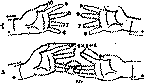
5x10=50
STRANGE MATHEMATICS
There are many ways to multiply numbers of two or more figures. Here is one of the strangest. Imagine you wish to multiply 23 by 17. Half of 23 is 11'/2. Write only 11 under 23 as you see in the picture. Half of 11 is 5l/2. Write only 5. Continue until you have 1. Now write numbers under 17. But this time you must multiply each number by two to write the number under it. Continue until you have a number on the same line as 1. Now draw a line through any row that has an even number on the left. In our example there is only one. Now add the rest of the numbers in the right-hand row.* Believe it or not, you will get the right answer. If you are interested why this method works, ask your teacher of mathematics to explain it to you.
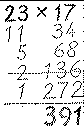
* the right-hand row — правый ряд
MAGIC IN MATHEMATICS
Here is an interesting trick you can show your friends. First take a sheet of paper and write on it the magic number 12 345 679. It is easy to remember this number because there are all figures in it from 1 to 9; only number 8 is not there. Now ask a friend to tell you his favourite figure. Multiply the figure which he is going to tell you by 9 in your head. Write the answer under the magic number. For example, if he tells you that his favourite number is 3, you write 27 under the magic number. Then ask him to multiply 12 345 679 by 27. The answer will surprise him, because there will be only 3's in it—it is his favourite figure. The trick works with any figure. Try it and see.