
WATERMARKS *
Here is an interesting way to write a secret letter. You do it with the help of watermarks. If you collect stamps, you know what a watermark is. On every stamp there is a mark which you cannot see. You can see it only when you put the stamp in water. This mark is called a "watermark". The watermark proves that you have a real stamp. People make watermarks on stamps by applying pressure.* The places where they have applied pressure reflect light in a different way when they are wet. It is easy to make watermarks and use them to write a secret letter. You put a sheet of paper in water, then take it out quickly and put it on a sheet of glass or a mirror. Put a dry sheet of paper on top of it. Now you may write on the dry sheet. You must use a hard pencil to apply pressure. When you raise the dry sheet you will find that you can see everything you have written on the wet sheet. When your wet paper becomes dry, you will not see anything, but the text will appear again if you put the sheet of paper in water and take it out quickly. Try it and see how it works.
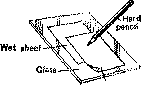
Dry sheet
* Watermarks — Водяные знаки (на бумаге)
* by applying pressure — выдавливанием
SPECTRUM ON THE CEILING
One of Newton's most famous experiments was to pass a beam of sunlight* through a prism to form rainbow colours* on the wall. You can carry out an experiment of this sort with an electric torch, a mirror and a bowl of water. Put the mirror in the bowl so that it is at an angle of 30 deg; to the level of the water. When it is dark in the room, you shine your torch on the mirror. A small spectrum of colours will appear on the ceiing. The experiment proves that there are many lights of different colours in white light. The water acts as a prism which reflects each colour at a different angle and forms different colours on the ceiling.
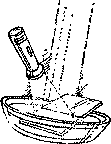
* to pass a beam of sunlight — пропустить луч солнечного света
* to form rainbow colours — чтобы получить цвета радуг
A DEVICE TO COPY PICTURES *
You know that the glass of a window will reflect an image like a mirror. It will reflect an image especially well at night, when it is dark in the street and there is light in the room. Thanks to this fact you can make a very good device which you will use to copy pictures. You get a sheet of glass and put it vertically on a table, as shown in the picture. Put the picture which you want to copy on one side of the glass and a sheet of white paper on the other side. Sit down on the side where the picture is. It must be dark in the room except for the lamp which shines on the picture. It will seem to you that there is an image of the picture on your sheet of white paper. Through the glass you will be able to see your hand and pencil when you copy the image.
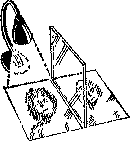
* A Device to Copy Pictures — Приспособление для срисовывания картинок
AN EXPERIMENT WITH A BOX OF MATCHES
Ask somebody to hold a box of matches 30 centimetres over the table, then drop it so that it falls on one end and stands. When he tries it, the box will fall on its side. You use the stabilizing power of friction.* Open the box of matches three centimetres as shown, then drop it. The box will stand, it will not fall on its side. There are many stabilizing devices which work on the same principle.
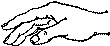
* You use the stabilizing power of friction.— Вы используете силу трения, которая придает коробочке устойчивость.
THE FORKS WILL NOT FALL DOWN
Here is a simple and amusing experiment to demonstrate the force of gravity.* Take two forks and join their teeth tight together with the help of a five-kopek coin, as shown in the picture. Then put the coin with the forks on a rim of a glass. You will soon find the right position of the coin when you may let the forks go, and they will not fall down. The force of gravity will hold them on the rim.
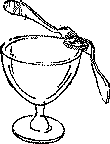
* the force of gravity — сила тяжести
HOW TO BREAK A STRONG ROPE
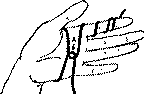
Do you know that there is a simple way to break a strong rope with your hands? Tie one end of the rope round your left forefinger, then put it round the hand as shown. Now take the rope half a metre lower with your right hand and turn it 4 or 5 times round the right hand. Close your hands into fists. Hold the fists together, then quickly move your right fist down and your left fist up. The rope will break in your left fist at the point A, This happens because all the force acts on the small point A, Here the rope acts like a knife and cuts through the point A.
A LEMONADE-STRAW CAN GO THROUGH A POTATO *
You don't think it is possible, but it is. Hold an unpeeled potato and a straw as shown. Your finger must cover the top opening* of the straw. Strike the potato quickly with as much force as you can, but be sure the straw is perpendicular to the potato. After some practice you will be able to do it almost every time. The explanation is this. You are holding the potato in your hand; so it is in a state of rest.* It is inert. The straw which strikes the potato has a great impulse of force.* The pressure of the compressed air in the straw will keep it hard. That is why it goes through the potato.
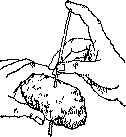
* A Lemonade-straw Can Go Through a Potato — Соломинка для (питья) лимонада может проткнуть картофелину
* the top opening — отверстие верхнего конца
* in a state of rest — в состоянии покоя
* impulse of force— импульс силы
EGG IN THE BOTTLE
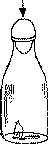
If you want to demonstrate to your friends how strong the pressure of the air is, here is a simple way to do it. Take a hard-boiled egg* and a clean milk bottle. Take off the shell and put the egg on the opening of the bottle, Then ask your friends to push the egg into the bottle. At first they will think it is possible.
* a hard-boiled egg — яйцо, сваренное вкрутую
They will try and try, but they will not be able to do it. The egg will not go in because the air in the bottle cannot come out. The pressure of the air in the bottle will not allow the egg to go in. Then you show them how you can do it. You throw a burning match* into the bottle and put the egg on the opening. The fire uses up the oxygen in the bottle. Then the pressure of the outer air* on the egg pushes it into the bottle. How do you take it out again? After your friends have tried it many times, you turn the bottle down so that the egg falls nearer to the opening. Then put back your head, as shown in the picture, and blow as hard as you can* into the bottle which you hold upside-down. When you take your mouth away, the egg will come out so quickly that you must be ready to take it in your other hand. This happens because the pressure of the air in the bottle becomes greater than the pressure of the outer air.
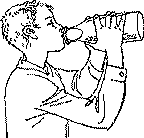
* a burning match — горящая спичка
* the outer air — наружный воздух
* as hard as you can — как можно сильнее (изо всех сил)
A THREE-KOPEK COIN CAN DANCE
The next time you buy a bottle of lemonade, you may try the following scientific experiment. When there is no lemonade in the bottle, but the bottle is still cold, you put a three-kopek coin on the opening, as shown in the picture. You must also put some two or three drops of water on the opening of the bottle. Then you put your hands round the bottle and hold it for half a minute. The coin will begin to jump up and down in a strange way. After it has danced for some time, you take your hands away. The coin will continue to dance. This experiment shows that things expand when you heat* them. And air too. When you hold the bottle in your hands, the cold air in the bottle becomes warmer. When the air becomes warmer, it comes out of the bottle and makes the coin dance.
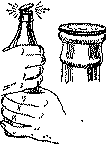
* expand when you heat — расширяются при нагревани
THE MAGDEBURG GLASSES *
You remember the famous experiment in Magdeburg, Germany, in 1650, when they proved how strong the force of vacuum was. You can also prove it with the help of two glasses and a piece of wet blotting-paper. To do that you light some matches and put them into the lower glass. Put the wet blotting-paper on the brim, then quickly put the second glass on the paper as shown. When the matches are burning, they will use up the oxygen in the two glasses. Now try to lift the upper glass. You'll find that the wet blotting-paper and the lower glass stick to it.
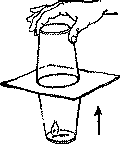
* The Magdeburg Glasses — Магдебyргские полушария {или тарелки)
BERNOULLI'S PRINCIPLE *
Bernoulli's principle says that when a gas or liquid is moving, its pressure becomes lower. When it moves faster, its pressure becomes still lower. Here is how you can demonstrate this principle at home. You push a thumb-tack through the centre of a small piece of cardboard and put a spool over the thumb-tack, as shown in the picture. You hold the spool in one hand and the cardboard in the other. Then you raise the spool to your mouth and blow down through it as hard as you can. At the same time you let the piece of cardboard go. Do you think it will fall down on the floor? No, it will not.
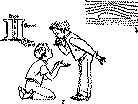
* Bernoulli's Principle — Закон Бернулли (давление текущей жидкости (или газа) больше в тех сечениях потока, в которых прорость движения меньше, и, наоборот; в тех сечениях, в которых скорость больше, давление меньше)
It will stay at the other end of the spool when you are blowing. Now that you know Bernoulli's principle, you can explain why your piece of cardboard doesn't fall down. When you are blowing into the spool, the air moves faster over the top of the cardboard and the air pressure* becomes lower. The air pressure under the cardboard is greater, and the cardboard does not fall down. The same principle explains why an airplane does not fall down when it flies. They make its wings in such a way that the air moves over the tops of the wings faster than it moves under the wings. So the air pressure on the tops of the wings becomes lower than the pressure under the wings, and the airplane does not fall down. It flies. If it stops moving,* it will fall down.
* the air pressure — давление воздуха
* If it stops moving — Если движение прекратится
TWO INTERESTING WAYS TO BLOW OUT A CANDLE *
There are many interesting ways to blow out a candle and some of them are of scientific interest. Here are two ways to do that.
* to blow out a candle — задуть свечу
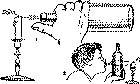
Take a clean bottle and close it with your thumb. Then put the opening of the bottle and your thumb into your mouth. Take away your thumb from the opening of the bottle and blow as hard as you can. Then close the opening of the bottle with your thumb again. Now if you put the opening of the bottle near the fire of the candle and take your thumb away, the compressed air which shoots out of the bottle* will blow out the candle. Another interesting way to blow out a candle with the help of a bottle is to put the bottle between your mouth and the fire of the candle and blow (Picture 2). You will blow out the fire and your friends will think you were blowing right through the bottle. The explanation is this. The pressure of a gas becomes less and less the faster it moves. When you are blowing, the air moves past the bottle and forms a place with low pressure in front of the candle. The outer air comes quickly to this place and the whirling of the air* blows out the fire.
* the compressed air which shoots out of the bottle — сжатый воздух, который устремляется из бутылки
* the whirling of the air — вихревой поток воздуха
AN EXPERIMENT WITH A TABLE-TENNIS BALL
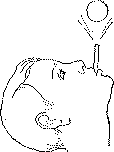
Take a piece of lemonade-straw 15 centimetres long and put one end of it in your mouth. Lean back your head* and hold a table-tennis ball 6—8 centimetres over the other end. Blow as hard as you can and let the ball go* at the same time. The ball will not fall down as you thought. It will stay in the air. The harder you blow, the higher it goes above the straw. The explanation is this. We already know that when the air moves quickly, its pressure becomes lower. In this experiment the air which quickly comes out of the straw moves round the ball and forms a place with lower pressure over the ball. When you are blowing hard your ball stays in the air or goes higher above the straw. It cannot move in any other direction because the greater air pressure on the sides of the column of air which you are blowing makes the ball stay in the "column".
* Lean back your head — Откиньте назад голову
* let the ball go — отпустите мячик
COLD WATER CAN BOIL
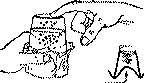
If you have been to the circus,* perhaps you have seen the following trick. The actor takes a glass of water and a wet handkerchief. He puts the handkerchief on the glass and pushes down the centre of the handkerchief. So the handkerchief on the glass looks like a well.* Then he turns the glass upside-down on his right hand, and takes it with his left hand, as shown in the picture. The pressure of the air pushes the handkerchief into the glass. "When I put my finger on the glass," the actor says, "the water will boil." And he is right. When he does that, you see that the water is boiling. Some people say that they can even hear the noise of the water when it is boiling. What happened was this.
* If you have been to the circus — Если вы были в цирке
* a well — колодец
 Air
pressure
Air
pressure
When the actor pushed the glass with his finger, the glass moved down a little through his left hand, and the handkerchief moved up a little. This lowered the centre of the handkerchief in the glass and made a vacuum. The vacuum made air come in through the handkerchief and you saw the illusion that the water was boiling.
THE BUTTON WHICH DOES WHAT YOU TELL IT
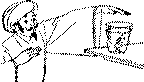
You drop a button from a shirt into a glass of carbonated water.* The button goes down. A moment or two later you move your hand over the glass and say, "Button, come up."
* carbonated water — газированная вода
* bubbles of carbon dioxide — пузырьки углекислого газa
* When enough bubbles have collected to counteract the weight — Когда накопится достаточное количество пузырьков, чтобы противодействовать весу
* carbonation — выделение углекислого газа
AN AUTOMATIC SIPHON *
People have made many different automatic siphons, but this automatic siphon is so simple that you can make it from a glass tube.* With the help of a candle you can bend the tube as shown in the picture. When your tube becomes cold again, you put it into the water, as you see, and your siphon will begin to work at once. When point A on the tube goes down, the water (which always finds its own level)* runs through the tube to point B. Thanks to its inertia, the water goes up and over point С and begins to siphon. You can also make such a siphon with the help of a plastic lemonade-straw. Water can run through such straws when you bend them. If one straw is not enough, you can put two or three of them together to make a long tube.
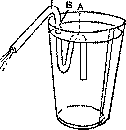
* An Automatic Siphon — Автоматический сифон
* a glass tube — стеклянная трубочка
* the water (which always finds its own level) — вода (которая стремится всегда восстановить первоначальный уровень)
YOU CAN GET THE WATER OUT OF THE GLASS
Put two glasses of water one on the other, as shown in the picture. The lower glass is standing in a large bowl. You move the upper glass a little to make a very small opening between the two glasses. The air pressure will not allow the water to come out.
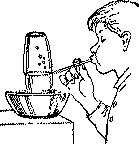
Now ask your friend if he can get the water out of the upper glass, but he must not touch the two glasses in any way. You may be sure he will not be able to do it. It is possible to do it with a straw. You hold one end near the opening between the two glasses and blow through the other end as hard as you can. Air will come up into the upper glass and make the water come out through the opening and down into the bowl. {If you find it difficult to put the two glasses of water one on the other, put them underwater in a large bowl, hold them together and then take them out.)
THE WATER IS IN THE LOWER GLASS
Take a wet handkerchief, turn one end of it but hold the other end. Then you put it over two glasses, as shown in the picture. You must be sure that the handkerchief touches the lowest part of the higher glass but only the top of the other glass. At night before you go to bed, you fill the higher glass with water. The next morning you find all the water in the lower glass! This phenomenon is called capillary action.* It made the water which was in the higher glass go through the handkerchief to the lower glass. You will learn more about it in the ninth form.
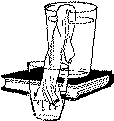
* capillary action — капиллярное движение (жидкости)
PASCAL'S LAW *
Pascal's law tells us that if you apply pressure to a confined gas or liquid,* the gas or liquid transmits the pressure undiminished* in all directions and the pressure acts on all parts of the liquid. You can demonstrate this with the help of a lemonade bottle, some matches and a balloon. You cut off the heads of the matches and then drop the heads into the bottle. Then you fill the bottle up to the opening with water and tie the mouth of the balloon tightly over the opening. The heads of the matches will be on top of the water, but when you press your finger on the balloon (as shown in the picture), they will go down slowly to the bottom. When you raise your finger, the heads go up again. The explanation is this. The pressure, which you transmit through the water, makes a very small part of water get into each head of the match. Then the head of the match becomes heavier and goes down. When you raise your finger, there is enough air pressure in the heads to make the water come out of them. So the match heads go up again.
* Pascal's Law — Закон Паскаля
* if you apply pressure to a confined gas or liquid — если вы производите давление на газ или жидкость, содержащиеся в замкнутом сосуде
* transmits the pressure undiminished — передает давление без изменения
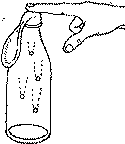 .
.PUT THE CORK IN THE CENTRE
Fill a drinking glass with enough water so that it is almost full. Put a small cork into the glass and ask your classmates or friends to make the cork stay in the centre of the water; it must not touch the sides of the glass. They will not be able to do it. The cork always moves to one side. When your friends have decided that it is impossible, you show them that it is easy to do it. Add more water to the glass from another glass until the water is a little over the rim. Be very careful. Because of the surface tension,* the water will form a convex surface.* The cork moves to the centre, where the water is highest, and there it will stay.
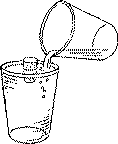
* Because of the surface ['se:fis] tension ['tenjn] — Благодаря поверхностному натяжению
* a convex ['kon'veks] surface— выпуклая поверхность
AN EXPERIMENT WITH A CARDBOARD ARROW *
Everybody knows that most things expand when you heat them and contract when you cool them.* But do you or your friends know what contracts when you heat it? It is rubber. You can demonstrate that rubber contracts when you heat it by the following experiment.
Take a rubber band * and put it round a small box. Then you cut out a cardboard arrow, put it on a pin, and push the pin under the band, as shown in the picture. If you now bring a candle to the point A of the rubber band, the cardboard arrow will move slowly to the left. If you move the candle near the point В of the rubber band, your arrow will slowly move to the right. Now you can explain it. The heat makes the rubber band contract. When it contracts it turns the pin and the arrow moves to the left or to the right.
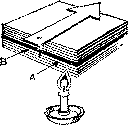
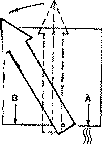
* a cardboard arrow — стрелка из картона
* contract when you cool them — сжимаются при охлаждении
* a rubber band — круглая резинка (для упаковки лекарств и т. п.)
HOW YOU CAN DEMONSTRATE INERTIA
You know, you can demonstrate inertia with the help of checkers. You build a tower of white checkers; only the second checker from the table (or floor) is black. Thirty centimetres away you put another checker vertically, as shown in the picture. If you press your finger down on the side of this checker,* It will move quickly to the tower. When the checker comes up to the tower, it will push out the black checker, but all the other checkers will not fall down. This simple experiment demonstrates inertia. Thanks to inertia the white checkers do not fall down when the black checker comes out. (If your checkers are small, you may find that it is better to put the black checker third from the table instead of second.)
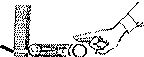
* press your finger down on the side of this checker — щелкните пальцем nо этой шашке
THE EGG AND FRICTION
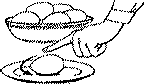
Imagine somebody has given you a number of eggs on a plate and said, "One of these eggs is hard-boiled. The rest are raw. Can you find the hard-boiled egg if you don't break any of them?" You will be able to do that if you know the laws of friction.* Put only one egg on the plate and try to spin it. The only egg that will spin well is the hard-boiled egg. The raw egg will not spin well because the friction between the layers of its liquid and the friction between the liquid and the shell kill the spin.*
* the laws of friction — законы трения
* kill the spin — замедляют вращение
THERE IS NO MAGIC
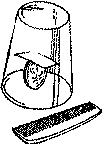
Put a fifty-kopek coin on its side, then put a small piece of paper on it and cover them with a drinking glass, as shown in the picture. Now ask your friend to throw the piece of paper off the coin, but he mustn't touch the glass or jump on the floor. The coin must not fall down. Don't show him at once how to do it. Let him think and try it for a long time, When at last he says it is impossible to do it, you comb your hair (the hair must be dry), and then put the comb (as if by chance) near the side of the glass. The piece of paper will fall down at once. But there is no magic. It is electricity that makes the piece of paper fall down.*
* It is electricity that makes the piece of paper fall down— Под действием электричества лист бумаги падает.