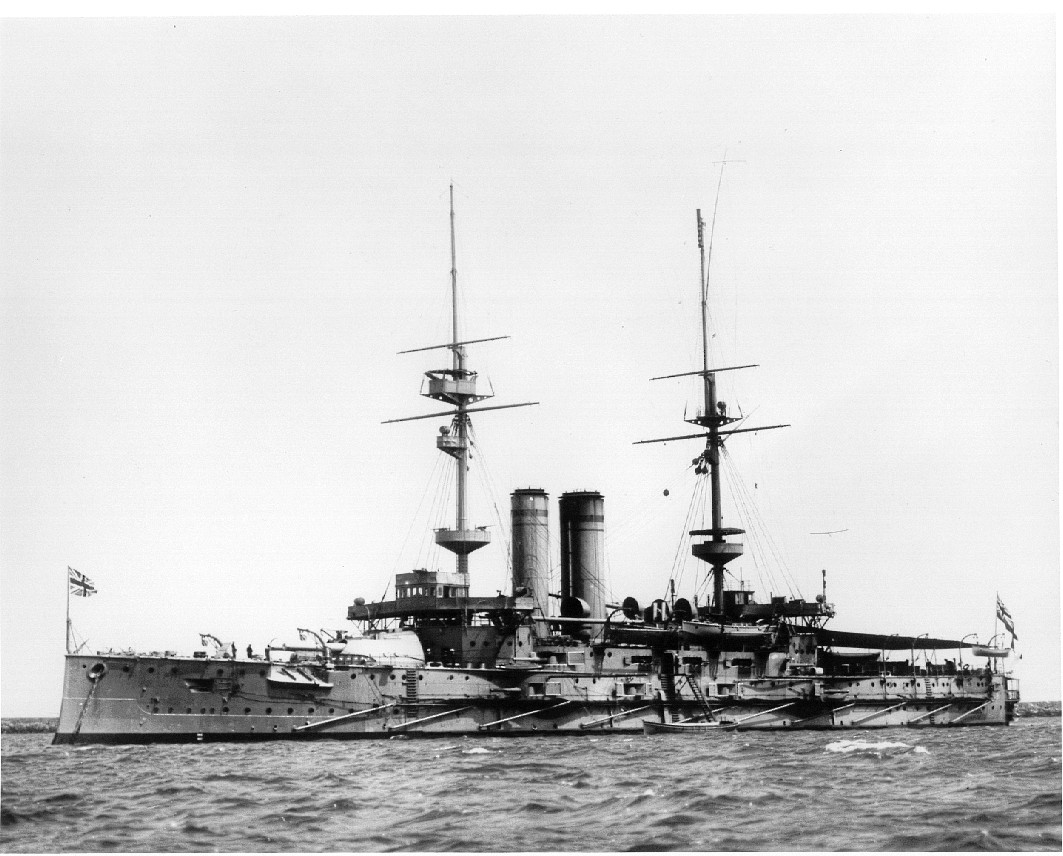
Laid down Chatham Dockyard 4th January 1897;
launched 23 March 1898; commissioned Chatham 27 March 1900.
Designed for the China Station with a shallow enough draught to allow
her to use the Suez canal. Remained there until 1903, in July 1904 went
into commissioned reserve at Portsmouth. In May 1905 joined the Mediterranean
Fleet, transferred to the Channel Fleet in December, remaining there until
March 1907. April 1909 Commissioned at Sheerness for the 4th Fleet (Nore
Reserve). In 1913 mothballed as joined the 3rd Fleet (Pembroke Reserve) to
be brought out in August 1914 to join the Battle Squadron operating from
Devonport. Later transferred to Loch Ewe for defence of the Grand Fleet anchorage.
In September 1914 dispatched to the East Indies for escort duties, operating
against the German light cruiser Konigsberg in November (Rufigi river, East
Africa).
But in April 1915 transferred to the Dardanelles, to support the ill-considered
and ill-fated landings around Cape Helles [Gallipolli]. Damaged on 25th
April and 2nd May. On the 13th May 1915 sunk by 3 torpedoes fired from the
Turkish torpedo boat Muavenet which was manned by a German crew at the time.
570 of her complement were lost.
The following extract from:
Dardanelles: A Midshipman's Diary 1915-16
(H. M. Denham) John Murray, 1981 describes the sinking (the Author was
on the Agamemnon):
THURSDAY MAY 13TH At about 1.15 a. m. it was realised
that the battleship Goliath, anchored in our usual berth in Morto
Bay, was in trouble. Cornwallis, anchored some distance astern, had
heard three dull thuds and, after hearing yells from men struggling in
the water as they were swept past her by the current, realised that
Goliath had been torpedoed and sunk.*
All ships were informed, weighed anchor and proceeded seawards.
Although Cornwallis soon got out her boats to rescue survivors,
less than 200 were saved of a complement of about 800. Later we learnt
that the ship was sunk by the Turkish torpedo-boat Muavanet (with
a German officer's help) which had eluded our patrol destroyers by creeping
down the Gallipoli shore towards the entrance of Morto Bay.
*The wreck of Goliath now lies in position 40° 02' 22"N, 26°
12' 23"E, very broken up and largely salvaged.
Extracts from Naval Review Vol. IV (pub by
Naval Society)
p.99 - HMS Amethyst at the Dardenelles
12th.-The Goliath while acting as right flank ship was torpedoed and
sunk by an enemy torpedo boat, which under cover of a fog, slipped down
the Straits, passed our destroyer patrol, fired her torpedoes, and escaped.
There was a large loss of life. The casemate-doors jambed and imprisoned
many of the guns' crews. An enemy " enclair " wireless message was intercepted,
which stated that a British transport had been sunk by three torpedoes.
p.144 - HMS Agamemnon in the Mediterranean
10th. It was reported today there were four or five Turkish destroyers
above the Narrows. Destroyers on patrol are warned that they may come down
the Straits during the night.
Took in ammunition all night and left at 7.10 a.m. on May 11th for
our anchorage off X Beach. At 8 a.m. on the 12th left for Morto Bay, anchoring
at 9.20 to renew our attentions on the Asiatic batteries, the Grampus (destroyer)
accompanying us to intercept floating mines. Owing to mist and drizzle the
aeroplane was unable to spot for us and the Asiatic batteries never fired
a round all day. The afternoon was clearer. The Soghon Dere batteries fired
three rounds only. The Ghurkas at dusk captured an important gulley on
the left flank.
Orders were received at 11p.m. on the11th, that Brigadier-General
Fuller, R.A., had taken over direction of firing of ships with the assistance
of Commanders Collard, Douglas, and Lieutenant Bent, at the Naval Observation
Station.
Position 10.53 p.m. on the 11th.
Situation unchanged. E.14 has sunk a large army transport. Patrols
from the Allied Fleet are in search of the enemy's submarines south of Cape
Matapan and near the Doro and Mykoni Channels ; coast of Asia and islands
are being closely watched.
At 7 p.m. on May 12th when we left, the Goliath had arrived off the
right flank ahead of us and subsequently appears to have anchored in the
position we were in, in Morto Bay. A bank of fog was slowly spreading
down the Straits on the Asiatic side from Chanak and Kephez Point; remained
under weigh off Y Beach. At 1.30 a.m. on May 13th a general signal was
made by the Cornwallis, lying at anchor inside the transports about a mile
and a half from Seddul Bahr, to send all boats to pick up men in water
floating down the Straits. As we were about seven miles off and the current
was running at three knots, we made for a position off Rabbit Island in
hopes of saving anyone who had been missed in the dark. Day broke at 3.45,
but there was no sign of anyone. Many steamboats and trawlers were searching
with the same purpose between us and the Straits ; Rabbit Islands were
hidden in fog, also a portion of the Asiatic coast, which cleared off about
8 a.m. Heard that the Goliath had been sunk by three torpedoes fired from
a Turkish destroyer which had apparently drifted down stern first in the
mist, and had been taken for one of our patrols. The O.O.W. of the Goliath
challenged her and an officer in the boat hailed the ship in good English.
The Goliath sank in about four minutes, 22 Officers and 164 men being saved,
over 500 drowned, including the captain (Shelford), who was on the bridge.
p.232-Dardenelles Notes HMS Prince George
19th.-At Mudros. We join the Rear Admiral at Helles to-morrow at 4
a.m. The arrangements now for covering seem to be better. The French look
out for the Asiatic batteries (when they feel inclined), two cruisers support
the left flank, each taking a certain number of hours, three ships anchor
off Cape Helles for bombarding, being spotted for by a station ashore,
and two ships take it in turn to lie off Sed-ul-Bahr to do anything that
may be required.
One great change, all ships anchor outside the straits at night off
Cape Helles. That is because of the Goliath. We only heard rumours at
Malta as to what had happened to her. The facts appear to be that one
night she was anchored in our billet under the cliffs in Morto Bay and
a Turkish T.B. got through our destroyer patrol without being seen, ran
up almost alongside the Goliath, and fired three topedoes at her. They all
hit, and the ship went down with nearly all hands. -No one in the Goliath
seemed to have seen her, although there is a story that she was hailed by
someone but fired her torpedoes at once. The extra-ordinary part of the thing
is that she was not even seen on her way up again, and reached the Narrows
in safety. It was a very smart piece of work on their part, but one wonders
what the devil our patrol was doing to let her get back. The submarine scare
does not seem to have put off anchoring the ships off Cape Helles by day.
They would be a fine and not very difficult bag.
Ships that are fitted with them get their nets out each evening.
p290 - operations in the Dardenelles in 1915 - notes from
HMS Prince of Wales
13th.-10.30 a.m. Goliath was torpedoed by an enemy destroyer at entrance
of Dardanelles at 1.29 this morning. Two torpedoes were fired, and destroyer
escaped, but apparently did not go back up the Straits. Four of our destroyers
were on watch at the time. The night was very dark, and the Goliath is
believed to have been burning search lights. Approximate number of survivors
20 officers, 160 men.
...
1.30 p.m. It has now been officially reported, from Malta that there
are three enemy submarines between that place and here, believed to be
making their way to Smyrna which they could use as a base. One of the submarines
was a large German one.
Re the torpedoing of the Goliath; the Majestic apparently was relieved
by the Goliath and had protested against the burning of search lights as
giving away her position; a protest that events have justified. Presumably
the four destroyers were without lights and it appears to me that a more
efficient watch could have been kept had they been burning searchlights
on the beam, so that no surface craft could pass them without coming into
the beam of the lights.