 |
|
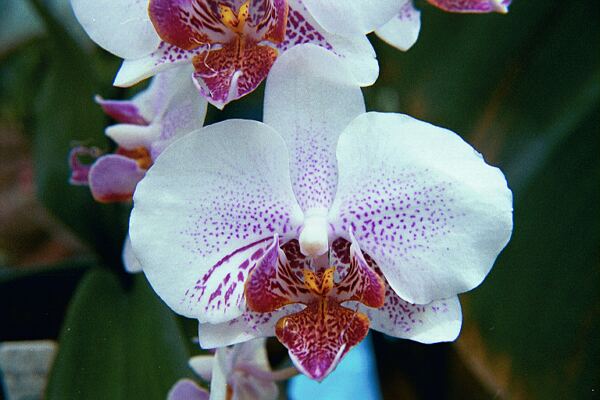
| C.L. Blume first established this genus in 1825. The word Phalaenopsis is derived from the Greek words phalaina meaning ‘a moth’ & opsis meaning ‘looks like’, & refers to the moth like appearance of the flowers. The genus of around 50 species can be found from India, through Southeast Asia, to the Philippines, & as far south as Northern Australia. LIGHT Phalaenopsis are low light orchids, & as such don’t like direct sun light, the leaves will burn easily during the hotter part of the day if they are not protected from the suns rays. Foliage colour is a good light indicator in Phalaenopsis, dark green foliage is indicative of too little light, while yellow coloured foliage indicates too much light. Ideally if light conditions are right there should be little or no shadow seen if you hold your hand about 300mm above the plant's leaves. TEMPERATURE The ideal temperature range for these plants is 15°C to 24°C. While they are in flower Phals should be kept above 16 °C, lower temperatures even for a short period will cause the buds to yellow & drop. In late autumn, a short duration, say a couple of weeks of slightly below average temperatures, around 12oC will help to initiate flower spiking. During the warmer months the plants will tolerate slightly higher temperatures, but remember, higher humidity and air movement must accompany higher temperatures. WATER These plants are monopodial plants, so have only a limited facility for water storage, which makes this aspect of their culture very important. Avoid watering the foliage as water in the crown of the leaves will cause rot to set in quickly, but the medium needs to be kept moist by directly applying water to the pot. Plants should be thoroughly watered & then not watered again until the media is almost dry. As long as your plants roots are in reasonably good condition, a plant which has become dehydrated (limp, wrinkled leaves) as a result of infrequent watering during warm, bright, dry days will quickly pick up moisture when the plant is watered more frequently & moved to a more shaded & humid location. HUMIDlTY This is important to phalaenopsis, with the recommended humidity being between 50% and 80%. Plants can be set on trays of gravel, partially filled with water so that the pots never quite sit in the water. Misting the plants in during dry weather is also beneficial, as is grouping plants together, as this helps raise the humidity by conserving the water that your plants transpire. In humid conditions, it is imperative that the humid air is moving to prevent fungal or bacterial diseases. Again, leaves should be dry as soon as possible, & certainly always by nightfall. AIR MOVEMENT Good air circulation is a necessity for these plants all year round & is an absolute requirement when the plants are in bloom to prevent spotting of the blooms by the fungus, botrytis. Botrytis is particularly common in damp & humid conditions. Good air circulation dries the plants and flowers, as well as keeps the spores of botrytis airborne. FERTILISER Phalaenopsis like to be fed regularly during their growth period, so this is a case of “weakly weekly” being ideal. That is, water on a feed at half or less the recommended strength on the packet about once a week, & only every couple of weeks in the winter. The feeding programme will depend a lot on what your potting media is, so the more often you water, the more often you need to feed. POTTING Phalaenopsis like to be potted in a well-draining mix, such as Pine bark, tree fern fibre, various types of stone, sphagnum moss, or any combinations of these. It is best to repot these plants at least once a year, usually just after the flowering has finished & the new growth stage has started. Root rot will occur if the plants are left too long & the potting media starts to break down. When repotting, you need to remove all of the old medium from the roots & trim off any dead or rotting roots, then give any cut areas a dusting of Cinnamon as this helps prevent any infection or rotting setting in. Spread the remaining roots over a handful of new media in the bottom of a new pot & fill the rest of the pot with the media, gently working it through the roots, so that the roots are just below the top of the media level. To promote new root growth after repotting the plant should be kept just a little drier & shaded for a few weeks, but remember to keep up the humidity. |
| Phalaenopsis Culture |
 |