|
|
|
|
|
|
|
Malaysia: Kuala Lumpur, Melaka, Kota Kinabalu (Jan/01)
 Mt. Kinabalu
The main purpose of this 10-day vacation in Malaysia was to climb Mt. Kinabalu . Besides summiting the highest mountain in Southeast Asia during Christmas, I also spend some time in Kulala Lumpur during Hari Raya and visited the historic town of Melaka (aka Malacca).
This was my second visit to Malaysia. For my first impressions on this country, visit the page about my first visit , in Jan/2001.
Once again, I stayed at Isa's family home and travelled with him.
We first went to Melaka, the historic city where the Portuguese arrived in 1511. By visiting the local sites and museums, I learned a lot about the Malaysian history and legends and a bit about Islam. Then we spent some time in Kuala Lumpur during the festivities that follows the end of Ramadan. The rest of the trip was spent climbing Mt. Kinabalu, located in the state of Sabah (Malaysian Borneo). For more on this climb, please visit the separate Mt. Kinabalu page in the Mountain Climbing section of this web site.
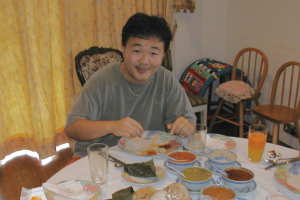
As always, visiting Malaysia is a great experience. And, as great experiences go, food is certainly one of the highlights. Besides the traditional Malaysian cuisine (a fusion of Malay, Chinese and Indian influences as described in my previous trip report), this time I sampled what is called the Nyonya cuisine (Babas and Nyonyas is how the offspring of the original Chinese settler who intermarried and adopted many Malay customs are refered to). The picture above is of a roti breakfastat Isa's.
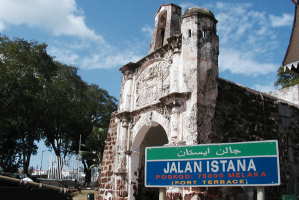
During the 12th and 13th centuries, because its strategic position at the tip of the Malay Peninsula (close to Singapore) , Malacca became a port-of-call ships from China, India, and Arabia. It was invaded and controlled by Portuguese (1511) and the Dutch (1641). The picture above is the "Porta of Santiago", the remains of the "A Famosa" Portuguese fortress built to protect the town.
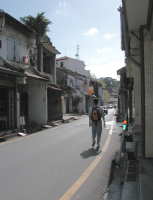
Melaka is full of history and buildings that shows its history. There are a large number of good museums and the historic sites are well maintained and documented.
In 1795, the Dutch relinquished control of Malacca to the British to prevent it from falling into the hands of the French, when the Netherlands was captured during the French revolution. Malacca stayed under British control for a long time. Then, in this century, came the Japanese, who occupied the peninsula. After the end of WWII, Malacca was back under British control.
The Federation of Malaya was formed in 1948. In 1955, Britain agreed on independence. The process of unification and idependence occurred during the 60's, with Brunei and Singapore leaving the federation (for racial, religious, and economic reasons). There was a struggle with a Comunnist movement in the following years.
Today, Malaysia is constitutional monarchy.
Nine Sultans from the different states take turns as King of the country
and the political power is exercised by the prime-minister. Since 1981, the
charismatic and visionary Dr. Mahathir is the head of the Islamic Malay state.
Ethnic problems aside, Malaysia's economy was one of the great success stories
of the post-war period. In the mid-1990, the country was posed to become an
economic power in the 21st century, which doesn't seem so certain now, after
the 1997 crisis.
|
|
|
|
|
|
|
