The Network Layer (2.4)
References:
Linux Networking Howto ...
PPP Howto ...
G. Herrin, Linux IP Networking, 2000, available on
www.kernelnewbies.org
Networking
This section summarizes the network configuration of a Linux system.
In order to configure the networking one need to set up a few
scripts and files, besides having the proper support compiled in the
kernel or as module (but this is ususally the case).
An isolated host usually has only the loopback interface
(IP 127.0.0.1), and can have a temporary ppp interface when it
dials up.
The bootproto should be set to "dhcp" if the IP address of the
interface is retrieved, using dhcp, from a dhcp server.
In this case BROADCAST, IPADDR, NETMASK, NETWORK and
GATEWAY are not used and unnnecessary.

ppp connection
To set up a
ppp connection start the pppd daemon with the
"connect" option and a suitable chat script; for example,
   /usr/sbin/pppd connect '/usr/sbin/chat -v -f /etc/ppp/chat-isp ' \
   user marco_corvi@oocities.com -d -detach &
The pppd deamon is passed the the command "connect" which takes the
script to execute for the connection.
The option "-detach" tells the deamon to go in background.
The command "user" sets the username used for authenticating with the peer.
The options of "chat" specify the verbose mode, and the chat file
to use. This file must contain the information to dial up your ISP
with your modem. For example, I have
   ABORT "NO CARRIER"
   ABORT "NO DIALTONE"
   ABORT "ERROR"
   ABORT "NO ANSWER"
   ABORT "BUSY"
   ECHO OFF
   SAY "Dialing your ISP ... \n"
   "" "at"
   OK "atz1"
   OK "atdt<ISP_NUMBER>"
   TIMEOUT 60
   SAY "Waiting up to one minute ... \n"
   ECHO ON
   CONNECT ""
The interface will have the name of the pidfile /var/run/ppp*.pid
which contains the pid of the deamon. The interface configuration can be seen
with the command
/sbin/ifconfig ppp_interface
The pppd deamon executes a few additional scripts:
- /etc/ppp/ip-up, invokes ifconfig to add the ppp interface to the
network. Your custom commands should be added into /etc/ppp/ip-up.local.
- /etc/ppp/ip-down, calls ifconfig to remove the ppp interface from the
network. Again, /etc/ppp/ip-down.local is the place for custom commands.
For example i have a script that writes log data to compute
the statistics of the connection to a log-file.
Finally pppd uses an configuration file, /etc/ppp/options, which specifies
all the other options. Here is an example,
# /etc/ppp/options
#
/dev/cua1       # device (should try /dev/ttyS1)
# /dev/modem
57600           # speed (try 115200 !!!)
debug           # debugging messages
lock            # lock the device
modem           # use modem control lines (CD): this is the default
# local           # do not use modem contro lines (ignore CD)
hide-password   # do not show password in syslog
logfile /etc/ppp/ppp.log  # logfile for stat purposes
# record /etc/ppp/ppp.rec # record file for pppdump (must try)
crtscts         # hw flow control
defaultroute    # `route add default`
noipdefault     # () disable local ip from hostname: peer must supply it
                # see local_ip_address:remote_ip_address option
# usepeerdns      # use if the provider does not supply DNS
                # see /etc/resolv.conf
# allow-ip *      # allow any ip_addr for the peer (w/o authentication)
asyncmap 0      # () no obsolete byte escaping
# mtu 552         # (can leave it disabled)
# mru 552         # (can leave it disabled: default 1500)
idle 180        # disconnect if we do not do anything for three minutes
deflate 15,15   # request peer deflate compresion (value range 8-15)
                # must have kernel module for BSD compression
bsdcomp 15,15   # request peer bsd compression (value range 9-15, 15 max)
                # pppd second choice (see man pppd)
                # must have kernel module for BSD compression
predictor1      # request peer predictor-1 compression
                # no effect unless kernel module supported
vj-max-slots 16 # number of VJ TCP/IP header compression slots (max 16)
Last the /etc/ppp/pap-secrets file should contain your login data
(so it should be readable only by root),
# Secrets for authentication using PAP
# client        server  secret                  IP addresses
marco_corvi@oocities.com * my_password
To terminate the connection send a SIGHUP to the pppd deamon,
kill -HUP ppd_pid
Network packets
References:
J. Postel, RFC 791 INTERNET PROTOCOL
J. Postel, RFC 793 TRANSMISSION CONTROL PROTOCOL
Networking is structured in a layered architectures (the OSI model)
in which the upper level relies on the lower level to send/receive
data.
- The bottom level is the physical layer, with network boards, switches,
cables, or radiowave, or whetever else;
- Immediately above it is the data-link layer.
This puts the datagrams in packets and transmits them via the network
interface. It adds start and end flags and bit error checking (CRC or
parity).
- Above it is the network layer.
This layer is responsible for routing the packets so that they can reach
their destination. It may split the segment in fragments.
It sends/receives datagrams.
- Next there is the transport layer.
This layer breaks the data in small-size chunks (segments)
that can be send to the network. It also reassembles incoming packets
into a stream. It provides also error checking.
- Above is the session layer.
This layer manages the logical control: source and destination,
startup and shutdown of a session.
- Above is the presentation layer.
This layer translates data from the network in a format usable by the
application, and viceversa from application format into network
format. Below this point bytes are a stream of octets.
- At the top there is the application layer, which interacts with the
user and with other programs.
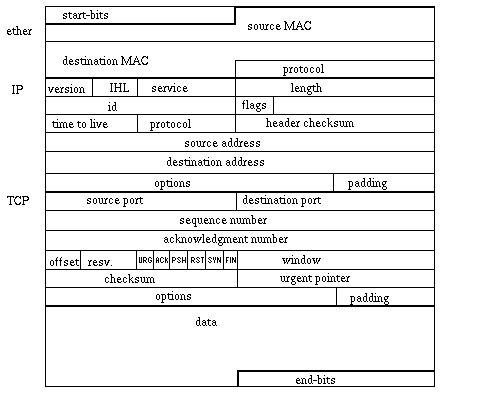
The network implementation does not strictly follow this model.
TCP provides initialization of a connection (three way handshake),
finilazation (FIN-ACK), and control.
TCP is session aware (logical ports).
IP provides fragmentation of long segments, and machine to machine
routing with the IP address system.
Finally ethernet encapsulates packets with their physical (MAC) address.
BSD Packet Filter
References:
McCanne, S. and Jacobson V.,
"The BSD Packet Filter: A New Architecture for User-level Packet Capture".
Proceedings of the 1993 Winter USENIX Technical Conference, San Diego, CA.
To be able to attach a BPF filter to the socket you need to have
compiled the kernel with the CONFIG_FILTER option. Infact the
sock_setsockopt commands
SO_ATTACH_FILTER and SO_DETACH_FILTER are conditioned to it (see net/core/sock.c).
These act on the socket's sock.
The first copies the filter code from userspace in a temporary
sock_fprog, and calls sk_attach_filter.
The second sets to NULL the sock's filter, and calls
sk_filter_realease to free the filter:
this does some sock bookkeeping, and free the filter if its ref-count drops
to 0 (see include/net/sock.h).
The filter structures are defined in include/linux/filter.h.
An instruction is stored in a sock_filter structure, which
is exactly as described in the paper:
16 bits of opcode, 8 bits of jump true, 8 of jump false, and 32 bits of multiuse field.
A filter program sock_fprog is an array of instructions:
it contains the len of the filter and a pointer to the instructions.
Finally a kernel sk_filter is a sock_fprog with prepended
a refcnt.
A number of macros are available to write BPF code.
Two can be used to write the filter statements,
- BPF_STMT( code, k ): initializer of a BPF statement;
- BPF_JUMP( code, k, jt, jf): initializer of a BPF jump statement;
The instruction codes are
| Instrcution code |
BPF_LD |
load in A register |
A = k, A = M[k], A = P[k], A = P[X=k] |
| BPF_LDX |
load in X (index) register |
X = k, X = M[k], X = len, X = 4*(P[k]&0xf) |
| BPF_ST |
store A register in scratch memory |
M[k] = A |
|
| BPF_STX |
store X (index) register in scratch memory |
M[k] = X |
|
| BPF_ALU |
perform arithmetical operations |
A = A+k, A = A-k, A = A*k, A = A/k, A = A&k, A = A|k, A = A<<k, A = A>>k,
A = A+X, A = A-X, A = A*X, ..., A = -A |
| BPF_JMP |
jump instructions |
... |
| BPF_RET |
return the number of accepted bytes |
ret A, ret k |
| BPF_MISC |
miscellaneous instruction |
X = A, A = X |
| size |
BPF_W |
word (32 bits) |
|
| BPF_H |
half-word (16 bits) |
|
| BPF_B |
byte (8 bits) |
|
| addressing mode |
BPF_IMM |
constant |
|
| BPF_ABS |
absolute packet offset |
|
| BPF_IND |
relative packet offset |
|
| BPF_MEM |
from scratch memory |
|
| BPF_LEN |
packet length |
|
| BPF_MSH |
... |
|
| arithmetical operations |
BPF_ADD |
addition |
A = A + k, A = A + X |
| BPF_SUB |
subtraction |
A = A - k, A = A - X |
| BPF_MUL |
multiplication |
A = A * k, A = A * X |
| BPF_DIV |
division |
A = A / k, A = A / X |
| BPF_OR |
bitwise or |
A = A | k, A = A | X |
| BPF_AND |
bitwise and |
A = A & k, A = A & X |
| BPF_LSH |
left shift |
A = A << k, A = A << X |
| BPF_RSH |
right shift |
A = A >> k, A = A >> X |
| BPF_NEG |
negative |
A = - A |
| jump instructions |
BPF_JA |
jump |
pc += k |
| BPF_JEQ |
jump if equal |
pc += (A==k)? jt : jf
pc += (A==X)? jt : jf |
| BPF_JGT |
jump if greater |
pc += (A>k)? jt : jf
pc += (A>X)? jt : jf |
| BPF_JGE |
jump if greater or equal |
pc += (A>=k)? jt : jf
pc += (A>=X)? jt : jf |
| BPF_JSET |
jump if in set |
pc += (A & k) ? jt : jf
pc += (A & X) ? jt : jf |
| registers |
BPF_K |
constant |
|
| BPF_X |
index register |
|
| BPF_A |
accumulator register |
|
| exchange instructions |
BPF_TAX |
copy A into X |
X = A |
| BPF_TXA |
copy X into A |
A = X |
Instructions are composed by adding the pieces together,
instruction code, optionally the size, and the addressing mode.
struct bpf_insn insns[] = {
  BPF_STMT(BPF_LD+BPF_H+BPF_ABS, 12),
  BPF_JUMP(BPF_JMP+BPF_JEQ+BPF_K, ETHERTYPE_REVARP, 0, 3),
  BPF_STMT(BPF_LD+BPF_H+BPF_ABS, 20),
  BPF_JUMP(BPF_JMP+BPF_JEQ+BPF_K, REVARP_REQUEST, 0, 1),
  BPF_STMT(BPF_RET+BPF_K, sizeof(struct ether_arp) + sizeof(struct ether_header)),
  BPF_STMT(BPF_RET+BPF_K, 0),
};
Example
Network kernel structures
References:
The net_device
The struct
net_device is defined in the header file
include/linux/netdevice.h.
It contains, among the others, the following fields,
- name, the name of the interface, eg, eth0;
- i/o specific fields: shared memory (mem_start, mem_end),
receive shared memory (rmem_start, rmem_end),
base_addr and irq;
- if_port, dma, state;
- next, a pointer for the linked list of net_device's;
- priv, a pointer to private data;
- owner, the owner module.
Its methods are, among the others,
- the initialization function init;
- the finalization function uninit and destructor
destructor;
- open and stop (close);
- poll;
- transmission functions: hard_start_xmit, hard_header,
rebuild_header, etc.;
- control functions: do_ioctl, change_mtu
The list of all net_device's is pointed to by dev_base, and
dev_base_lock protects from concurrent access to it.
The loopback_dev is a net_device.
The socket structure
The structure
socket is defined in the header file
include/linux/net.h and is rather short,
state, the socket_state;flags, ops, pointer to the protocol functions;inode, pointer to the associated inode;fasync_list, asynchronous wake-up list;file, sk, pointer to a struct sock;wait, wait queue head;type, socket type; -
passcred,
The protocol operations, struct
proto_ops,
are the user interface API.
At the user level there is only one system call
sys_socket();
the specific function is selected with an index.
Indeed the user systemcalls do not map 1-1 on the propotol functions.
bind(socket, umyaddr, addr_len), release(socket), connect(socket, uservaddr, addr_len, flags), listen(socket, len), accept(socket, new_socekt, flags), getname(socket, uaddr, addr_len, peer), sockedpair(socket_1, socket_2), setsockopt(socket, level, optname, optval, optlen), getsockopt(socket, level, optname, optval, optlen), sendmsg(socket, msghdr, len, cookie), recvmsg(socket, msghdr, len, flags, cookie), mmap(file, socket, vma), poll(file, socket, poll_table), ioctl(socket, cmd, arg), shutdown(socket, flags), sendpage(socket, page, offset, size, flags),
The
proto structure is a function table with pointers to routines
for the IP protocol, that operate on the sock structure.
The functions are, mainly,
close(sock, timeout)connect(sock, uaddr, addr_len)disconnect(sock, flags)accept(sock, flags, error_pointer)ioctl(sock, cmd, arg)init(sock)destroy(sock)shutdown(sock, how)setsockopt(sock, level, optname, optval, optlen)getsockopt(sock, level, optname, optval, option)sendmsg(sock, msghdr, len)recvmsg(sock, msghdr, len)bind(sock, uaddr, addr_len)backlog_rcv(sock, sk_buff)get_port(sock, snum)
The inet protocols are kept on the list
inetsw.
At start three static protocols are added, SOCK_STREAM, SOCK_DGRAM, and SOCK_RAW.
These are permanent and cannot be modified.
Other protocols can be registered and unregistered with the functions
inet_register_protosw and
inet_unregister_protosw
respectively. These take as parameter a pointer to a struct
inet_protosw
which contains, among other things,
type and protocol, are the lookup key;prot points to a struct proto;ops points to a struct proto_ops;

The sock structure
The structure
sock is defined in the header include/net/sock.h,
and is rather large. There is a note in the source saying that it really should be
better organized.
Among other things it contains
daddr, and dport: the destination address and port;rcv_saddr, local reveiving (bound) address;num, local port;next, pprev, bind_next, bind_pprev
hash linkage pointers;state, connection state;saddr and sport, source address and port;family, address family;refcnt, reference count;sndbuf and rcvbuf,
size of sending and receiving buffer in bytes;sleep, a wait_queue_head for the sock;receive_queue, sk_buff_head of incoming packets;write_queue, sk_buff_head of outgoing packets;filter, pointer to a sk_filter;socket, pointer to the socket;
The socket buffer structure
sk_buff is defined in
include/linux/skbuff.h, and contains (besides other things)
next and prev, because the socket buffer
are tied together in a doubly linked list;list is the socket buffer list to which this sk_buff belongs;sk, the socket the owns this sk_buff;stamp, time of arrival;dev, network device on which this sk_buff arrived;h, a pointer to the transport layer header;nh, a pointer to the network layer header;mac, a pointer to the link layer header;cb[48], control buffer (for private data);len, length of actual data;protocol, packet protocol number from the driver;head, pointer to the head of buffer;data, pointer to the beginning of data;tail, pointer to the tail of data;end, pointer to the end of buffer;
Exercise
[to do]
Marco Corvi - 2003