Province of Pampanga
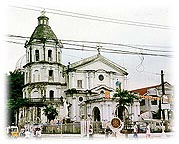
The Augustinian Missionaries were the first Europeans to settle in Lubao, a town in Pampanga, in 1571., From there they established mission centers in Candaba, Macabebe, Bacolor, Arayat, Mexico, Guagua (where my Aunt Fe lives) and other towns.
The civil province of Pampanga once included the provinces of Zambales and Bataan. The inhabitants at first resisted Spanish forces when these came in the 16th century. They were however subdued later by the Spaniard Martin de Goiti, after whom a famous plaza in Manila is named. But the province continued to be a hotbed of rebellion during the Spanish era, and more recently an area of social unrest with the Hukbalahap movement of the 1950's and the 1960's.
Recent years, however, have wrought havoc in Pampanga. The withdrawal of the American Air Force Base from Clark Field in Angeles City has greatly affected the economic stability of many people. The biggest tragedy that has struck Pampanga and the most personal was the volcanic eruption of Mount Pinatubo. Dormant for the last 500 years, Pinatubo vented its fury of destructive Lahar on the towns of Pampanga that lay in its path, including my own. The lahar still flows down unavoidably during the rainy season, changing the topography of the land and rendering thousands of families homeless for good. Other families, like mine, were resettled into "tent cities" causing an almost insurmountable problem for government and church agencies.
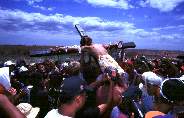 San Fernando, population 188,385 in thirty-four barangays, was originally carved out from the towns of Bacolor and Mexico was founded in 1755. Aside from being made as capital of the Philippines of the revolutionary government for about a month in 1899 and the provincial capital since 1904, it is also the current regional capital of Central Luzon. San Fernando is now the domicile of giant lanterns and the place of the world renowned annual re-enactment of the Crucifixion of Jesus Christ. The Philippine Christmas Village, the Philippine National Sports Center, the University of the Assumption and the Pampanga Sugar Development Co, Inc. are located in this town.
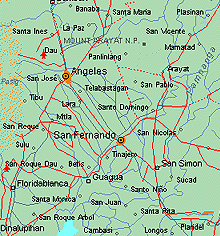 Pampanga is about 850 square miles (2,180 square kilometers) in area and bounded on the west by Zambales, northwest by Tarlac, northeast by Nueva Ecija, east by Bulacan and south by Manila Bay. Presently inhabited by more than 1.7 million people, it is one of 7 provinces that compose the so-called Central Plain of Luzon.
 During the Spanish times, Pampanga was one of the richest Philippine provinces. It is believed that early Pampangans were descendants of Malayan pioneers from the Malay Peninsula and Singarak Lake in West Sumatra. They settled along the river banks of the Rio Grande de la Pampanga in the Island of Luzon covering a large territory which extended to the Gulf of Lingayen in the North, to the Zambales mountains in the West, to the Sierra Madre range in the East and to Manila Bay in the South.
 The name Pampanga was attributed to the early settlers along the Pampanga River who were then called "taga pangpang". The Spaniards have a difficulty pronouncing the "ng" part which led to the corruption of the original word to the present term Pampanga.
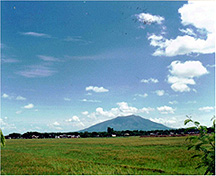 Being an agricultural province, Pampanga has average-income earners as a whole. Economically it is stable; sugarcane fields in this province are extensive and fish production along its swamps and rivers sufficient. Another enterprise that was thriving in the province was the sale of American goods coming from the American airforce base in Angeles City.