celluloid archive
Welcome to the
film review cubicle of the Markophone. Take a look around, but don't bump
your head. Differing (or other) opinions can be directed to
markophone@yahoo.com
(Reviews copyright
The Markophone, submitted by me and various others)
|
|
Futurama, Volume One (the
first 13 episodes) |
VS. |
SpongeBob Squarepants The
Complete 1st Season |
|
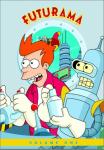
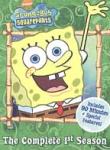
In
one corner we have the first Futurama DVD collection. Despite what Amazon might tell you, this is
the first 13 episodes, NOT the first season.
The first season only had nine episodes, thanks mostly to the terrible
scheduling by Fox. All episodes are
presented complete as-aired. In the
other corner, the complete first season of SpongeBob Squarepants, comprising 40
“episodes” or shorts.
First,
the technical crap. Both DVDs have the
clear video and audio that you’d expect from DVD. The SpongeBob DVDs were a little easier to
navigate, however. For some reason, the
Futurama DVDs all start with a “main menu” of simply the episodes. For the extra material, you must first select
an episode. A minor detail, but still
not the best menu structure.
For
those unfamiliar with Mr. Squarepants, the series revolves around a sea sponge,
the title character. He is a charming,
at times naïve main character, definitely not a carbon copy of Bugs Bunny (to
whom the series has sometimes been compared).
SpongeBob is an old-fashioned nice guy.
He works as a fry cook at the Krusty Krab. His boss is (surprise) a crab, his best
friends are a dim-witted starfish named Patrick and an energetic squirrel (who
uses an old-style scuba suit to live underwater) named Sandy. His next-door neighbor, the “black
sheep” of the series, is Squidward Tentacles, a grouchy octopus. The characters are all drawn very cleverly,
despite the fact that Squidward has only six tentacles. Instead of drawing the lumpy shape of a real
sea sponge, the creator Stephen Hillenburg decided to draw a rectangular
kitchen sponge. There are lots of
cartoon liberties taken – for example, you can’t really have fire underwater – but
all are used to humorous effect. The
episodes are short, with varying levels of humor. I’m speaking from an adult standpoint
here...some of these just don’t hold up as well to repeated
viewings. A few gems do stand out,
however, such as “Bubblestand”, “Squeaky Boots” (a
hilarious reworking of Poe’s “The Telltale Heart”),
“Suds”, “Rock Bottom” (in which Hillenburg gets to play
around with some of the bizarre things that live deep in the dark part of the
sea...definitely the strangest episode in the bunch, and one of my favorites
for that reason), and pretty much anything with Plankton, the tiny nemesis of
SpongeBob who’s out to steal the secret formula for Krabby Patties (the
underwater version of a burger).
The
voice talent in the SpongeBob series features some more recognizable faces than
Futurama. SpongeBob himself is voiced by
none other than Tom Kenny, who got his start in stand-up comedy many years ago. Patrick is voiced by Bill Fagerbakke (spelling?)
the big lummox from that old ABC series “Coach”. And most surprising of all, SpongeBob’s
boss Mr. Krabs is voiced by Clancy Brown, the big bad immortal from the first Highlander
movie.
“Futurama”
revolves around Philip J. Fry, a pizza delivery boy. One night he makes a delivery to a cryogenics
lab, and accidentally falls into one of the cryo-tubes. He awakens in the year 3000, to a new Earth,
and a new universe as well. He becomes a
delivery boy working for his great-great-great...etc-nephew Professor
Farnsworth at Planet Express. His
delivery missions are captained (is that a word?) by a cyclops, on whom Fry has
a crush. His best friend is a cranky
robot with LOTS of vices and a wonderfully playful lack of emotions. Much like the very early days of “The
Simpsons”, “Futurama” is fast paced, with lots of rapid-fire
jokes, sight-gags, and the like. This
lends very well to repeated viewing, as you’re likely to catch a sign or
a line of dialogue that you missed the last time around. Unlike the sprawling undersea world of
SpongeBob, the future Earth of Fry’s time is packed solid with gorgeous
scenery. There is very little wasted
space here, especially in the street scenes in New New York...not a storefront
is spared of a gag. And it works, just
like it should.
The
episodes are, like any series, varied in humor quality, however most are
above-average. Lots of pop-culture
references (and digs), so younger teens or kids won’t get all the jokes. Many are definitely of an adult nature,
too. Not quite as raunchy as “The
Family Guy”, but this series definitely deserves its 11:30pm time slot on
Adult Swim. Some of the stand-out
episodes are “I, Roommate” (Fry moves in with Bender, hilarity
results), “Fear of a Bot Planet” (the crew makes a delivery to a
world inhabited by human-hating robots, hilarity results...my favorite episode
in this collection), and “Fry and the Slurm Factory” (sendup of
“Willy Wonka and the Chocolate Factory” in which Fry wins a tour of
the factory that produces a strangely addictive soft-drink called
Slurm...hilarity results).
The
extras are lopsided. While SpongeBob
does have a good “documentary” about the creator and the origins of
the show, that’s really all it has.
The commentaries (on a handful of episodes) are simply the cast watching
the show...no real information or anything even entertaining. “Futurama”, however,
delights. The few extras that are
featured on the DVD are quite nice.
There are deleted scenes for a few of the episodes, commentaries which
are a joy to listen to, and some character designs and other stuff to look
through.
I
think that part of the appeal of “Futurama” is in the fact that it
was a limited series...it’s all gone now, there won’t ever be new
episodes. With that said, the series
will never suffer from disease that has plagued “The Simpsons” for
about five goddamn years now...IT’S OLD, everything has
already been done. Each story in
“Futurama” is new and fresh, because the writers never had a chance
to get overly-comfortable with the characters.
There is also more material for humor there, as well as the obligatory
guest voices from celebs.
There
can be only one victor, and that victor is...FUTURAMA. The jokes come faster, are funnier, and the
writers are more adept at that elusive beast they call “comedic
timing”. Plus the commentaries are
better. I enjoy both shows, but
“Futurama” has made me laugh more and harder, and that’s what
it all comes down to. Sorry, SpongeBob.
(skewered
by Mark)
|
|
Lock, Stock, and Two
Smoking Barrels 1998 Written and directed by Guy Ritchie Starring Jason Flemyng, Nick Moran, Jason Statham, Vinnie Jones, P. H. Moriarty |
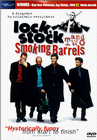
With
his sophomore film (his debut was
actually The Hard Case from 1995, which I haven’t seen), Ritchie established
himself as a writer with a definite feel for character, and one who
wasn’t shy about juggling many characters and several disparate
plotlines, eventually weaving them together at the end. His films (this one and its successor Snatch)
seem very loosely constructed, but in fact if any elements were removed, it
wouldn’t make any sense.
Definitely not a movie to watch in the background, and one that benefits
from repeated viewing.
The plot begins with a group
of four friends, one of whom (Eddie, played with a wonderfully low-key verve by
Nick Moran) is a card shark. The boys
gather together $100,000 in order to enter Eddie into a high-stakes card game
with “Hatchet” Harry Lonsdale, the local “big boss”,
played with gusto by P. H. Moriarty. As
luck (or circumstance) has it, Eddie not only loses the game, but finds himself
in debt to Harry, to the tune of $500,000, with a week to pay it all back.
A slew of characters are
introduced and developed, as the boys contemplate various schemes to raise the
money. Ritchie lays out these plotlines
very carefully, allowing them to occasionally intersect, but gradually merging
them into the whole. The storytelling is
top-notch and the dialogue is playfully dark.
Ritchie’s sense of visual flair is unparalleled here, in my
opinion his best work despite being his first big-screen effort. He demonstrates rare knowledge of the film
medium, using the camera as another tool to tell the story. This pulls the audience in and lets us feel
more involved, like a good De Palma film.
His music integrates with the visuals perfectly, making for a kinetic,
unbridled energy, and highly entertaining.
(reviewed by Mark)
|
|
Snatch 2000 Written and directed by Guy Ritchie Starring Jason Statham, Alan Ford, Brad Pitt, Vinnie Jones, Benecio Del Toro, Dennis Farina |
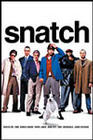
Another
“caper film” from Guy Ritchie,
with a very similar construction to Lock, Stock, and Two Smoking Barrels. This time around, Jason Statham plays
Turkish, a promoter of illegal boxing matches, who gets mixed up with Brad Pitt,
a fast-talking Irish bareknuckle boxer.
The heavy this time around is played by veteran Alan Ford (the narrator
of Lock,
Stock...) as “Bricktop”, a very nasty man indeed. As his earlier film, the cast is also
populated by figures from London’s real underground, lending an unnatural
sense of credibility to his films.
As before, there are several
separate plotlines revealed to the audience, gradually coming together as the
characters move towards the conclusion.
The performances are steadily excellent, even Pitt, who seems to quietly
relish his unintelligible role here. I
won’t say any more about the story itself, as half the fun of the movie
is discovering how everything comes together.
Ritchie still shows his visual and musical flair, drawing the audience
into the story, but I felt this time around was a little sub-par to Lock,
Stock... Not enough to prevent
me from recommending it, but after watching and re-watching the two, I feel the
earlier film is the stronger one.
(reviewed by Mark)
|
|
I Drink Your Blood 1971 Directed by David E. Durston Written by David E. Durston Starring Bhaskar, Rhonda Fultz and Arlene Farber 83 minutes |
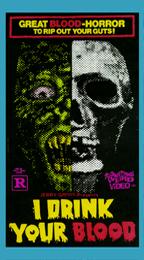
Originally
released theatrically on a double bill
with Del Tenney's 1964 black and white film I Eat Your Flesh in an MPAA-mandated version shorn of 10
minutes, this gore classic gets a new lease on life thanks to a
deluxe limited DVD release. The film is restored to its bloody glory
with loads of extras and much-improved picture quality over the out-of-print
VHS release. Included are outtakes, commentary, an alternate ending and
very fun animated menus.
A group of violently
unpredictable hippies known as the "Sons and Daughters of Satan," led
by the oddly charismatic Manson-like Horace Bones (Bhaskar) ride their van into
a small town. After local girl Sylvia Banner (Arlene Farber) happens upon
one of their dark midnight masses, she is caught and violently raped. The
unholy group then shacks up in one of the town's derelict houses whereupon
they capture and snack on their new abode's vermin
inhabitants. Meanwhile, the girl's veterinarian grandfather
(Richard Bowler) attempts vengeance on the group, but is beaten and dosed with
LSD. Sylvia's little brother Pete (Riley Mills) decides to take
matters into his own hands by killing a rabid dog lurking in the woods and
injecting its crazed blood into the town bakery's meat pies, which are then purchased
and eaten by the hippies! Now infected by rabies, the group (including a
pregnant woman, an Asian psychic and a mute) takes on the town and each other
in a blood-soaked killing spree that includes dismembered body parts brandished
as ghoulish trophies, suicides and (disturbingly) a Sharon Tate-esque double
murder. It should be noted that no blood is ever drunk, however many
corpses pile up.
This is one of the fastest
moving horror films of its era and obviously inspired by Night of the Living Dead (most notably in its nightmarish scenes of
ghouls attacking en masse as a collective, mindless killing
force). A young David Cronenberg may have caught this at the drive-in and
picked up on its themes of spreading hysteria caused by disease which led to
films such as Shivers and Rabid. Especially notable in
this sense is the scene where one of the group offers herself to a gang-rape,
happily using the rabies as a sort of STD. I Drink Your Blood is very much of its time, as evidenced
by scenes of older, hardhatted construction workers clashing with the younger,
jobless and nomadic hippies. Also, the Asian hippie setting herself on
fire might have been inspired by the Vietnam war, as some Vietnamese
protestants committed self-immolation to prove their point. Although the
acting as a whole is decidedly hit and miss, largely due to
some inexperienced acting turns, Riley Mills turns out to be one of
the better child actors in films of this type, portraying a believably upset and
resourceful young man. Also of it's time period is the score,
consisting of dated early '70s riffs, and the color stock of the
cinematography, which favors overly pinkish skin tones. Amusingly,
hydrophobia (fear of water experienced by those infected by the rabies) comes into
play as a defense against the killers, making this possibly the only horror
film in which a rampaging ghoul is deflected with the squirt of a garden hose.
(reviewed by Mike)
|
|
C'era una Volta il
West (Once Upon A Time In
The West) 1968 Directed by Sergio Leone Writing credits: Dario Argento/Bernardo Bertolucci/Sergio
Leone With: Henry Fonda, Claudia Cardinale, Jason Robards,
Charles Bronson and Gabriele Ferzetti Tagline: "There were three men in her
life. One to take her... one to love her... and one to kill her." |
Sergio
Leone's epic widescreen homage to the
Hollywood western has become a cinematic classic, ranking up there with Clint
Eastwood's revisionist Unforgiven as the best western
ever. Leone plays with the genre's conventions primarily through
evocative camerawork and music, and with a minimum of dialogue, letting the
scenery and rock-solid characterizations tell the sprawling story.
The film, shot in Spain, Arizona and Utah, follows several stories, all
centering on greed, murder and revenge. In one, gunmen, led by Frank (Henry
Fonda), massacre an entire family, led by Brett McBain (Frank
Wolff), who are awaiting the arrival of their father's new bride. Newly
widowed, Jill McBain (Claudia Cardinale) valiantly attempts to hold on to
the land she has inherited, vital for the building of a railroad to the
West. But the soulless outlaws who performed the
slaughter want to complete the job by offing her. There's also a
mysterious Mexican known only for the musical instrument he plays, named
"Harmonica" (Charles Bronson), who has his own reasons for
hunting down these bandits... and he has bloody vengeance on his
mind. Throw into the mix Manuel 'Cheyenne' Gutierrez (Jason Robards) as
an occasionally-retired gunslinger with a thing for McBain and sparks
do fly. The storylines eventually
intertwine and the characters violently clash, leading up to one of Leone's
trademark high-noon showdowns.
All participants are in high
form here; Leone had already established the game rules of the spaghetti
western with his “Man With No Name” trilogy starring Eastwood.
Bronson showed what he had learned working in previous westerns for TV and
the cinema. He wisely chose not to ape Eastwood's mythic loner
figure, yet appeared just as iconic and memorable. Bronson
successfully carried both a gun and a grudge for a murdered family member
in this film, a few years before he would become typecast as
the one-dimensional urban vigilante of the Death Wish tedium of the
'70s and '80s. Dario Argento's work on the story keeps the
numerous plot points and characters afloat and succinct without
succumbing to the "style over content" approach of his giallo work in
the '80s and '90s.
The music by Morricone is
strong and enjoyably thematic, but not as overly brassy as his previous
spaghetti western work, being more subdued and moving the story along without
overpowering the visuals. The cinematography by Tonino Delli Colli (who
would go on to shoot Leone's Once Upon A Time In America)
continues the sustained suspenseful tight close-ups of Il Buo, Il Brutto, Il Cattivo
(The
Good, The Bad, And The Ugly) and the sweeping, panoramic views of the
old west that move this epic's 165 minute running time along briskly. The
film isn't screened on television nearly as much as the Eastwood films, most
likely due to it's unwieldy length and Eastwood's star power. A restored
DVD is now out, as the film was cut to a mercilessly short 140 minutes upon
it's first American release.
(reviewed by Mike)
|
|
Evolution 2001 Dir: Ivan Reitman Starring David Duchovny, Orlando Jones, that Sean
kid with three names |

This
movie, while not a huge box office or
critical success, was a rollicking good time.
Of course, I thought the same thing about Ready To Rumble, but we
don’t need to get into that now.
With Evolution, Ivan Reitman once again managed to find a cast with
enough chemistry to carry off a mediocre movie.
Don’t ask me how, but
there is magic onscreen between Duchovny (poking fun at his X-Files history
with government conspiracy jokes) and Jones (almost fresh off his amazing stint
in the early days of MadTV). These guys
are obviously having a lot of fun with this movie and these roles, and
it’s definitely contagious.
The basic premise of the
movie is that a meteor crashes in Arizona, and the crash “wakes up”
the one-celled but quickly-evolving organisms on the meteor. As expected, this quickly escalates, as the
populace of the nearby small town is terrorized by the aliens, and the
government moves in to attempt to clean things up.
The story elements are hardly
original. The government is represented
solely by the military, who are all the stereotypical military bad guys. The aliens have some interesting designs,
with some enjoyable visuals, but nothing that would win an award. Still, the effects are not bad, considering
the comic-book level of the movie. Reitman
never tries to take things too seriously, and continues to push the envelope
right up to the disgusting ending. He
definitely did not get his “ooze-quota” with Ghostbusters, as there is
no shortage of dripping slime in Evolution. I laughed, I gagged, I’m glad I saw it.
(reviewed by Mark)
|
|
Tsui Hark’s
Vampire Hunters Also known as Era of Vampire 2001 Dir: Wellson Chin Starring Ji Chun Hua, Ken Chang, Yu Rong Guang |
Tsui
Hark is a well-known name to fans of Hong
Kong cinema, having produced, directed, or some combination thereof , countless
films, among the more notable the Once Upon a Time In China series
starring Jet Li. With Vampire
Hunters he takes on traditional Chinese spiritual fables.
For those only familiar with
American vampire stories and movies, this flick may come as a shock. There are no bullshit romantic ideals of the
vampire here...viewers instead find an inhuman monster, bearing more
resemblance to traditional movie zombies than the sexy, dark-haired vampire
fakery most people have been inundated with (no thanks to Anne Rice).
As the story goes, a group of
vampire-killers, led by the tonsured Master Mao Shan (played by Ji Chun Hua,
and I mean completely tonsured...no
eyebrows, either) tracks an elusive vampire to the grave of a general. The grave has been disturbed by the time they
get there, meaning one of two things, both bad.
The general has become a zombie, and if he’s eaten human flesh, he
will change into a vampire. No surprise,
as that’s exactly what happens.
Hey, there wouldn’t be a movie otherwise!
The master dispatches his
four star pupils to track down the vampire as he proves too elusive for
them. Three months pass and the foursome
believe that the vampire may be hiding in or near the palatial Jiang
estate. The Jiangs, we soon learn,
harbor a grisly family secret, which eventually leads to catastrophic
events. Yu Rong Guang turns in a good
performance as the elder Master Jiang.
The action scenes,
specifically the fight scenes, may leave some fans wanting more. Quick cuts, close angles, and harsh editing
leave a lot of the fights to the viewer’s imagination. In a world where slow-motion fights are
quickly becoming the norm, however, I had no problem with these fights. The swordplay, though very sparse, is simply
wonderful. The cast are all equally likeable,
even poking a little fun at other genre movies (most blatantly Bulletproof
Monk ). And the gore is, well,
plentiful. There is no dainty biting of
necks here...when the vampire feeds, he violently draws the victim’s
blood out of eyes, nose, and mouth.
Decomposing zombies hop around the sets, bodies explode, and the blood
flies freely. I liked it a lot.
(reviewed by Mark)
|
|
Guyver: Dark Hero |
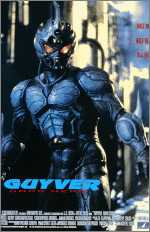
The Guyver returns to battle the forces of evil in this action-packed
sequel to the 1991 film. Although he was once just an average student,
the discovery of an alien machine has transformed Sean Barker (David Hayter)
into the powerful Ultraman-ish Guyver. This time, the world's strongest
superhero must change his destiny to save the planet from the Zoanoids, alien
creatures disguised as agents of the villainous Chronos Corporation.
After working on films such as PREDATOR
and GREMLINS 2: THE NEW BATCH, creature effects artist Steve Wang graduated to
director status to helm both the MIGHTY MORPHIN POWER RANGERS theatrical
franchise and the two (so far) American adaptations of Yoshiki Takaya's
popular Japanese manga. Flexible fighting alien costume and
makeup concepts from the children's series carried over into Wang's GUYVER
monsters, making for strange bedfellows with the profanity and R-level violence
and gore of this effort.
Overlong by at least 15 minutes, the film
gets bogged down by talk, delivered by merely mediocre actors. The
dialogue would've benefited from some of the warm, fanboy-friendly humor
found in the scripts of recent hero slugfests such as SPIDER-MAN and THE
X-MEN to make talk of Zoanoids and extinct alien cultures wash down easier. The
film is at its best when the titans clash; amongst rocks, water or whatever's
in their way. Both the Guyver costume and the evil Zoanoids are
well-realized creations; every penny of the film's $1,000,000 budget is on the
screen and Wang knows how to stage fight scenes (using talented martial
artists whose work shine through all that latex) for the fullest
effect. The score by Les Claypool III (no relation to the bassist for the
funk band Primus) is good, but poorly edited into the film, with an overreliance
on the main hero/villain themes. The film is currently only available on
VHS or as a Region 2 (Europe only) DVD, making a video store rental your best
bet to catch this one.
(reviewed by Mike)
[EDITORS’s NOTE: Les Claypool III also
does, or did, music scores for lots of anime, none of which come immediately to
mind. Maybe someone else out there can
send a few titles that he worked on?]
Mark’s Full-Clip of Movie Reviews...With Spoilers!
That’s right...if you don’t want
to know how these movies end, don’t bother reading any further. And also screw you, you humorless sons of
whores.
Phone Booth (Colin Farrell, Kiefer Sutherland, Forrest
Whitaker): Don't even bother. 90 minutes of a guy in a phone booth. And I'm not exaggerating. And it's not a GOOD 90 minutes, either. Terrible dialogue. Colin Farrell is just about as bad an actor
as, well, Ben Affleck. That means he
SUCKS, for those of you who like Ben Affleck.
He gets out, and the sniper gets away.
Dark Blue (Kurt Russell, some new guy):
Police drama with Kurt Russell.
Gritta police drama, so-so plotline and development, but good
performance by Russell. Can’t
remember how it ends. He might have
died.
Anger Management (Adam Sandler, Jack Nicholson, Marisa Tomei): Utterly
forgettable. Sandler of course gets the
girl, the whole movie was a setup by his “therapist” Nicholson, and
everyone lives happy ever after.
A Mighty Wind (Michael McKean, Harry Shearer): Likeable movie with a very likeable
cast. I had no idea I could enjoy folk
music so much.
NARC
(Ray Liotta, Jason Patric): Boring,
despite the presence of Ray Liotta.
Another gritty police drama, but not engaging enough for my terrible
attention span. Ray Liotta dies. Everyone should have.
Just Married (Ashton Kutcher, Brittany Murphy): Pretty-looking movie about a pretty-looking
couple and a bunch of situations that would never happen in real life. Some funny moments of slapstick, but not
worth a feature-length movie. Plus
Brittany Murphy, who always looks skanky.
At the end they get back together, big goddamn surprise, and everyone
lives happy ever after.
Ocean’s Eleven (George Clooney, Matt Damon, Julia Roberts): Fun.
Romp. Playful. Laugh.
Happy. Helmet. All of the above are true except for Julia
Roberts, whose presence I cannot abide in any form. They all get away.
The Italian Job (the Wahlberg boy, Jason Statham, Charlize
Theron): See OCEAN'S ELEVEN, especially
the parts about "fun" and "playful". They get away.
Rat Race (Seth Green, Rowan Atkinson, John Cleese, Jon Lovitz): Laffs crammed in like an AIRPLANE movie. Everyone is funny. A "don't-think" flick. They give away all the money and everyone
lives happy ever after.
Dracula 2 (Who cares about the damn cast):
For a change, a vampire movie that isn't that bullshit romantic Ann Rice
non-horror crap. Unfortunately, that
doesn't make it GOOD. Ebert and Alucard
gave it "two crucifixes down, WAY down". A vampire movie that not even Glen Benton
would bother with. Dracula gets away in
the end.
(by guess who)
|
|
Black Mask |

Some of the names in the cast and crew may be familiar to some...Yuen Wo Ping got American exposure when he directed the fight scenes in The Matrix, and Jet Li got his American introduction with Lethal Weapon 4 and Romeo Must Die. You already know you're in for a treat.
In Black Mask, Li plays Tsui (Michael in the dubbed version), a former member of an elite, experimental group. The government had taken volunteers and created the 701 Squad. These people were engineered to be the ideal soldier...they feel no pain, have amazing strength...in other words, they've been robbed of their humanity.
The 701 Squad is disbanded, and Tsui flees, alone. He manages to make a life for himself, changing his name and taking a job at a library, trying to become human once again. But the 701 Squad is about to resurface, and Tsui knows he is the only one who can stop them. His best friend, who happens to be a cop and knows nothing of Tsui's past, gets tangled up in the violence, and Tsui must step in to protect his friend and his co-workers at the library, while keeping his true identity secret. He dons a black mask and proceeds to take out the bad guys.
The movie has some of the most amazing fight scenes and stunts I've seen, and if you've never seen a Jet Li movie before, this is as good a place to start as any. This is bloodier than most "chop-socky" flicks out there, so if you like that sort of thing, there's another selling point. For more info on the movie, check out the Black Mask web site, which has trailers, photos, and lots of information on the cast and crew.
If you like this one, check your video store. When Romeo Must Die came out in theaters, they started to re-release some of Li's older movies. Fist of Legend is one of his best, a remake of the Bruce Lee classic; Twin Warriors is great, and has more of a storyline, giving Li more chance to act, besides fight.
(reviewed by Mark)
Riding Bean
genre: anime
This is one of my all-time favorite anime titles. It's relatively short, clocking in at around 45 minutes, but chock-full of action and twists! Bean Bandit is a courier for hire, usually paid to smuggle things...or people. As the story goes, he's framed for kidnapping a big-wig's daughter, and has to figure out exactly what's going on before he can take his revenge. The overall tone of the video is quite tongue-in-cheek, bordering on the absurd. Bean seems to posses almost superhuman strength (he rips a car door off the hinges in one scene), and sports a conveniently bullet-proof leather jacket. He also wears a bandanna around his head which also appears bullet-proof, as he manages to take a bullet to the head at point-blank range and come away merely stunned. Absurd in the comic sense, and thoroughly enjoyable. The plot twists are also quite clever, so make sure you're paying attention. Good quality animation, and they get a little help from a computer for a few scenes, but nothing that's intrusive or overly noticeable. The violence is mostly comic-book, nothing too graphic, yet there are some sexual overtones, so I wouldn't recommend this one for young kids.
(reviewed by Mark)
Project A-Ko
genre: anime
This one IS my all-time favorite anime release. I have lost count of how many times I've seen it, and every time I catch something else that I didn't notice the last time through. The basic plot follows 16-year-old A-ko Megami and her friendship with classmate C-ko. The conflict is introduced through B-ko, A-ko's rival for C-ko's attention. No, I have no idea why they have such nonsensical names, nor why they are fighting for another girl's attention.
Another twist is added to the mix as we realize that A-ko was gifted with superhuman strength, kind of like a teenage Supergirl She doesn't fight crime or anything, however, in all other aspects she's a typical high school student. In B-ko's attempts to gain C-ko's attention, she uses various giant robots in vain efforts to put A-ko out of the picture. Yet another plot twist as we realize that the earth is about to be visited by aliens, intent on taking C-ko for some reason (I won't give it away).
The whole tone of the movie (yes, feature movie length) is VERY comic and absurd, and they poke fun at TONS of aspects of Japanese and American culture. That's one of the things that makes this flick stand up to repeated viewing, because you won't catch all of the jokes the first time through. Another interesting note is that the entire cast is female, taking a good-natured poke at many other anime titles, a fair number of which feature female-majority casts. The animation is fantastic, and the character designs may look a little familiar. This movie, which eventually became quite a few movies, was created by Rumiko Takahashi, who also created the Lum series, Ranma 1/2, and many others. Takahashi is definitely adept at this type of absurd humor, and this movie is a good starting point if you're interested in checking out any of her other series.
(reviewed by Mark)
|
|
The Black Scorpion (1957) |

As giant insect movies go, this falls somewhere between lowbrow fun such as Bert I. Gordon's tacky BEGINNING OF THE END (1957) and the imaginative THEM! (1954), Gordon Douglas' high-water mark in this subgenre. The film follows the destruction caused by a group of giant scorpions. The creatures have been living in caverns under the ground of Mexico. Once released into the world above, they proceed to attack everyone and everything in Mexico City. The creatures eventually end up attacking each other, leaving only the largest one for the poor humans to deal with. The Black Scorpion is lured into Aztec Stadium where the movie reaches its climax.
While the story itself offers little more than by-the-numbers hunt the humans/hunt the monster scenarios, it's notable for two exciting setpieces, one in a volcano housing different radioactive mutations, and the other a climactic face-off between the army and the lead menace. The excellent stop-motion animation was provided by Willis H. O'Brien who made KING KONG (1933) such a seminal film. The quick-moving, vicious scorpions are indeed terrifying and believably deadly in a way that other '50s giant insects weren't. The only letdown is the closeup shots, consisting of a slow-moving, cartoonish facade with an incessant drooling problem, topped off with THEM!-like loud insect breathing on the soundtrack. These shots are recycled throughout the film and don't match O'Brien's work in the least. Interestingly, it seems to have been Ray Harryhausen (O'Brien's pupil in stop-motion magic) who made the giant-monster-on-the-loose cycle marketable again with THE BEAST FROM 20,000 FATHOMS (1953), thus essentially providing work for his mentor.
The use of Mexico City as a locale is one that offers a variety of scenery and local color from the customary stagnant laboratories and army bases of films of this ilk. The city would soon come under attack again from dinosaurs and the like in '60s giant monster-fests. The acting throughout the film is passable, though never risible, save for Teresa Alverez's natural beauty and ease of delivery. The film looks crisp and detailed, save for the climactic rampage through town of the giant black scorpion, in which it seems some fuzzy economical camera tricks were employed to segue the monster into the same scenes as fleeing citizens.
(reviewed by Mike)
|
|
The Uninvited (1944) |
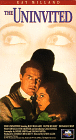
A brother and sister move into an old seaside house they find abandoned for many years on the English coast. Their original enchantment with the house diminishes as they hear stories of the previous owners and meet their daughter (now a young woman) who now lives as a neighbor with her grandfather. Also heard are unexplained sounds during the night. It becomes obvious that the house is haunted. The reasons for the haunting and how they relate to the daughter whom the brother is falling in love with, prove to be a complex mystery. As they are compelled to solve it, the supernatural activity at the house increases to a frightening level.
The first serious American ghost movie after
a succession of light comedies (usually with The Three Stooges or The Bowery Boys),
THE UNINVITED delivers solid '40s thrills in terms of restless spirits.
Ray Milland (soon to star in some of Roger Corman's better '60s efforts)
delivers a solid leading performance. Gail Russell was indeed a beauty
and the camera does a good job of showing off her large, pleading eyes.
Her kittenish demeanor brings to mind the lead in Val Lewton's excellent CAT
PEOPLE (1942).
The film suffers a bit from overly maudlin incidental music and cliched acting styles, but these were both par for the course in this decade. The leading actors are all likable and deliver fun quips, although the two romances that derive (quickly) out of the mystery seem contrived and forced. The cinematography is rather plain and uninvolving, bar the excellent location work, until the climax where shadows and light come to the fore to show off the excellent ghost effects, which still look eerily believable more than half a century later. This may have been intentional to heighten the unreal from the real. In Great Britain, all the ectoplasmic emissions were removed, due to that country's reluctance to show anything frightening after the great '30s UK horror ban. British critics at the time commended the film for creating an involving film without resorting to the cheap tactics of showing the ghosts!
Interestingly, a scene where one of the leads finds their footing collapsing under them, plunging them close to death at the edge of a sea looks more believable than a similar one in John Carpenter's expensive ESCAPE FROM L. A. (1996) more than 5 decades later!
(reviewed by Mike)
|
|
Singles |

Singles is an untraditional movie, with characters more down-to-earth than you might expect. Set in Seattle, Washington, the heart of the movie revolves around Campbell Scott's on-again, off-again relationship with Sedgewick. The movie also touches on the lives of the people around them, and there is where it truly succeeds.
Scott's character can be easily identified with...he is "everyman", just trying to get through life, work, and the pursuit of happiness. Sedgewick's character is like someone the viewer maybe went to school with, but hasn't talked to in a few years. As she and Scott get to know each other, we see that they're both not too different from the rest of us, as they relate ex-boyfriends, dysfunctional families, etc.
The supporting cast is just as important to this movie, however, and it's the rest of these people that set this movie apart from so many other "love story" flicks. Matt Dillon is a would-be rock star in local band Citizen Dick, and he's quick to remind people that they're really quite successful...in his own mind, that is ("We're huge in Belgium.") Bridget Fonda plays his romantic foil, and she is irresistible. She almost steals this movie, as she realizes that Dillon doesn't care about her nearly as much as himself or the band, and decides, with a shrug of her figurative shoulders, who needs him anyway?
Crowe expertly weaves these characters and sub-plots together, never once leaving the audience confused or lost, but gently guiding us. The men and women populating his version of Seattle are quirky, but still firmly believable, and it's this quality that pulls the audience into their lives until the closing credits. The movie is also sprinkled with some surprise appearances...watch the closing credits carefully for familiar names. And after the credits, they've also included three scenes that never made it into the finished movie. Look for this one, this is one of my favorites.
(reviewed by Mark)
|
|
The Stunt Man (1980) |
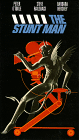
Although rarely shown on television and a with a 1987 videocassette release getting harder and harder to find at the local video store, Robert Rush's best work is a little-seen gem of a dark comedy, centering on how films and people's lives influence and change each other. Cameron is an ex-soldier on the run. He stumbles onto a movie location at a beach resort, and megalomaniacal director Eli Cross compels him to take the job of a stunt man, to replace one who earlier drowned in a dangerous stunt. While Cameron needs the cover offered by the job and begins to fall in love with actress Nina Franklin, he worries that the fate intended for him by Eli is the same as the fate suffered by his predecessor.
O'Toole's deserved Oscar nomination for best actor in the role of maniacal perfectionist Cross led to a revival of his career, which had begun to fizzle after LAWRENCE OF ARABIA (1962) brought him so much critical attention. Similarly, Hershey found herself with a reanimated career following this film. Railsback, previously seen as Charles Manson in the television movie HELTER SKELTER (1976) is suitably intense and gives a fine sense of bewilderment as he performs his duty as Cross' lab rat in increasingly dangerous stunts. The stunt setpieces are the second attraction of this film (after the grand performances). Enjoyably over the top and elaborate, they cast a bright, revealing light on Hollywood's reliance on spectacle, even more appropriate for the computer-guided summer films of the nineties.
The film is well-written with some truly outstanding and memorable lines, barring a real letdown of an ending, which refuses to diffuse the tension and implicit animosity between two of the main characters, leaving their awkward situation strangely unfinished. Also lacking is the use of Dominic Frontiere's rollicking Vaudevillian-style comedy piano score. Admittedly a black comedy, the music's placement still seems both out of place and overused, weakening scenes that would've worked fine without any incidental music at all.
(reviewed by Mike)
High and Low
dir: Akira Kurosawa
starring Toshiro Mifune
b&w
This is an incredible, edge of your seat movie, released over thirty years ago. For anyone who wants to try out one of Kurosawa's films, I highly recommend hunting down this one (I rented it at Thomas Video in Clawson) or Akira Kurosawa's Dreams, one of my top 5 all-time favorite movies.
This movie features a Kurosawa regular, Toshiro Mifune, as a businessman working in the management levels of a Japanese shoe company. The younger men moving up through the company want to make cheaper shoes that won't last as long, so their customers will come back sooner to buy another pair. He feels the opposite, however, and is sure that these inexperienced men will run the company into the ground. He has therefore been saving his money, squirrelling away here and there throughout the years, so he can make a move to buy a majority of the company's stock, and thus hold controlling interest. No one could have seen what would happen next.
His son is playing outside with his chauffer's son, away from the house, and he receives a phone call from a man claiming to have kidnapped his son. The man demands a ransom that Mifune can afford, but will completely wipe him out, and he won't be able to buy control of the company like he's wanted to for years. Just then, his son runs into the house, looking for Mifune's chauffer's son. It turns out that the chauffer's boy was kidnapped by mistake, and now Mifune must decide...it's not his son, and the ransom would practically bankrupt him, but if he were to ignore the kidnapper, he would be destroyed by the community that his company depends on.
I won't give away any more than that, because the movie takes some very clever twists (as you've already seen), and it's definitely worth sitting through. Mifune is a master in this art, and he expertly handles the complex emotions that this character is put through. It's an exceptional story as well; just when you think it's done, and everything is resolved, another wrench is thrown into these people's lives. I call this one "a roller-coaster ride of a movie!" See it!
(reviewed by Mark)