
TT BROWN SAUCER '58

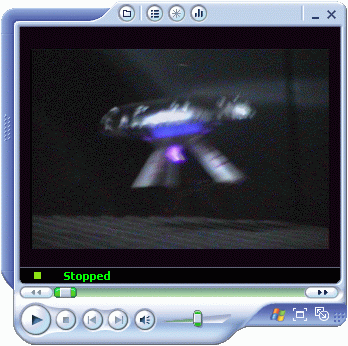
I have already made several different ones, but so far, this one is the only saucer that was able to liftoff vertically off the workbench. Its improvement over the previous saucers I made is it used a parabolic auxiliary electrode placed between the main electrodes. The configuration is supposedly one of the most efficient as claimed by TT Brown.

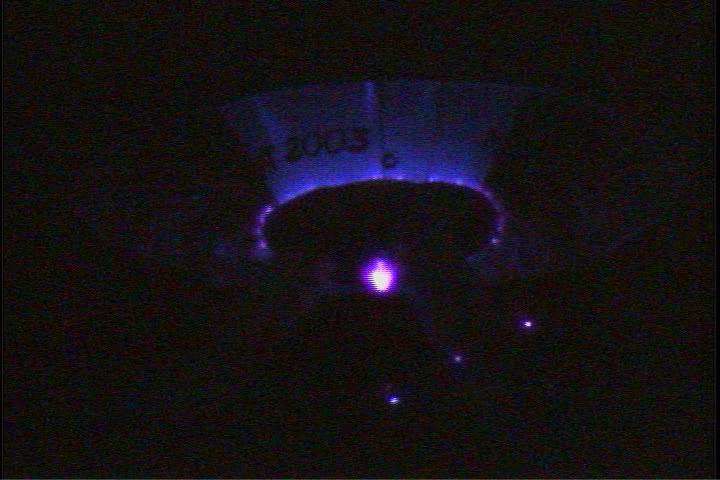
You'll see in the UFO58a picture a purple halo, this is the edge of the auxiliary electrode. The bright discharge at the bottom is the ions flowing from the negative electrode going to the auxiliary electrode. The positive arcuate is only seen in the video and in UFO58c picture. The bright blue glow between the auxiliary and and positive arcuate is the paper dielectric. Somehow, the ionization causes paper to glow blue. In all dielectrics I've used, like polystyrene, straw, and acetate, paper's the one that produced the strongest thrust despite its leaking current.

The level of brightness you've seen in the pictures as well as in the videos is real, not time exposed, digitally enhanced, or photomultiplied. Although the thumb picture that linked to this page is light enhanced using Bryce 3D so the arcuate edges as well as the landing gear is clearly visible see the thumb picture You'll notice there seems to be no tether cords, well, there is actually three, its dark in color and not noticed.

>>Click here to view video in Windows Media (r), .wmv format,  788 kb <<
|<<Home
<<Flying Saucers Page

>>Diagrams and Replication Tips in MS Powerpoint Click Here<<

|<<Home
<<Flying Saucers Page
>>Diagrams and Replication Tips in PDF file Click Here<<
The picture above is the very low light image of the saucer in the same position as the saucer image below.  The bright purplish glow below is the corona glow from the main electrode going to the auxiliary electrode (visibly surrounded as a halo by the purple glow).  The bluish glow just above the auxiliary electrodes is the paper dielectric.  The paper glows blue when high voltage electricity is passed through it.

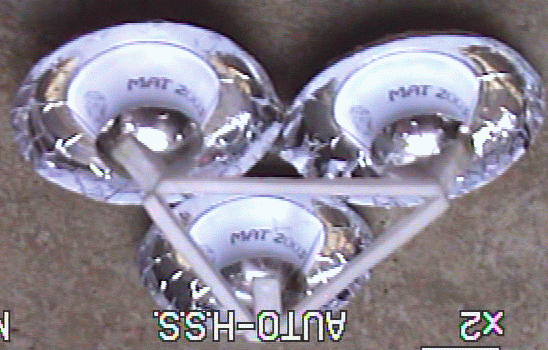
The picture below is just three of these saucers joined in the shape of a triangle.  The white styrenes below the saucer is meant for adding rigidity and for protecting the auxiliary electrode during rough landing.  The manner the saucers is positioned is meant for upward movement.  Its not stuck at the ceiling, its just placed upside down, then flipped the image vertically so its positioned correctly for upward movement. 

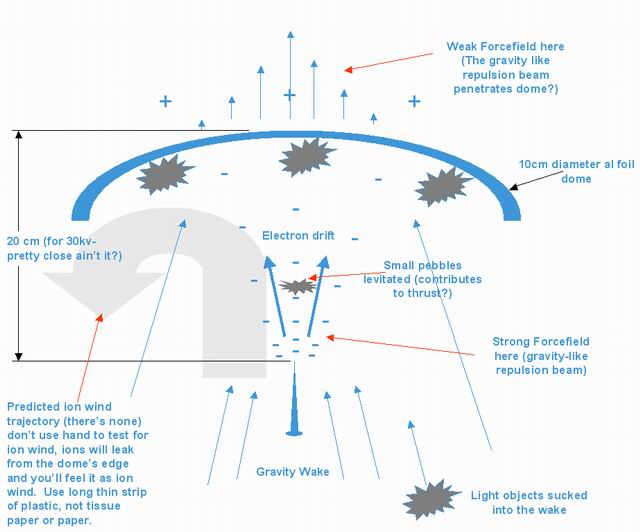
The diagram below depicts some of the experiments I did earlier with a simple TT Brown Saucer, and some of the results.