|
"Imagine this: an organic pill that kills the appetite and attacks obesity. It has no known side effects and contains a molecule that fools your brain into believing you are full." BBC NEWS, talking about Hoodia |
Natural herbal diet pills hoodia that stops the appetite
|
|
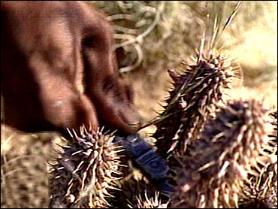
If you haven't heard of Hoodia yet, you soon will because it is being touted as the new miracle supplement for safe, effective weight loss. Hoodia gordonii, (Hoodia) is the botanical name for a cactus like plant that grows in Southern Africa. Scientists have recently isolated several compounds in this amazing plant that are responsible for dramatic weight loss. This all-natural appetite suppressant is also being applauded for containing no dangerous stimulants that caused adverse side effects associated with weight loss products of the last decade. Hoodia (or Hoodia Gordonii) is a South African dwelling plant that the San bushman have used to help endure long hunting expeditiions for generations. Hoodia Gordonii is actually a succulent not to be confused with a cactus. It belongs in the succulent family of Asclepiadaceae along with stapelia, stephanotis and vinca. There are approximately 20 species in the genus of Asclepiadaceae. As it grows it forms stemmed clumps approximately one foot high and bears, pale purple saucer-shaped flowers in shades of red or purple brown. Hoodia Gordonii is a leafless spiny succulent plant ( not a cactus ) with fleshly finger-like stems. Rows of thorns are present along the stems, bearing flesh coloured flowers. Hoodia Gordonii grows naturally in the harsh desert conditions of South Africa. Now Hoodia Gordonii has been found in the semi-deserts of Zambia, Zimbabwe, Botswana, Namibia, Angola, the Republic of South Africa, and now found in some other arid regions of South American Nations such as Chili, Peru and some regions of West China including Gansu, Sichuan and Shanxi. Real South African Hoodia is RARE and EXPENSIVE. It takes approximately 5 to 7 years for the Hoodia gordonii succulent to mature and provide appetite suppressant qualities. The African government has limited the amount of Hoodia it exports and the number of suppliers to receive it in the USA. Because of the growing awareness and popularity of this miracle herb, rip-off products that contain very little or no authentic Hoodia in them are beginning to flood the marketplace. The Hoodia Gordonii plant originated in the southwestern part of Africa and grows best in the semi-arid areas of South Africa primarily the Kalahari. In its native habitat it is extremely difficulty to identify because it looks similar to succulents of the same family of which there are many. Only an experienced botanist or as the case in South Africa with Hoodia Gordonii a San people can identify the plant prior to it's blooming. Hoodia pills are my life saver. I have a thyroid problem and this causes depression and weight gain. These pills take my hunger away so I can get back into shape and they make me happy, nice "side effect" ;-) Now my Doctor is taking them too! M S (Germany). Thank you, the second Hoodia Gordonii shipment arrived yesterday April 4, 2005. By the way Hoodia is working very well I lost 12 lbs or (5.5 kg) in 2 months. Not dramatic but then again losing weight slowly is the best way to go. At this stage I don't pay attention to carbohydrates, fats, sugars and other diet fads. Regards - G D B (USA) So you've bought a supply of hoodia, and now you want to know how to use it. To cover this, There are experience in using hoodia for weight loss. The optimal way is taking hoodia tincture every morning and afternoon. Easy enough, right? To understand how all this works, you have to understand what "hunger" really is in the first place. Hunger is just an illusion. It's a signal in your brain, a chemical message that causes you to feel certain feelings and, ultimately, act on them. Your body creates the illusion of hunger even when you're not really needing calories. And your body, like mine, doesn't know when to turn it off. The hunger signal is only turned off when your hypothalamus thinks you've eaten enough food. Your hypothalamus -- part of your body's endocrine system -- decides this by sensing the rise of sugar (glucose) in your blood. Eat enough carbohydrates, and your blood sugar rises, which convinces your hypothalamus to tell your brain that you're no longer hungry. Consuming hoodia is surprisingly simple: slice off a piece of the succulent, peel off the thorns, and just start chewing on it. You don't even need to swallow it. The taste is rather bitter by most Americans' palettes, but after several minutes of chewing, you've already started absorbing the chemical. Guess what? Your hunger is vanishing with each passing moment. The San Tribesmen, the original discovers of the plant, also say it makes you feel stronger, more energetic, and more focused. Nobody complains of any side effects whatsoever, and the plant has been chewed for literally thousand of years by various generations of the San, with no ill effects known whatsoever. Hoodia was eaten as a fresh food by the San tribe for thousands of years with zero side effects. There are no known adverse side effects as a result of taking Hoodia in conjunction with prescription medications and other herbal supplements. However, if you are presently using any prescription medication and are under the care of a physician, you should always consult your physician before taking any supplement medication. Hoodia Gordonii is famous for its effects as an appetite suppressant and mood enhancer. Excellent results have been reported from people using it as part of a weight loss program, leading to many international companies making and selling Hoodia as a "new miracle diet pill". There are 13 species of Hoodia which are native to Southern Africa but ONLY ONE variety - the "Gordonii" has the needed natural ingredients for weight loss. If you purchase the cheap imitation products sold by people out of their garage that you see on EBAY, and in the Google and Yahoo ads you will NOT have the results shown on the Personal Diet Results pages. Folks I have been through this over and over - read about the nineteen companies that have sent me Hoodia Gordonii Cactus products to test and how only a couple of them really work. Certainly any hoodia company out there that's selling an honest product is conducting a variety of testing, trying to find out who has counterfeit products and who has real products and trying to inform and educate their own customers about the fact that they have the real thing. But, as always, test results offered by companies who have financial interest in proving their product to be genuine simply don't carry the same weight as independent test results from an unbiased third company. To make matters even more challenging, Hoodia grown in South Africa under the San tribe's influence is required to be grown under organic conditions. That means they can't use pesticides. Entire crops have been known to vanish virtually overnight thanks to the ravages of various insects. All this means that if hoodia really catches on with the public -- the supply will be even tighter for many years. Prices are going to go up, and eventually, only the wealthy may be able to afford the pills necessary to lose weight. Scientists at the South African Center for Scientific and Industrial Research were the first to successfully prove that Hoodia contains a miracle molecule that suppresses the appetite. Later, a human clinical trial was conducted by scientists in Leicester England. A group of morbidly obese men and women participated. Half the group were given Hoodia and half were given a placebo. At the end of 15 days, the group on Hoodia had reduced their food intake by 1000 calories a day. Given the average daily diet is around 2200 calories, this was a stunning success. It has been established that the P57 molecule found in wild harvested Hoodia Gordonii works by mimicking the effect that glucose has on nerve cells in the brain in effect fooling the body into thinking it is full, even when it is not, thus curbing the appetite. Laboratory experiments show animals automatically restrict their food intake when taking hoodia orally. Rats, a species that will eat anything from meat and plants to indigestible fiber, lowered their dietary calorie intake to a degree that made them get thin when fed comparative amounts of hoodia.
Quality plastic surgery procedures and dental care at the Prague private clinic.
|