End-of-Course Test Study Guide: Part 1 of 7 (15% of Final Average!!!!)
Content Domain 1: Scientific Processes and Nature of Biology
1. List the steps of the scientific method, in order. Write a brief description of each step.
2. In the fish respiration experiment, what kind of data was collected; quantitative or qualitative? How do you know?
quantitative (we counted the breaths they took)
3. What is the independent variable? temperature of the water How do you know? we controlled it
4. What is the dependent variable? # of breaths per minute by the fish How do you know? it depended on the temperature
5. What are some controlled variables (constants)? same fish, same size container, same amount of water...
6. What is the difference between a conclusion and an inference? conclusions are explanations based on scientific data & observations. inferences are explanations of data based on facts but not on direct observations.
7. Describe when you would use the following types of graphs:
a. Line graph-shows how quantitative variables are related (numbers must form a continuum)
b. Bar graph-comparing groups in terms of one characteristic
c. Pie graph-showing percentages or fractions; parts of a whole
8. List some common tools used by scientists to make observations. microscope, electrophoresis equipment
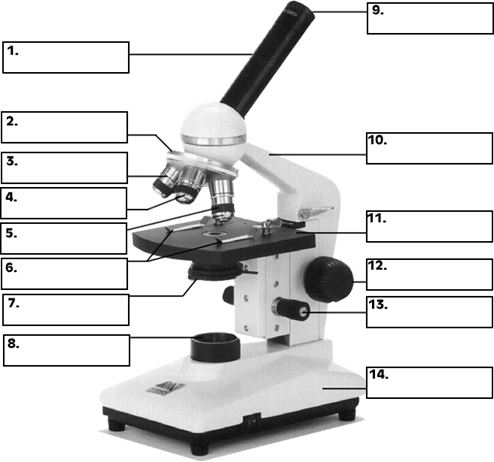
9. Label the parts of the microscope. What is the function of each?
1. eyepiece
2. revolving nosepiece
3. low power objective
4. medium power objective
5. high power objective
6. stage clips
7. iris diaphragm
8. light source
9. ocular lens
10. arm
11. stage
12. course wheel adjustment
13. fine wheel adjustment
14. base
a. Objectives- lenses that magnify specimen (multiply objective times eyepiece to get total magnification)
b. Coarse wheel adjustment- used first, only on low power! makes big changes; bigger knob.
c. Fine wheel adjustment- may be used with any objective, after coarse wheel has located specimen, to sharpen focus
d. Diaphragm- used to adjust the amount of light allowed through the stage opening
10. Metric System…complete the chart. Remember: K h D base d c m
|
Prefix |
Symbol |
Multiple of base unit |
|
kilo- |
k |
1000 |
|
hecto- |
h |
100 |
|
deka- |
da or D |
10 |
|
deci- |
d |
0.1 |
|
centi- |
c |
0.01 |
|
milli- |
m |
0.001 |
Convert the following:
a. 531 kg = 53100000 cg
b. 21 mm = 0.021 meters
c. 0.02 hl = 20 dl
d. 2 g = 0.002 kg
e. 2 g = 2000 mg
11. What is the metric unit for the following?
a. length meters b. mass gram c. volume liter
12. Common Safety Rules: When should goggles be worn? when working with acids/chemicals, flame, or glassware When should you wash your hands? after every lab
13. What is the subject of each of the following branches of biology?
a. Botany plants
b. Ecology how organisms interact with each other & their environment
c. Genetics study of heredity
d. Microbiology study of microscopic organisms
e. Taxonomy study of classification
f. Zoology study of animals
14. List the 8 levels of classification in order from most broad to most specific. Domain, Kingdom, Phylum, Class, Order, Family, Genus, Species (Desperate King Philip Came Over For Great Spaghetti)
15. The scientific name for humans is Homo sapiens or Homo sapiens (write it properly).
16. Humans would be most closely related to organisms with the same (D K P C O F G S).
17. Complete the following Kingdom Chart
|
Kingdom |
Main characteristics |
Examples |
|
Archaebacteria |
unicellular, prokaryotic, heterotroph or autotroph, lives in harsh environment (& everywhere else) |
methanogens, halophiles |
|
Eubacteria
|
unicellular, prokaryotic, heterotroph or autotroph, cell walls contain peptidoglycan |
E.coli, Streptococcus |
|
Protista
|
usually unicellular; eukaryotic; algae are autotrophs; protozoa are heterotrophs |
Amoeba, Paramecia, Volvox |
|
Fungi
|
usually multicellular; eukaryotic; heterotrophs (decomposers) |
yeast, mushrooms, bread mold |
|
Plantae
|
always multicellular; eukaryotic; autotrophs (photosynthetic) |
grasses, trees, flowers, fruits, vegetables |
|
Animalia
|
always multicellular; eukaryotic; heterotrophs |
insects, sponges, squirrels, jellyfish |