End-of-Course Test Study Guide Part 2 of 7 (15% of Final Average!!!!)
Content Domain 2: Cellular Basis of Life
1. List the 3 parts of the cell theory: a. cell is the basic unit of life; b. all organisms are composed of cells; c. all cells come from pre-existing cells.
2. List the characteristics of living things:
a. Made of cells
b. Require food for energy to carry out life processes
c. Respond to stimuli in their environment
d. Reproduce offspring
e. Growth and develop
f. Maintain homeostasis; a balance of internal conditions
g. Have and pass on a genetic code
3. A unicellular organism has to perform all metabolic activities within one cell.
4. A multicellular organism has specialized/differentiated cells that perform certain jobs.
5. In multicellular organisms, a group of related cells makes up tissues, which makes up organs, which are grouped into organ systems, which work together to make up the organism.
6. A prokaryotic cell does NOT contain a nucleus or membrane-bound organelles.
7. A eukaryotic cell does have a nucleus and other organelles.
8. Passive transport does not require energy. There are 3 examples:
a. diffusion- movement of materials from high to low concentration.
b. Osmosis- movement of water from high to low concentration.
c. Facilitated transport- movement of materials from high to low, with the help of a transport protein.
9. Active transport does require energy input from the cell because materials are moving against the concentration gradient, from low to high.
10. Large particles may be engulged into the cell by endocytosis; while they are removed from the cell by exocytosis. Both of these require energy.
11. If a cell is placed in a hypertonic solution, water will leave the cell, causing it to shrink. Remember, water also goes from high to low.
12. If a cell is placed in a hypotonic solution, water will enter the cell, causing it to swell/burst.
13. If a cell is placed in an isotonic solution, there will be no net movement of water because dynamic equilibrium has already been reached.
Label the following solutions as hypotonic, hypertonic, or isotonic. Use arrows to indicate the direction water will move.
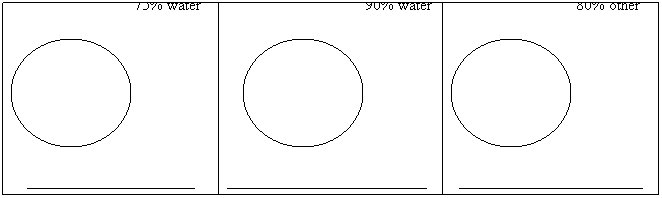
hypertonic (water leaves) hypotonic (water enters) isotonic (water moves both directions equally)
Match the organelle with its function.