End-of-Course Test Study Guide Part 4 of 7 (15% of Final Average!!!!)
Content Domain IV: Genetics and Patterns of Change
1. The 3 stages of the cell cycle are interphase, mitosis, & cytokinesis.
2. Interphase is the longest phase. What 3 things happen during this phase?
a. G1: cell grows
b. S: DNA is replicated
c. G2: cell prepares to divide
3. Mitosis is the division of the nucleus in eukaryotic cells.
4. Cytokinesis is the division of the cytoplasm.
5. The two resulting cells are identical and are called daughter cells.
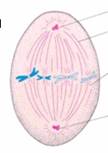
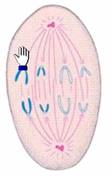
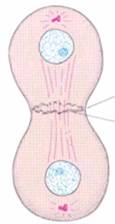
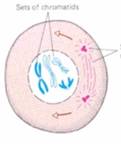
6. The four phases of mitosis are (include a description of each):
a. prophase: duplicated chromosomes become distinct & spindle fibers radiate across the cell
b. metaphase: duplicated chromosomes line up randomly in the center of the cell between the spindles
c. anaphase: duplicated chromosomes are pulled to opposite ends of the cell. The number of chromosomes at each end will be the same as the original number
d. telophase: a nuclear membrane forms around the chromosomes at each end of the cell. spindle fibers disappear and the chromosomes disperse and become less distinct.
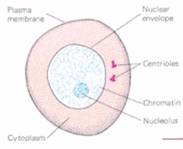
Label the following diagrams and put them in order.
metaphase anaphase telophase prophase interphase
Order: interphase, prophase, metaphase, anaphase, telophase
7. The difference between animal cell division and plant cell division is animal cells pinch in and separate, but plant cells have cell walls that are too rigid to pinch, so a cell plate forms to divide them.
8. Cell division is necessary in order for a cell to reproduce for growth and repair.
9. Mitosis makes diploid cells, which means there are 2 of each chromosome (pairs). In humans, these cells have 46 chromosomes. Since the 2 chromosomes in the pair are similar, they are referred to as homologous.
10. Meiosis is how sex cells are formed (also called gametes). They have half the number of chromosomes and are therefore referred to as haploid cells.
11. In meiosis, 4 cells are formed, all of which are different. In egg production, only 1 egg forms, along with 3 polar bodies. It makes 4 sperm.
Genetics
12. Genetics is the study of heredity. The father of genetics was Gregor Mendel, who did his research on pea plants.
13. A characteristic a person receives from his/her parent is a trait. The instructions for them are carried on genes, which are found on chromosomes.
14. A person gets one gene for each trait from each parent. The alternative versions of genes are known as alleles. If the two alleles are identical, the pair is homozygous, if the pair is different, it is heterozygous, or hybrid. The combination of alleles is called the genotype, while the physical appearance is the phenotype.
15. The allele that shows up is dominant, while the one that is hidden is recessive.
16. Mendel’s work is summarized in 3 laws:
a. Law of Dominance: the dominant allele will prevent the recessive allele from being expressed. The recessive allele will appear when it is paired with another recessive allele in the offspring.
b. Law of Segregation: gene pairs separate when gametes are formed, so each gamete has only one allele of each gene pair.
c. Law of Independent Assortment: different pairs of genes separate independently of each other when gametes are formed
17. A genetic cross involving only one trait is a monohybrid trait. If it involves 2 traits, it is a dihybrid trait. The cross is done on a Punnett square.
18. Black fur is dominant to white fur in rabbits. If a heterozygous rabbit is crossed with a white rabbit, what will the genotypic and phenotypic ratios of the offspring be?
Bb x bb B b
 Genotypic ratio: 50% Bb, 50% bb
Phenotypic ratio: 50% black, 50% white b
b
19. The sex chromosomes in males are sperm, while females have eggs.
20. Some traits are carried only on the sex chromosomes. These are called sex-linked, or X-linked traits. Usually, they are on the X chromosome, so are more common in males since males only have one X chromosomes.
21. During meiosis, homologous chromosomes may cross over, resulting in a new combination of genes.
22. Changes in the genetic code of an organism result from mutations, which may be spontaneous or caused by a mutagen.
23. Sometimes during meiosis, homologous pairs do not separate, so the resulting sperm or eggs will have either one extra or one missing chromosome. This is called nondisjunction and can lead to genetic disorders called trisomy or monosomy. An example of a trisomy of the 21st chromosome is Down Syndrome.
24. Genetic engineering has lead to many advances in medicine and agriculture. Bacteria have been produced that can make insulin, thanks to recombinant DNA.
25. When a species changes over time, it is referred to as evolution. This occurs due to natural selection. This theory was proposed by Charles Darwin.
26. According to natural selection, organisms that are more suited to their environment will survive and reproduce, therefore passing on their traits.
27. Evolution that occurs within the species level is called microevolution.
28. Evolution that occurs between different species is called macroevolution.