



|
Mohacs 1526 |
|
Suleiman' life in the early days of his reign alternated between going to war and spending time in the Topkapi Palace. It had been three years since the victory at Rhodes and the indolence of life in the Palace must have been a powerful reason to put off the austerity of life on campaign; or so the Janissaries reasoned. While the inactivity may have suited Suleiman, the Janissaries were becoming increasingly bored and restless with life in Constantinople, and denied the comforts of domesticity while trained specifically for war and nothing else they were always anxious for the next adventure. Despite Suleiman's fiercesome reputation they were never slow to express their displeasure and on this occasion they vented their anger on senior officials and the Jews, plundering and vandalising their residences. a small band of the more volatile warriors forced their way into Suleiman's living quarters where it is said that he killed three of them y his own hand before withdrawing into a safer part of the Palace. The revolt was suppressed and the leaders were executed but the point had been made and in 1525 preparations began for yet another excursion into mainland Europe. Once again Hungary was the object of Suleiman's wrath, ostensibly to suppress the sporadic fighting on the border, but in reality Suleiman never needed much of a reason to attack a Christian country and the surrounding countries trembled accordingly. |
|
In April 1526, The Turkish forces numbering 100,000 men and 300 cannon marched out of Constantinople with Suleiman at it's head and Ibrahim at his side and once again Hungary appealed for help from its Christian neighbours who as always were otherwise engaged. Once again Hungary found itself to be isolated and alone, preparing a hopelessly inadequate defence for the forthcoming assault by the formidable Turkish army. Strangely, all of Suleiman's campaigns into mainland Europe were always in late Spring and were always marked by abnormally bad weather at a time of the year when it would have been expected to be perfect and this campaign was no different with torrential rain and floods slowing the march. |
|
It took until the middle of July until they entered into enemy territory but by the time the Janissaries came to a city called Peterwardein they were thirsting for a fight. Ibrahim was at the head of the force of Janissaries who forced their way through the outer fortifications of the city but encountered stern opposition at the walls of the inner citadel. The defenders were few but held on stoutly and resolutely throughout two weeks of incessant Turkish attacks. The mining skills of the Turkish engineers finally decided the battle by blowing two great holes in the walls of the citadel through which the Janissaries gleefully poured through, slaughtering what remained of the gallant garrison. Ibrahim arranged a gruesome victory celebration in which 500 heads on pikes were exhibited to a delighted Suleiman. |
|
The rain was still falling in torrents when the Turkish army arrived at the swollen River Drave which they were astonished to find completely undefended. Bridges were thrown up and the Ottoman hordes poured across a natural defensive position which had been totally overlooked by the Hungarian forces. |
|
The aristocratic King Louis of Hungary had gathered a force of largely Hungarian noblemen and chose to make a stand at a place called Mohacs to the south of Buda further compounding his previous tactical errors. On the face of it, his stand appeared to be quite heroic but in reality it was foolish in the extreme as Louis must have known that reinforcements numbering 20,000 men with John Zapolya at their head were approaching from the north. The sensible thing to do would have been to retreat in the direction of Buda and meet up with Zapolya but it seems that Louis was arrogant and misguided enough to believe that his army alone could defeat the Turks and prove forever the superiority of the Magyar nobility. |
|
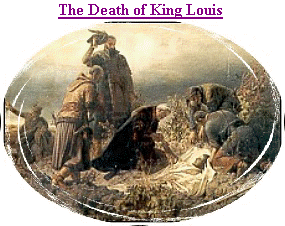
The two armies came face to face in August 1526 with the Hungarians outnumbered 4 to 1and composed mainly of heavily armoured cavalry which was an anachronism even in those days. The God of battles must have thrown down his sword in despair when he saw Louis' tactics which made the yet-to-be-performed Charge of the Light Brigade appear sensible. Throwing caution to the winds and abandoning any semblance of defence, Louis drew his cavalry up line after line and thousands of armoured Knights, the cream of Magyar nobility, formed up on huge mounts to attack the Turks. |
|
Followed by an army of infantry at the run, they thundered down upon the Turkish ranks organized by the capable and intelligent Ibrahim. At first it seemed that the lunatic charge had succeeded as the horses and riders trampled through the centre of the Turkish forces and at one stage up to the tent of Suleiman himself but Ibrahim had ordered the Turkish centre to give way deliberately and the line parted allowing the horsemen to gallop through unimpeded. It soon became apparent that the charge while glorious had achieved little but effect and the cavalrymen found themselves surrounded by Turkish artillery which mowed them down like skittles. An army which displayed the heads of their victims had little compunction on massacring a helpless enemy and the Hungarian army perished en-masse. |
|
|
|
Suleiman's diary for that day recorded laconically ; |
|
" August 31. The Emperor seated on a golden throne receives the homage of the viziers and beys ; massacre of 2,000 prisoners ; the rain falls in torrents. September 2. Rest at Mohacs ; 20,000 infantry and 4,000 heavy cavalry are buried". |
|
Mohacs has been described as " The tomb of the Hungarian nation " and became a part of the Ottoman Empire for the next 150 years. |
|
Suleiman went on to appease the Janissaries with the sack of Buda and Pesth and returned like a Roman conqueror to Constantinople with thousands of slaves and 2 cannon captured from Mehmed the Conqueror 70 years earlier. |
|
The Siege of Vienna 1529 |
|
Soon after the humiliation at Mohacs the Hungarian nation had another problem to contend with when Ferdinand of Austria sensed an opportunity to step in and annexe Hungary to Austria. The diplomatic preliminaries were quickly dispensed with when Ferdinand sent forth an invading army which defeated the seriously weakened Magyar forces in battle after battle and Hungary was on the way to becoming a satellite of the Hapsburg Empire. The factions represented by John Zapolya were astute enough to foresee the inevitability of a struggle between Austria and Turkey and were justifiably fearful that Hungary would be the arena where that struggle would take place. In anticipation of this probability, John Zapolya sent his representatives to Constantinople and successfully exacted a promise from Suleiman that the Turks would support him in any forthcoming battles against the Austrians. The ambassadors sent by Ferdinand on much the same mission did nothing but reinforce Suleiman's opposition to the Hapsburg claims for Hungary. Arrogantly, they had demanded the immediate withdrawal of all Turkish forces from Hungarian soil and went on to insult Ibrahim who was representing Suleiman as usual. When it came to arrogance, Suleiman had no peer and the Austrian ambassadors were thrown into prison and Suleiman prepared for war. |
|
In the Spring of 1529, Suleiman marched out of Constantinople at the head of the largest Ottoman army yet assembled; 250,000 troops and 300 cannon set out on the 800 mile journey to Vienna. As ever, the campaign was marked by incessant rain but this time it was far worse than anything they had previously encountered and despite it being the month of May it was also freezing cold. The army suffered greatly as day by day they struggled to march in sodden clothes along roads turned into quagmires by the numbers of men and animals and cannon passing along them. Medieval roads were little more than dust tracks at the best of times but the constant deluge and passage of the army transformed them into a glutinous mud which slowed them to a crawl and in the process led to many casualties through fatigue and accidents and it was not until mid-July before the army reached the scene of their geat victory at Mohacs. John Zapolya was waiting to greet the Turks and he kissed the hand of Suleiman in supplication pragmatically accepting his role as vassal to the Emperor of the Ottomans. |
|
The constant downpours had become a major factor in this campaign and as Suleiman ploughed through the mud on the road to Vienna, the garrison were granted more time to shore up their defences. Suleiman's late arrival also allowed 8,000 German reinforcements to enter the city - a welcome morale booster for the defenders which would never have happened had the Turks been able to move faster. The additional troops went to make up a total contingent of 20, 000 defenders with 72 cannon facing the might of the Turkish army. The differential in forces was not quite as daunting as it may have first appeared ; the defenders were under no illusions as to what their fate would be should the city fall and consequently were more resolute than ever to defend the city ; many of the defenders were experienced mercenaries who were no strangers to battle ; and again the weather had been an Austrian ally causing most of the Turkish cannon to be abandoned all the way from Constantinople to the walls of Vienna. |
|
|
|
Two days after they left Vienna it began to snow and the journey back to Constantinople was in the nature of a "retreat from Moscow" with cold and hunger prevalent and many lives were lost crossing freezing rivers and fighting exhaustion. During the march to Vienna discipline had been strong and any attacks on the local populations they passed through had been relatively small but the opposite was true on the return journey and their were many atrocities as all discipline broke down and the frustrated and angry Janissaries plundered and raped throughout the whole of the return march. Such were the intensity and numbers of these barbaric actions that from that time onward the very name "Turk" became synonymous with fear and hatred and while the details of that march have been largely lost in time the folk- memory still lingers even after hundreds of years. |
|
It is open to debate as to whether Suleiman truly believed he was victorious at Vienna but he certainly counted it as a victory and returned in triumph to Constantinople. Perhaps he was unable to face the real truth which was that after a decade of resounding and spectacular victories Suleiman had encountered his first defeat. |
|
The siege of Vienna 1529, is generally acknowledged as one of the defining battles between Islam and Christianity and it is open to conjecture as to what the map of Europe would look like today if the tide of Islam had not washed up and spent itself at the gates of Vienna. |


