

magnanimity in allowing the shattered remnants of the Knights to leave would
ever have any repercussions in the future. Among those Knights was a future
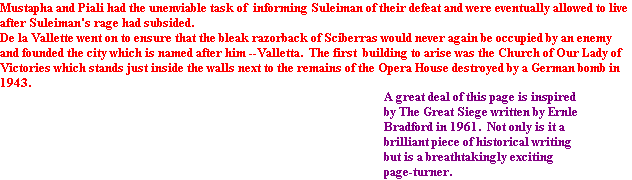
Grand Master, Jean Parisot de la Vallette, one of the most remarkable men of
his era and destined to become Suleiman's nemesis. He was 28 years of age at
the siege of Rhodes and when Suleiman decided he would come to terms with the
Knights once more, la Valette was 70 and the Grand Master in Malta. In the
intervening years, la Valette's whole life had been dedicated to the Knights of St
John and in retrospect his whole life experience had been a preparation for the
trials he would face at the Siege of Malta. He served in every capacity that the
Order had to offer, having the distinction of becoming General of the Fleet and
the ignominy of being a Turkish galley slave for a year where he added Turkish
to his other four languages. It was as a galley slave that he first came across
Suleiman's admiral, Dragut, who sympathised with his downfall { years later
when la Valette had been returned to service the roles were reversed and
Dragut found himself a galley slave in the Italian fleet } and intervened to ease
his plight. It is difficult to comprehend how such an intellectual as la Valette
could have survived the hardships of life in the galleys but it is a measure of the
man that the Turks were to come up against in Malta.
Charles 1st, King of Spain, granted them the island of Malta for the sum of one Maltese
falcon to be paid each year and in 1830 they took up residence in their new home. It has
to be said, that after the lush greenery of Rhodes the island of Malta was distinctly
unappealing; it was small and very hot and the land was arid. Nevertheless, the Knights
struck up a cordial relationship with the Maltese { which would prove to be vital during
the days of the siege } and the distinctive auberges and churches and fortresses which
were always evident wherever the Knights settled, began to spring up.
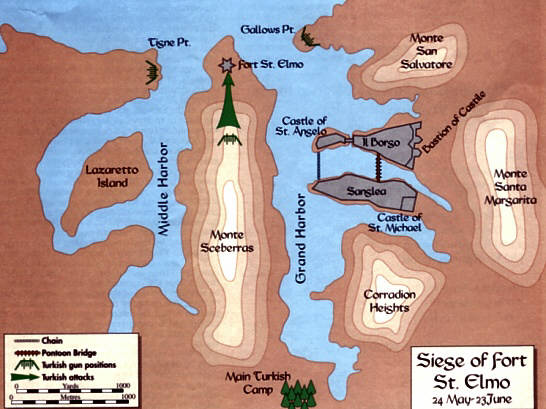
Sciberras, Fort St Angelo { Borgo} across the harbour and Fort St Michael { Senglea } next to it. Suleiman's forces
were faced with not one fortress but three.
base for sheltering their carracks and galleys and raiding the Mediterranean shipping as they had always done.
Expert sailors, the Knights and their Maltese allies soon became the scourge of the seas once again and their
temerity in attacking Turkish ships, as before drew the attention of Suleiman. The corsair, Dragut, who had raided
the islands many times advised that there would be little difficulty in subduing the Knights and it was on this
recommendation that Suleiman set out once more to rid himself of this thorn in his side. Suleiman did not take part
in the expedition and the fleet of 200 ships carrying 30,000 men was led by Admiral Piali Pasha who commanded the
navy and Mustafa Pasha in charge of the ground forces - the differences between these two would lead to frequent
disagreements which had grave repercussions during the battle.
particular the battle for the fort of St Elmo are up there with the
Alamo and Rorke's drift for courage and tenacity in the face of
overwhelming odds. The Turkish intention was to capture St
Elmo which was expected to fall easily and swiftly and then take
each of the other forts in turn. The stubborn resistance offered by
the defenders of St Elmo took away much of the impetus of the
Turkish attack and gave them pause for thought at the task they
had undertaken.
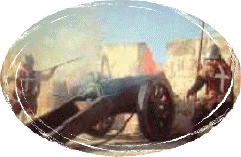
the attack upon St Elmo, reasoning that with the fort in Turkish hands his fleet could safely anchor in the adjacent
harbour of Marsamuscetto { Middle Harbour }. On the face of it, his plan seemed to have merit but it was prompted
purely from the viewpoint of a sailor and gave no thought to the army who were obliged to drag all their siege
equipment all of the five miles from the anchorage and over the rocky hillside up to the craggy Sciberras razorback.
Eventually, the heights of Sciberras swarmed with Turkish soldiers setting up barricades { sacks filled with soil
were dragged up the hillside as the ground was too hard to dig }and their formidable array of artillery consisting of
cannon capable of hurling solid stone balls weighing between 60 pounds and a massive 160 pounds in size. Mining
was not an option due to the solid rock of the hillside and attack from the sea was out of the question as the seaward
walls of St Elmo stood on sheer cliffs which were virtually unscaleable. The attack would then be based upon the
massive artillery to hand, followed by waves of troops and on May 24th, 1565 the Turkish guns opened up on St Elmo.
this with 400 enlisted men arrived from Messina and a force of 64 Knights who volunteered their services. The
initial bombardment had a devastating effect on the stone walls and as the masonry was knocked down in the day, the
garrison built new ones within the original by night, slowly retreating more and more within the fort. Predictably,
the Turkish Pashas were prodigal with their manpower and wave after wave of troops were beaten back from the
gaps in the walls with the defenders using the dreaded Greek fire to good effect. After 5 days of incessant attacks
the defenders caused wholesale panic in the Turkish ranks when they actually came out of the fort on the attack.
The front-line Turkish forces, unused to such boldness fled in panic closely followed by the Christians who were
killing indiscriminately as they went. Up until this point the Janissaries had been held back but Mustapha now
realized that without their intervention the panic could easily turn into a rout and so for the first time in 43 years
the Knights of St John and the Janissaries came face to face in battle -- warrior monks versus Moslem Spartans.
Slowly, the smaller force of Christians was forced back to within the walls of the fort where they let loose a final
withering fusillade at the oncoming waves of Muslims and after giving the Turk a bloody nose they returned to the
embattled fortress.
famous corsair Dragut. The first that the defenders knew of his approach
was when the whole of the Turkish fleet sailed past St Elmo firing a salute
to Dragut and his 15 ship fleet and at the same time killing several
gunners on Sciberras with erratic cannonballs which overshot the fort.
After his tumultuous welcome Dragut landed at nearby St. Julians Bay
and conferred with the Turkish commanders.
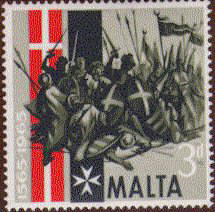
of those years his exploits throughout the Mediterranean had made him a
legendary and iconic figure. The life of Dragut is too long and his
adventures too numerous to recount here but he was not called The Drawn
Sword of Islam without good reason. Suleiman's instructions to Mustafa
and Piali were to defer to Dragut in all things and his arrival was at once
inspirational and galvanic to the Turkish forces.
employed and his words were reinforced by the destruction of a Turkish battery via a cavalry attack from Medina on
the day that he landed. Dragut was emphatic in his view that it was a mistake to attack St Elmo from the outset but
having embarked on such a course it was too late to turn back and the only thing to be done was to destroy the fort as
quickly as possible and adopt a new plan of campaign. He quickly saw that the only point of attack was coming from
Sciberras and at once ordered a battery sited on Gallows Point and another on Tigne Point { now Dragut Point } so
that the fort was forced to defend on three sides; more cannon were moved up to join the existing battery and
ominously the Janissaries were ordered to take the outer curtain of St Elmo as a matter of urgency. The latter order
was achieved far easier than anyone envisaged when a Turkish patrol exploring the battered ravelin found in the
early dawn that the small number of defenders had fallen into a sleep of utter exhaustion. The Janissaries were
called upon to attack immediately and the defenders of the ravelin were slaughtered to a man. From this vantage the
Janissaries then ordered an all-out attack against the fort and after a fierce fight the use of Greek Fire settled the
issue with the attackers falling back once again. A measure of the lengths the Turks were prepared to go was the
loss of 2,000 men for the deaths of 90 defenders in this one attack alone.
Angelo each night by boat and he was well aware that St Elmo had exceeded by far any reasonable expectation of holding
out against the Turks. The fort was reduced to little more than a pile of rubble when a delegation of the besieged
Knights sent a letter to the Grand Master to say they were at the point of exhaustion and asked permission to sally
forth from the fort in a final charge and be relieved of the incessant bombardments. It is not clear whether de la Valette
was sincere in his reply --- there is a feeling that it was a ploy, but he replied that he would send a force of volunteers in
their place and they were to return to St Angelo immediately. The response from the Knights was that they would
remain and retain their honour even though they were well aware that it was a virtual sentence of death.
fort was bleeding the Turkish forces grievously and he was determined that the taking of the fort would cost them dear.
the Turks; firstly the Aga of the Janissaries was killed and worse again
Dragut was mortally wounded by shrapnel whilst setting up the battery
which would finally reduce the fort.
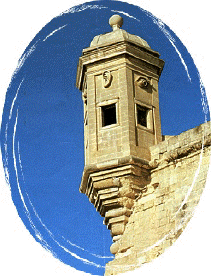
reinforcements in the final days - even de la Vallette was pragmatic
enough to realize that the fort was now doomed. The last four days were
spent in hand-to-hand fighting with each succeeding day depleting and
exhausting the defenders more and more. Surrender was never an option
and as the Janissaries swarmed through the walls on the final day the
able-bodied and wounded fought until the bitter end.
Pasha was heard to say ;
pay for so large a father ?"
theChristian Knights to crucifixes and floated them across Grand Harbour and in
the same spirit de la Vallette reciprocated by decapitating his Turkish prisoners
and firing the heads across the water into the Turkish camp.
Dragut's lead they set up batteries on Sciberras, Corradino Heights and Gallows Point from which three vantages they
set up a devastating fusillade upon the forts. As usual de la Vallette had been busy also and had ordered wooden stakes
to be driven into the sea-bed from Senglea around to St Michaels and cables fastened to the stakes making an attack
from the sea difficult. In conjunction with this, there was a Great Chain from the boats of the Order slung across from
St Angelo to Senglea preventing access to Dockyard creek. The work was not in vain because as soon as the initial
bombardment had ceased Mustapha Pasha's first attack came from boats sailed across Grand Harbour onto the weakest
of the forts at Senglea. The boats stuck on the cables and the Turks were forced to disembark in the sea where many
drowned or were picked off easily by the defenders. Despite heavy losses the attackers eventually formed up on the
small beach-head and heavy fighting took place. At one stage it was feared that Senglea would fall right at the start but
de la Vallette's foresight was once again vindicated when a bridge of boats he had ordered to be stationed further to the
rear of Dockyard creek enabled reinforcements to race across and reinforce the defenders. Throughout the
forthcoming battle the intention was that Senglea was always to be reinforced at any given time in the same way that St
Elmo was always fortified.
and this was graphically illustrated when Mustapha Pasha gathered together a flotilla of ten boats each containing 100
picked men and ordered them to land at Senglea Point. The 5 gun battery hidden at the base of St Angelo could hardly
believe their good fortune and proceeded to blow the Turkish boats to smithereens - just one boat straggled back to
Sciberras and the unfortunate Janissaries who did not drown were killed as they came out of the water.
prodigious rate and so he reverted to yet another bombardment and for the following 6 days the forts were subjected to a
constant rain of cannonballs. The inevitable Turkish attack followed and this time instead of concentrating on the
weaker St Michaels Mustapha Pasha decided that if he attacked both forts in unison then one would be unable to
reinforce the other. At fort St Angelo, as fast as the cannonballs had been knocking down the walls the Turkish
prisoners had been forced to build them up again but not in the same place --- just a few hundred yards within the
damaged outer walls. So that when the Janissaries came on in their massed attacks they penetrated the outer walls and
ran on to find themselves facing a new wall from where a withering fire slaughtered them in their thousands.
would fall. The fighting was as fierce as any that had gone before but little by little the Turks began to infiltrate the
fortress and to the dismay of the watchers at St Angelo here and there the Turkish banners began to be raised. The
defenders were slowly being overwhelmed and it was inevitable that the fort would fall at any moment. It was at this very
point in time that Piali and Mustapha's original tactical mistakes came back to haunt them once again and the shade of
Dragut the corsair must have wrung his hands in despair. On the very cusp of victory the Janissaries were astonished
to hear the signal to retreat and the whole full-scale assault faltered and then shuddered to a halt and as the recall
became more insistent they realized that it was no mistake and retreated accordingly. They later found the reason for
the recall; while the battle was taking place, the unguarded Knight's citadel of Medina had formed up a cavalry unit and
massacred the defenders of the Turkish base camp destroying everything as they went. Yet another defining moment in
the siege had been detrimental to the Turkish cause.
the bastion of Castile which was the landward side of St.Angelo. For once the
Turkish sappers had been able to dig beneath the walls and following a gigantic
explosion, the Janissaries poured into the breach in a human wave of frustrated
fury, planting their standards as they went. The furthest point of St Angelo had
been breached and the defenders initial instinct was to withdraw into the safety
of the fort but de la Vallette would have none of it. He realized that the Turks
had their foot in the door and it was imperative that they were removed from the
shattered bastion and donning his armour he led the attack to expel the Turks
from their vantage point. The attack was successful and led to the Turks
ending up back where they had started and the walls being rebuilt once again
but de la Vallette was injured in the leg and as at St Elmo the defenders of St
Angelo were beginning to feel wearied by the incessant attacks.

Catholic Church led to the
dissolution of the English Langue. As
a result only one English Knight and
two gentlemen adventurers were
present at the siege. Sir Oliver
Starkey was at de la Vallette's side
throughout the battle and they are
side by side still in the crypt of the
Cathedral in Valletta.
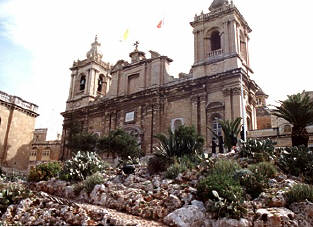
The Turkish
army then disembarked at Mellieha Bay and
faced the Christians on the plain between Medina and the
sea. Mustapha had badly misjudged the mood of his men
and the fresh troops slaughtered the weary Turks
pursuing them into the surf as they fled into their
galleys.