|
Istanbul |
||||
| .Istanbul
is often described as 'the crossroads of Europe and Asia', a heaving
bazaar-city of camels, carpets and caravanserais. Such a geographical
description is accurate in that this metropolis of 15 million occupies
both sides of an east-west land bridge divided by the 32km (20-mile)
Bosphorus Strait, which also connects the trade routes of the Black Sea
to the Sea of Marmara and the Mediterranean. As a result, the city has
been a jealously guarded centre of world trade since the Byzantine era,
when its silks, religious artefacts and luxury goods were the envy of
all empires. Protected by water on three sides, Istanbul was also the
ideal military watchpoint, with the natural harbour of the Golden Horn
nestled within the city perfect for hiding an entire fleet of warships.
Because of its advantages as fortress, port and commercial crossroads,
it is not surprising that Istanbul's imperial history stretches back for
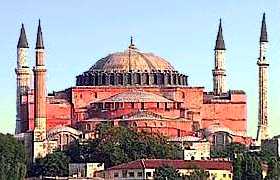
more than 1500 years. Even after Constantinople fell to the Ottoman Sultans in 1453, the city remained a worldwide distribution point for valuable spices and textiles brought via the 'Silk Road' from as far away as China. To this day, it is Turkey's economic capital and biggest trade centre, home to nearly half the country's wealth. Such a prime position, however, has meant that Istanbul has suffered from frequent sieges and its heritage constantly threatened as it changed from a Hellenic outpost to New Rome, the world's first Christian capital, then became the seat of the world's biggest Muslim Empire. It was coveted and even occupied by the Allies in World War II and today still suffers from the strains posed by an identity both eastern and European. Fragments of this varied architectural inheritance are visible. Although most were recycled - for example in the Basilica Cistern - some classical columns still stand in Gülhane Park yet only a few floor tiles remain from the once-huge Byzantine Great Palace. Most sections of the Theodosian Walls, which protected the city for centuries until it finally succumbed to Mehmet the Conqueror, are still standing and being restored. Mehmet resisted desecration of many Byzantine structures and many fine churches, most significantly Haghia Sophia, were simply rededicated to Allah, which helped to preserve them. Visitors may be confused by this jumble of Byzantine, Ottoman and modern buildings and it may seem that the general population has scant regard for the past - some Islamic extremists have even tried to write Christian Constantinople out of Istanbul's history. Furthermore, rapid industrialisation has drawn thousands of rural poor to the metropolis, resulting in a vast social gap between 'native' Istanbullites and the newer arrivals. Istanbul's growth rate is currently treble the national average, with no sign of abating. In contrast to the rest of the population, a wealthy elite - about 25% - live in the newly built suburbs, preferring a glamorous, cosmopolitan lifestyle to crumbling antiquities. Indeed, the sophistication of Istanbul's café society, the designer shops, thriving nightlife (over 60% of Istanbullites are under 25 years old) and vibrant contemporary cultural life may all surprise the visitor. By the end of 2001, however, Turkey's economy had reached its worst crisis since the republic was formed in 1924. The August 1999 earthquake, corruption scandals, global recession and the war in Afghanistan, to which it has sent troops as a staunch supporter of US interests, all took their toll. Unemployment has reached record proportions and worst hit are the recent migrants, many of whom are being thrown out of work. Paradoxically increased competition and vast devaluation of the Turkish Lira against hard currency saw a notable upswing in tourism in 2001 as foreigners took advantage of excellent prices. Politically Turkey is also improving its image in regard to human rights, hoping to meet requirements for future entry into the EU. Recent constitutional reforms have eased restrictions on the Kurdish language as well as making it more difficult to ban political parties. The buzzing atmosphere of the pedestrian Istiklal Caddesi, with its hundreds of bars, cinemas, art galleries, restaurants and bistros, is more cosmopolitan than ever and the troubled economy has made younger citizens even more keen on cultural expression. The use of Byzantine and Ottoman buildings for contemporary arts and music events also shows the way the past is being reclaimed and Istanbul's multicultural history celebrated. |
 |
|||