|
Manila map
of Manila
see my pictures in Manila
|
||||
|
Fondest
memory of Manila:
Not exactly my fondest memory, but more an account of what I felt when I
just arrived in New Manila International Airport( New MIA) . When I
arrived at the airport I took a cab to the pension where I had booked my
first night`s stay. I was quite unprepared for my 15 day stay in Manila.
I had only booked for one night since I figured I would probably find a
place to live soon enough. (Eventually I did). Anyway, as soon as I
dropped my bags in my room I went outside to take walk and get to know
the area. I was staying in the `nera airport area(at phillipines village
hotel (1 of the best hotal in manila), a busy tourist hotal. My first
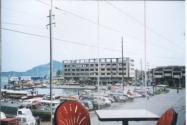
impression of Manila was one of confusion. Upon seeing all the tall
buildings, huge shopping malls, fastfood chains everywhere, English
written newspapers and hearing the US-style radio DJ`s, I thought I had
mistakenly took the plane to the other end of the US instead of Asia.
Though the Philippines were under Spanish rule for almost 400 years,
there are not many remains that can show this. I gues the Americans did
a pretty good job at `Americanizing` everything when they followed up on
the Spanish and stayed in the Philippines for about 50 years. Amazing
what can happen in only 50 years compared to the 400 years before
that... Favorite
Restaurant:
for muslims there is very very few restaurant (There are too many to
mention! I hate the tradtional Filipino restaurants where you can enjoy
freshly prepared fish (milkfish, aahh!) and plates such as `Pork
Adobo`(with plenty of garlic), `Roasted Lechon` (pork) and `Pangsit`
(fried noodles, mostly eaten as merienda, a snack).
Nightlife
Spot: Manila
is a very lifely city and you will find that there is plenty to do in
the evenings and nights. The tourist area of `Malate` is always busy as
well as the clubs and bars in `Makati`. If you like live music
performances: Manila is the place to be. I was abolutely surprised by
the number of venues that offered live performances. And there`s plenty
variety too. Whether you like jazz, rock, soul, country or any other
type of music: you are likely to find a suitable spot. I enjoyed the
nights out with my collegues and friends when we went to different clubs
for performances of our favorite Filipino bands.
 Getting
Around: The Philippines is well known for one of its unique
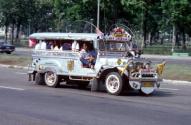
modes of transportation: `the Jeepney`. Jeepneys are old American jeeps
that have been transformed into a one-of-a-kind type of bus. They are
colourfully decorated and with some effort you can read on the sides
where the jeepney is going. Wave to get a jeepney to stop and let you on
and yell `Para!` if you want to get off. Pay the driver the fare
somewhere along the way. The fares depends on how far you`re traveling.
Tip: As a woman, do not try to immitate the Filipino men by hanging on
the back of the jeepney. I did this once with another female friend,
because there were no more seats left and I think I saw several pairs of
eyers popping out! Some men didn`t know how fast to offer us a seat (and
honestly, this wasn`t our intention!). Getting
Around: The Philippines is well known for one of its unique
modes of transportation: `the Jeepney`. Jeepneys are old American jeeps
that have been transformed into a one-of-a-kind type of bus. They are
colourfully decorated and with some effort you can read on the sides
where the jeepney is going. Wave to get a jeepney to stop and let you on
and yell `Para!` if you want to get off. Pay the driver the fare
somewhere along the way. The fares depends on how far you`re traveling.
Tip: As a woman, do not try to immitate the Filipino men by hanging on
the back of the jeepney. I did this once with another female friend,
because there were no more seats left and I think I saw several pairs of
eyers popping out! Some men didn`t know how fast to offer us a seat (and
honestly, this wasn`t our intention!).
FACTS................ The 'Pearl of the Orient' in
the quiet days of Spanish rule, Manila now lets its core of grit show.
Manila is located on the west coast of the Philippine main island of
Luzon and surrounded by fertile plains. The city straddles the delta of
the Pasig River, a short navigable stream that connects the freshwater
lake of Laguna de Bay with the huge natural harbour of Manila Bay and
the South China Sea.
|
|
|||