
| home | games | about | mpjournal | school | links |
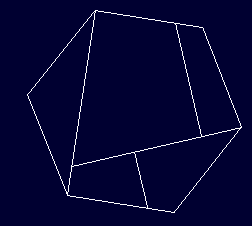
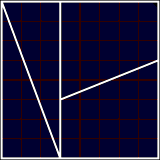
Any two rectilinear figures with equal area can be dissected into a finite number of pieces to form each other. This is the Wallace-Bolyai-Gerwein Theorem. For minimal dissections of a triangle, pentagon, and octagon into a square. The triangle to square dissection is particularly interesting because it can be built from hinged pieces which can be folded and unfolded to yield the two shapes.
Laczkovich (1988) proved that the circle can be squared in a finite number of dissections (~1050). Furthermore, any shape whose boundary is composed of smoothly curving pieces can be dissected into a square.
The situation becomes considerably more difficult moving from 2-D to 3-D. In general, a Polyhedron cannot be dissected into other Polyhedra of a specified type. A Cube can be dissected into n3 Cubes, where n is any integer. In 1900, Dehn proved that not every Prism can be dissected into a Tetrahedron (Lenhard 1962, Ball and Coxeter 1987) The third of Hilbert problems asks for the determination of two Tetrahedra which cannot be decomposed into congruent Tetrahedra directly or by adjoining congruent Tetrahedra . Max Dehn showed this could not be done in 1902, and W. F. Kagon obtained the same result independently in 1903. A quantity growing out of Dehn's work which can be used to analyze the possibility of performing a given solid dissection is the Dehn Invariant .
This page involves
problems of cutting a region (such as a polygon into the plane) into pieces
(possibly putting them together to form a different polygon). Related topics
include tiling (in which the whole plane is cut into pieces) and
triangulation (in which a region is cut into triangles or higher dimensional
simplices).
<go to top>
On angles whose squared trigonometric functions are rational, J.Conway, C.Radin and L.Sadun:. This somewhat technical paper on the theory of Dehn invariants (used to determine whether there exists a dissection from one polyhedron to another) makes the theory more computationally effective. It contains the fascinating observation that there should exist a dissection that combines pieces from a dodecahedron, icosahedron, and icosidodecahedron to form a single large cube. HOW MANY PIECES ARE NEEDED?
An automated rectangular tiling prover. This system uses a constraint-propagation algorithm, similar
to Waltz famous line –labeling technique, to automatically find dissection of planar regions into rectangles.
<go to top>
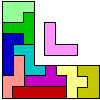
Pentominoes are polyominoes which consist of five squares. The term "polyomino" was invented by Solomon W. Golomb, professor in mathematics and computer science at the University of California.
The simplest form of a polyomino is the monomino, a single square. If you look at two squares you will find that there is only one way to connect them to form a domino. Then there are the trominoes, which can be connected in two different ways. The polyominoes that consist of four squares are called tetraminoes and there five ways to connect them.
There are 12 pentominoes. With these 12 pentominoes you can make different sorts of Pentomino puzzles, two of which I will describe: The Alphabet Pentominoes and the Board Pentominoes.
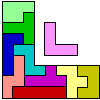
All 12 pentominoes can be
formed from 9 of the remaining pentominoes and are always three times as
large as the original. Choose one pentomino and try to make it with nine of
the remaining pieces. You can see one example opposite. The pentomino pieces
may be turned any way you like.
<go to top>
The objective of this Board Pentomino puzzle is to try to fill a board with all 12 pentominoes. The size of the board is 8x8 squares (checkers board). Since the 12 pentominoes together total 60 squares, 4 squares have to be left open. A few possible boards are shown below.
Draw the 12 different pieces
on a piece of triplex or other material of your choice and carefully saw
them out. Sandpaper them and paint all the pieces on both sides. When the
pieces are finished, you can start puzzling.
<go to top>