Sets
A set is a collection of objections satisfying the conditions of a rule.
Each object in a set is called an element, or member, of the set.
 means "
 is an element of set
  "
"

 means "
is not an element of set "
means "
is not an element of set "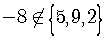
A set is finite if the number of elements in the set is finite.
A set is infinite if the number of elements in the set is more than any given
number. The elements of the set go on forever.
A set is empty is it contains no elements. The empty set is also called the
null set. It is denoted the symbol
 .
The empty set is not written as
.
The empty set is not written as  .
.A set can be specified by
1) listing the elements of the set between braces, { }
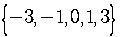
2) by enclosing within braces a rule that determine the elements of the set
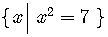
This is read " the set of all
 such that
  ".
".The vertical bar
 is read as "such that".
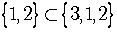
If each element of a set
 is also an element of a set
  ,
we say that
,
we say that
is a subset of , and we write
 .
.
The null set
has no elements, so every element of
is an elementof any set.
 for any
If two sets
and
 have the same
elements, the sets are said to be
have the same
elements, the sets are said to beequal, and we write
 .
.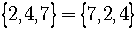
Notice that the order in which the elements are listed does not matter.
The Set of Real Numbers
 is the set of natural numbers, that is, the set
of positive integers.
 is the set of integers, consisting
of the negative integers, zero, and the positive integers.
 is the set of rational numbers, that is,
 numbers that can be represented as the ratio of two integers,
the denominator being nonzero.
 is the set of irrational numbers, that is, numbers that can not be
represented as the ratio of two integers, the denominator being nonzero.
Examples are
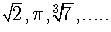
 is the set of real numbers, that is, the set consisting of all the numbers.
See Figure 1, page 3; Table 1 and Figure 2, page 4.
Basic Properties of Real Numbers
For any numbers
 in the set of real numbers,
  ,
the following are true.
,
the following are true.Closure:
 for addition.
 for multiplication.
The sum and the product of any two real numbers
are also real numbers.
Associative:
 for addition.
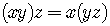 for
multiplication.
for
multiplication.Commutative:
 for
addition.
for
addition. for multiplication.
Identity:
 is the unique additive identity.
 for any real number.
 is the unique multiplicative identity.
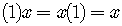 for any real number.
Inverse: For any number
 , there
is a unique real number,
, there
is a unique real number,  ,
,
called its additive inverse such that
 .
.For any number
, there is a unique real
number,  ,
, called its multiplicative inverse
such that
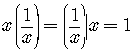 .
.Distributive:


See Example 1, page 7.
Further Properties:
Subtraction:

Division:
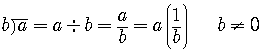
Remember that division by
 is never permitted.
It is a meaningless operation.
Negatives:
1)

2)

3)
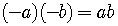
4)

5)

6)

Zero properties:
1)

2)
 if and only if
  or
or  or both
The second property is very important in solving equations.
See Example 2, page 8.
Fraction properties:
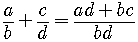
1)
 if and only if
2)

3)

4)
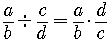
5)
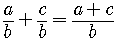
6)
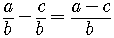
7)