 |
| What is Cooperative Learning? |
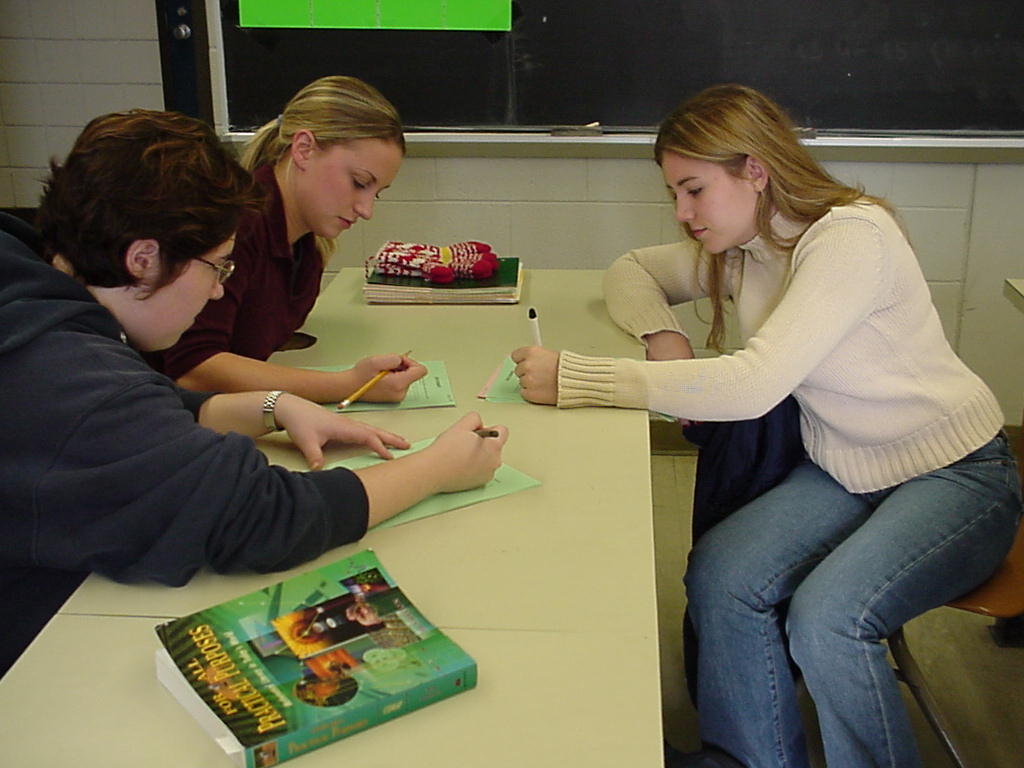
| Cooperative learning is a way to design a learning environment based on student to student interaction so that students can work together and take responsibility for each other's learning as well as their own (National Association for Research in Science Teaching). The other two main designs are the competitive learning environment and the individual learning environment which focus on the student working independently rather than with other students. The Cooperative Learning Center at the University of Minnesota has collected research on over 600 studies which compare the three different learning structures. The studies result in the conclusion that "having students work together cooperatively is much more powerful than having students work alone, competitively or individually" (NARST). |
| Cooperative Learning Elements |
| * Positive Interdependence * Individual Accountability * Face-to-Face Interactions * Interpersonal & Small Group Skills * Group Processing Taken from: Learning Together & Alone, D.W. Johnson and R.T. Johnson. Englewood Cliffs, NJ: Prentice Hall. Second Edition, 1987. |
| Cooperative Learning Conditions |
| * Small, Heterogeneous Groups * Other Students as a Major Resource * Teacher Acts as Consultant * Positive Interdependence between Group Members * Individual Accountability- all members are responsible for knowing the material *Evaluate by Comparison to a Present Criterion Taken From: Learning Together & Alone, D.W. Johnson and R.T. Johnson. Englewood Cliffs, NJ: Pretice Hall. Second Edition, 1987. |
| Misconceptions & Truths about Cooperative Learning |
| There are some common misconeptions about cooperative learning that tend to hinder the opinions about this teaching strategy. In order to create a truth-based, justifiable opinion, it is important to realize what things are true about cooperative learning and what things are just hear-say or misconceptions. |
| Truths * Students must use specific skills in order to work cooperatively * The work of a cooperative group results in a joint product or group conclusion * Use of cooperative skills ensures an equal division of tasks * Once they experience cooperative learning, most students acknowledge that group grades are fair * Almost all human activity is cooperative * More management problems may exist in traditional classrooms, which require silence and attention * Research shows that high achievers in cooperative learning situations do as well or better than their peers in traditional classrooms * Students in the same group can be assigned different tasks * The concept of cooperative learning is simple, but its implementation is complex Taken From: Cooperative Learning Merrill Biology by Linda Lundgren, (Lake Forest, IL: Glencoe:1991), p.2. |
|
 |