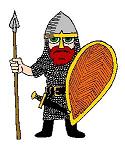
Sir Edward Ravenskeep was a condottiere, which, for those unschooled in Renaissance Italian history, was the leader of a mercenary army. Now mercenaries, at least in recent times, have acquired a reputation of being unscrupulous, conniving, money-grubbing, Machiavellian rapists and murderers, perhaps because, they were, often times – well – unscrupulous, conniving, money-grubbing, Machiavellian rapists and murderers. They were, to use the vernacular of the twentieth century American youth, " a bunch of real assholes." Ravenskeep was, alas, little removed from this apparently appropriate stereotype. He did his job well. Some say he loved it: riding around Italy propping up this prince or bringing down that one, only to later bring down the former and reinstall the latter. He was, in the parlance of the late twentieth century business sector, "a service provider in a largely agricultural and manufacturing-based society."
Sir Edward, a native of Surrey, first made a name for himself at the close of the Hundred Years War when he handed over a small town in Burgundy to the French in exchange for two casks of white wine (apparently they were having fish that day) and an entire brothel. He claimed to have been knighted by Henry II of England. (How this could be, since Henry died in 1189, 148 years before the Hundred Years War began and more than 250 years before Ravenskeep was even born, was never determined. This may have been due to the fact that no one in Italy, perhaps Sir Edward included, seemed to know that Henry II had been unavailable for knightings for much of the past three centuries. At the end of the Hundred Years War, which, as its name indicates, lasted 116 years, Sir Edward and his small army had made their way from the Low Countries to northern Italy. There they had sold their services to the likes of the Visconti, - the famed "Vipers of Milan" - the Medici, the Borgia, and other popes and princes of the Italian peninsula, sometimes to two or more of them at the same time in what the late twentieth century would call "risk management" or "hedging your bets." There were stories –"vicious rumors," as Ravenskeep himself called them - that he had been banished from Guelders in the Low Countries, though for what exactly is still unclear. Perhaps they were afraid he’d strike another of his famous deals with the French wine merchants. Suffice it to say it was most likely not for singing too loud in church.
He called his small army "The Guelder Rose Cavalry," perhaps after Guelders, which, in spite of the poor treatment and rather inhospitable send-off he received from the burgers of Arnhem, he apparently still loved. And, although they lost most of their horses in a minor skirmish in France and had since taken up archery - a skill requiring long years of practice, and therefore never fully mastered by Ravenskeep’s men - they still took pride in being cavaliers, and continued to call themselves such, so as to not be confused with those uncouth infantrymen or number-crunching artillerymen. The people of Guelders, and other locales where Sir Edward’s band passed the time, or, blessedly, simply passed, called them "Ravenskeep’s Ravening Ravagers," apparently enjoying alliteration. The name, however, didn’t stick.
The banner of the Guelder Rose Cavalry showed a bright pink rose with dark green leaves on a forest green field and the words "Saipe Fidelis" ("Sometimes faithful") misspelled on it: "Saipe Fedeles." Now any botanist and many non-botanists know that the guelder rose, a European shrub, (Viburnum opulus, of the honeysuckle family,) has large clusters of white flowers, not pink ones, and Ravenskeep’s dreadful Latin simply drove the scholars at Rome, Bologna, and Sienna purple with rage. These errors, painted on the banner of the Guelder Rose Cavalry - which was proudly flown whenever they rode into battle, or - more often - into a defenseless village to rape and loot – were apparently never caught by Sir Edward or any of his men. But then, it goes without saying that they most likely pursued interests altogether different from either botany or Latin.
Ravenskeep, while fancying himself a real "Renaissance Man" was quietly scoffed at by the more learned of Italy who called him, rather bluntly, an idiot. Those even less inclined toward him called him an inveterate liar and a poseur, though seldom to his face. (Though Lodovico Sforza was reported to have said something to this effect to his face once, but then Sforza, who worked his way up from being a condottiere to being the Duke of Milan, was a big, strong man, skilled with weapons and could, and apparently did, get away with it.) It was rather hoped, by the Italians, that Sir Edward would not do quite so well and would one day simply go home to England and leave Italy alone, but then Italians have always pretty much wanted outsiders, especially armed, invading outsiders, to go home and leave Italy alone, so this is nothing new.
But alas, this was not to be, at least not yet. After playing a crucial role in the Battle of the Piazza Verberationis Immanis (The name, in English, means something like "Square of the Brutal Beating," apparently not in honor of a famous battle which might have taken place there ages ago, but for a particularly vicious attack on a young Dominican priest whose tomb, to this day, stands next to a fountain in a corner of the square), Sir Edward not only made a name for himself in Italy (to match the one he’d made for himself in France), but was made -much to the chagrin of the locals- Count of San Otto, a small, largely-insignificant Italian city-state with little if anything to do with the site of the battle, save perhaps that the some of the locals of San Otto once sold cabbages in the Piazza one late summer. The battle was nothing but a minor skirmish, mind you, but the Medieval and Renaissance Italians tended to blow everything way out of proportion, (witness the Fourth "Crusade" in 1202, which was little more than the savage rape of Constantinople.) But the Duke to whom he’d sold his services was so pleased with Sir Edward’s results that he had the pope make Ravenskeep a count. Italy, and in fact the rest of Europe and perhaps the rest of the world, was, at that time, not a very democratic place, and did not bother to confer with the little people as to who they’d like to see in the big chair. Sir Edward was, therefore, in spite of his subjects’ displeasure, a count: no longer simply an idiot to the locals, but now an arrogant, titled idiot.
He insisted on being addressed as "Your Munificence," and in official correspondence as "His Munificent Lord, Count Eduardo (such was his name in Italian) of San Otto and of the House of Ravenskeep, knight," though it was never certain whether he’d confused munificent for magnificent, as he was not known to be particularly generous (nor, for that matter, particularly magnificent.) His men, however, always called him Sir Edward, though it was rumored they called him other things when he wasn’t around, especially if they’d been drinking. He took to wearing fine clothes, no longer the slashed doublets he had worn as a mere condottiere, and took to writing poetry (simply being able to write would, perhaps, have been impressive enough, but this writing poetry was over the top), painting, and (gasp) reading; he even tried to learn to play the lute. Many of these arts, like archery, were never fully mastered either by Ravenskeep or his men, some of whom half-heartedly took a stab at reading and writing. For a period soon after being named count, he traipsed around in a cardinal’s broad hat and red robes and insisted on being addressed as "Your Most Eminent and Reverend Lord Cardinal," but abruptly ceased that when threats of excommunication were received from Rome. Sir Edward, while never a particularly devout Christian, (he sincerely thought the Epistles were the wives of the Apostles) understood the need to maintain a good image, even if it meant sucking-up to the ecclesiastical big-wigs on many occasions.
Now San Otto was a wide spot in the road situated just down the road from an even wider spot called San Loreto. San Loreto was named for Loreto, a local cobbler who because of his pious devotion, and his shoes – an early version of Gucci perhaps - became patron saint of boot-makers. San Otto, in turn, was named for an influential and particularly well-connected cleric in the service of the Holy Roman Emperor Otto III, (the two are not thought to be related), who because of his pious devotion and his schmooze, became patron saint of bootlickers. Even further down the road from San Loreto stood Palio, which in Italian means "cloak" for it was here, or so the local priests claimed for years, "that Jesus spread his cloak upon the green grass, sat down, and taught us parables." They were, apparently, blissfully unaware that Jesus never even so much as set foot in Italy, nor did He even come within a thousand miles of the place, though, we must admit, He did create it. These grimy little details did not keep the more entrepreneurial-minded among the locals from selling small pieces of cloth from the supposed Palio in the town market for more than a hundred years. If, in fact, there was such a cloak, and these were actual pieces of it, it would have been, if sewn back together, more than 500 feet wide and a quarter mile long and been made of linen, wool, silk, horsehair, leather, grass and twigs, and gold thread. It was apparently mostly royal purple in color, but also green, gold, black, an off-white, a sort of beige color, and an ugly orangish brown. Suffice it to say that latter-day scientists did not even bother running tests on the pieces of cloak to verify their authenticity.
Even a bit further down the road, stood the city of Testudo, said to be a bastardization – or is that a malapropism - of the name for the ancient Roman army maneuver whereby they overlapped shields and held them over their heads and all around them, thus encasing themselves in a thick layer of shields which looked rather like a tortoise in a shell and was called, in Latin, "The Tortoise". Apparently they executed such a maneuver when they took the city from the Etruscans or Sabines, or from whomever was unfortunate enough to have been living in the area near the Romans at the time.
It so happened that one fine morning, between the soup and the second course, Ravenskeep, i.e., Sir Edward, i.e. the Count of San Otto, a.k.a., "The Munificent," received word that the Duke of Palio was marching on Testudo. The Duke of Palio in Testudo! This meant, perhaps, that Palio - beautiful Palio with its lovely, laughing maidens, was unprotected! Gorgeous Palio, with its white-stone palace which housed intricately-carved golden candelabra, marble floors and staircase, silk curtains, fine silverware, mahogany and amber-paneled walls, and fine artwork – the type you see at the Louvre, the Metropolitan Museum, or at Sotheby’s - which he and his men could loot at leisure, was calling to him! Wondrous Palio, with its fountains and rose gardens and tapestries that reminded him so much of Flanders and nearby Guelder, beckoned! Pious Palio, with its cathedral’s packed treasury and Chapel of the Palio - the famed Palio - which could be looted as well, or perhaps kept to bring in the tourists, was left all alone! Learned Palio, with its three hundred-year-old library, which would burn for days, was unguarded! Ah, Glorious Palio, with its well-stocked wine-cellars of French Champagne, Sherry, Portuguese Oporto, Amontillado and Spumanti - was ripe - positively ripe - for the picking; weakly defended while the Duke was foolishly traipsing off to take Testudo! Ah, to be in Palio!
Being a connoisseur of fine food, Sir Edward, of course, had enough manners and good taste to finish his meal, wipe his fingers on a napkin, and only then set out, in some semblance of haste, to Palio, wending his way through the mountains that made travel in Medieval and Renaissance Italy such a pain in the ass. He took with him most of the Guelder Rose Cavalry: 100 hand-picked men, of which there were now only 48, though John Sadington had gout and would probably not be effective in battle. He was, however, an effective administrator and could, once the looting stopped, be set up as governor of Palio. In addition, Robert de Beufort and 12 others were off attacking the fortified convent at Rocino, a sort of annual event for them, though they never managed to take the convent. They agreed to meet up with Sir Edward in the hills outside Palio.
They did of course, but not as Ravenskeep had hoped. When Sir Edward and his 34 men came to The Hill of Starlings overlooking Palio, he found Robert de Beufort and the other twelve waiting for them, accompanied by an additional 150 men, all freshly equipped with horses, lances, swords, and armor, and flying the banner of the Duke of Palio.
"I hope you understand, Sir Edward." de Beufort tried to explain. "It’s nothing personal, you understand, just business." He looked nervous, perhaps a bit ashamed.
"Not at all, Robert." said Ravenskeep, trying to sound cheerful. After all, I suppose I did the same to Count Giovanni at the Battle of the Umberto River." They all laughed. The look on the Count’s face when the Guelder Rose Cavalry had turned on him and attacked his crossbowmen from behind when he had counted on them as a reserve against the Medici! What a scream!
"I’ve been made governor of Palio until the Duke gets back. Then I shall be made count of Testudo." de Beufort smiled proudly.
"Is he paying you and the men well?"
"500 gold florins to be divided among the thirteen of us. The others are vassals of the Duke, not mercenaries."
"Really?" Sir Edward was impressed. "Those are capital wages! The Medici only paid us 200 florins at Umberto, but then they were always cheapskates unless it had something to do with art. Does the Duke need any others?"
"I’m afraid not, Sir Edward. I am instructed to slaughter you and your men and accept no quarters."
"Ah, I see." Ravenskeep nodded, trying not to look disappointed. "I ‘m afraid I can’t match the Duke’s pay either. We’ve only got, at most, 400 guilders."
There was an awkward silence.
"Did you take the convent this time?"
"No." de Beufort blushed a little in embarrassment. "But we did get through to the second defensive wall this time - before they drove us off with boiling oil and a withering volley of arrows." He smiled somewhat proudly. "Perhaps after this I can take the other 150 men and we’ll take the convent. The Duke has promised us cannons."
"Splendid." Ravenskeep smiled. He paused a moment. "Well, I wish you luck, Robert. I always knew you were going places."
"Thank you, sir." said Robert, always one to be polite.
There was another awkward silence. Goodbyes are always difficult.
"Shall we get on with it?" Sir Edward asked. He felt awkward and thought that the least they could do would be to get this mess over with as quickly as possible to spare them all any more embarrassment or awkward moments.
"Certainly, Sir Edward. Whenever you’re ready. Would you like to rest a bit? You all look tired." de Beufort offered. No need to be rude when you’re about to kill someone, now is there?
"Oh, no, no. You look hot in that armor and it looks like it might rain here in a bit. Let’s get this over with so we can all – er – um, well, at least some of us, can get home before we get drenched."
"As you wish." de Beufort said, drawing his sword.
"Oh, and one more thing: could John sit this one out? His gout is acting up."
"I’m sorry, Sir Edward. I have my instructions."
"Ah, yes. Of course."
The battle, which ensued, was rather messy, as most battles are, or so I’m told. De Beufort, while a skilled fighter, lacked the leadership experience which Sir Edward had gained from years of heading a band of illiterate, ignorant, uncouth, looting, raping, murderous, and back-stabbing mercenaries in the Low Countries, France and Italy, negotiating with kings, princes, dukes, counts, and the occasional bishop - and then double-crossing them, and, of course, he learned a lot by being the oldest of seven boys. De Beufort missed several chances to defeat the Guelder Rose Cavalry, or what was left of it. His men, and the 150 horsemen of the Duke, could not fight effectively in the close quarters of the Hill of Starlings or mount an effective cavalry charge among the olive groves flanking the road. Although they outnumbered the Guelder Rose Cavalry by almost 5 to 1, they were less experienced then the 34 men under Sir Edward who had been battle-hardened in France and the Low Countries before coming to Italy. De Beufort’s men were saved from utter defeat only by the Guelder Rose Cavalry’s lack of proficiency with the bow. Ravenskeep’s men consistently undershot their targets - if this were a basketball game, the halftime statistic would say that they were shooting only 35% from the free-throw line - but they did well enough to wound many of the horses which threw their riders and caused a great deal of disarray among de Beufort’s men. Toward evening, de Beufort, most of his army still intact but in some disorder, fell-back into the walled section of Palio leaving Sir Edward and his men to loot and raze the suburbs outside the walls. They then laid siege to Palio itself, just to show they could.
They could not maintain the siege, however - not even for a day and Sir Edward, after yelling over the wall to de Beufort not to be discouraged by losing the battle, to keep working on being a condottierre and to not give up – he had real potential – left with his remaining 15 men back to San Otto, which by then had fallen to the Duke of Palio, who had apparently used the attack on Testudo as a feint to draw Ravenskeep out. The plan had worked perfectly and Sir Edward and his men were in San Loreto when they received word that San Otto had been taken and was held by a strong garrison and that the Duke of Palio, now, at least de facto, the Count of San Otto and Testudo, was marching on San Loreto.
The Duke of Palio, said to be a nice man if you met him in a social setting, besieged Sir Edward in San Loreto, setting up cannons and lobbing large, stone cannonballs over the walls at regular and irregular intervals, to keep the Guelder Rose Cavalry on its toes. He allowed the women - mostly consisting of a group of Domincan nuns, the children, and the old men, to leave the city under a flag of truce. He even offered the Guelder Rose Cavalry, Sir Edward included, safe-passage if they promised to abandon their arms and leave Italy. He gave his word as an Italian, but Ravenskeep had known too many Italians, and had even heard of one Italian cardinal, later an antipope, who had sworn on his cardinal’s hat a similar safe-passage if a city surrendered to him. He had the inhabitants slaughtered when they emerged from the city to take up his offer. This made Ravenskeep a wee-bit apprehensive to take up the Duke’s offer.
Sir Edward maintained his position in San Loreto for a remarkable 54 days before the Duke finally had enough and attacked. The Duke, however, had not mulled around outside for almost two months, but had left the army in charge of one John Sadington, who had somehow slipped away from Palio under the guise of being dead, only to resurface in the camp of the Duke of Palio and make a healthy profit as his lieutenant. The Duke, in turn, went off to Rome to be named Count of San Loreto (the minor detail of actually being in possession of the city could be ironed-out later), and Count of San Otto (the pope apparently overlooking the fact that there already was one). And, true to his word, he had Robert de Beufort, in spite of his embarrassing loss at Palio, made Count of Testudo.
The attack was unopposed, partly because only 16 men cannot adequately defend a city, but also because, upon entering the city, the 16 men who then comprising the Guelder Rose Cavalry were nowhere to be found. No bodies were ever found; no tunnel was ever discovered under the walls. Had they snuck out with the old men, the children, and the nuns? It was never determined. John Sadington claimed that he had parleyed with Sir Edward after the nuns had been given safe passage, so that they could not have snuck out then, but it was always suspect that Sadington had been paid-off (admittedly a most unlikely event for a mercenary) by Ravenskeep and that he had let them slip away. The Duke proposed to have Sadington executed, and became quite adamant about this after discovering that there was no Dominican convent in San Loreto, but Sadington too - gout and all – slipped away, disappointed at the gratitude he received for handing the city of San Loreto to the Duke without shedding a drop of blood. Bloodless victories had been one of his specialties, for which Sir Edward, particularly when they were out-numbered, was often grateful, calling him Sadington the Parleyer.
Whatever became of the Guelder Rose Cavalry? Robert de Beufort, as stated earlier, was made Count of Testudo. He eventually married the Duke’s eldest daughter and, when the duke died without a male heir, became Duke of Palio as well as Count of San Loreto and San Otto. He eventually took Rocino. The twelve men with him took their 38 florins and either went home to England, or joined de Beufort’s guards at Testudo. John Sadington disappeared for a while, resurfacing back in England as a parleyer during the War of the Roses. He was later arrested by the Duke of Gloucester but died of gout – if gout can kill you - before he could be properly executed. Of the other 15 who remained with Sir Edward, or the fate of Sir Edward himself, nothing is known for certain. Some say they slipped off to Spain to fight the Moors and the other enemies of Ferdinand and Isabella, as did Cesare Borgia. Some say they lingered in Italy, finding odd mercenary work when it was available, but not continuing as the Guelder Rose Cavalry. Still others say they went back to England which is exactly what the Italians, and the French, and the people of Guelders, had always wanted them to do. All that is left of Sir Edward’s legacy in Italy is a statue of him that stands in the Piazza Verberationis Immanis, where Ravenskeep first made his name in Italy. The inscription reads simply, in Italian: "Edward Ravenskeep: Count of San Otto." In the 1920’s it was modified, so that now, instead of a baton or a sword, Ravenskeep holds the pole of a streetlamp, so that he now plays a constructive role in Italy, lighting the way for the little Fiats that drive by, or the young lovers cuddling at the base of the statue, happy and unaware as to exactly who the hell Edward Ravenskeep was.
Years after the Siege of San Loreto, a man calling himself William Ravenskeep returned to Italy claiming to be the son of Sir Edward and, thus, the Count of San Otto. However, he was never able to take up his throne as Duke Robert de Beufort would have nothing of it, and because the French, and later the Spaniards, were soon to arrive and muck things up in Italy – far more so than had been done thus far. William, it was said, was a cultured, erudite, gracious man: handsome and charming, a poet and player of the lute, with a lovely singing voice. He was proficient in Latin, Greek, French, Italian, and Spanish as well as his native English. He carried himself with dignity and modesty (even if he did have the gumption to want his throne back), drank modestly, was always a perfect gentleman with the ladies, and avoided fights whenever possible. When it was not possible, it was said that he was brave and resourceful, but honorable as well. He was, in short, nothing like his father.
