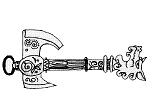
Didysis had been gracious enough to tip the executioner of Riga "a little something extra to get something nice for the wife," and was even thoughtful enough to bring a thank you card, a small box of candies for the executioner’s two young children, and to tell the little girl that she had a pretty dress. For all this, it must be said, that the executioner did a nice job, something they’d most certainly write-up in the trade journals if he’d done it today. One German chronicler put it quaintly, that he’d done his work "in one fell swoop, so to speak, and didn’t botch the job." According to tradition, the executioner left a single red rose in the window of his apartment above the Swedish Gate on the day there was going to be an execution. That day he didn’t forget, and even made sure it was a fresh, fragrant one with silky, soft petals. It is such attention to detail which is sorely missed today in all but the finest hotels and restaurants. But I digress.
Jurgis Didysis grew up in Vilnius, the capital of the Grand Duchy of Lithuania. Little is known about his upbringing or his family except that his mother, if the chronicles are to be believed, and in this case they aren’t, had once baked cookies for the Grand Duke of Lithuania when he’d come over to play one afternoon. In recognition of this "benevolent act of kindness to our person," as the Grand Duke later put it, he made her son the Voevode of Naugaudius and Palatine of Kaunas, with the right to call the Grand Duke "cousin."
This situation did not last long, though, and, during a campaign against Moscow, a violent dispute took place in the company of the Mikhail Aleksandrovich, Grand Duke of Tver, involving two barmaids – one blonde and the other brunette – during which Didysis is said to have called the Grand Duke of Lithuania "a lot more colorful things than just cousin," though what exactly is not preserved by the chronicles.
He left Vilnius, in the words of the great Lithuanian epic poem "in a bit of a tizzy," and made his way to Poland where he offered his services to Ludwig, the King of Poland and Hungary. The King, more favorable to "persons of the female persuasion," declined the offer, but made Didysis his personal secretary and later chancellor of Poland. Another dispute with his sovereign, also involving two barmaids – their haircolor has not been recorded for posterity, though one of them was named Agnieszka - forced Didysis to flee Poland in the dead of night dressed as a Benedictine nun. He remained in hiding in the Cloister of St. Clara in Prague for the next seven years, where he expanded the abbey and increased its activities for the poor and destitude, eventually being named abbess, before a dispute with the Holy Roman Emperor, this time involving two more barmaids, both named Anna, forced him to flee Bohemia dressed as the Archbishop of Salzburg.
He began major renovation work on the Archbishop’s palace and greatly expanded the art collection, (Most art critics grudgingly admit that he had impeccable taste in art.) before the real archbishop, returning from a visit to Rome tried to have him burned at the stake (even after all he’d done for the architectural and artistic value of the palace). He fled, again dressed as a Benedictine nun, back to Lithuania, where his erstwhile "cousin," the Grand Duke, had died and had been succeeded by his son, Jagello, who was too busy in Krakow marrying Jadwiga, becoming King of Poland, and being baptized, to care much about whether or not Didysis was in Vilnius or not.
Jurgis took up residence in Vilnius where he built a Benedictine convent but did not take up the position of Mother Superior personally, instead striking a deal with the bishop (some sources claim it was the bishop’s representative, not the bishop himself) at a local tavern. It is alleged that Didysis agreed to allow the bishop to name the Mother Superior in exchange for the bishop not trying to pick up the barmaid working that evening. They agreed and Didysis and the barmaid were later married.
Vytautas, the nephew of Jurgis' former "cousin", emerging victorious from a power-struggle with his cousin the King of Poland in 1393, became Grand Duke of Lithuania. He soon called Jurgis back to serve as his ambassador to the Khan of the Golden Horde where he served the Grand Duke faithfully and was obedient to the command "not to embarrass us by entering into any dispute involving barmaids, racing stallions, hunting falcons, fermented honey, or anything else, with any representative of the Khan or his retinue, any merchant of Genoa or Novgorod, or anyone else." Whether he was faithful first to the Grand Duke’s command, or to his new bride, is ultimately not know and perhaps not truly relivant. Following the embassy Sarai, he returned to Vilnius and was named Great Etoman (hetman or chief) of the Army of Lithuania but was dismissed in disgrace over a dispute with the Voevode of Volynia and the Palatine of Kiev, this one not involving barmaids, but rather the placement of troops at the Battle of Vorskla River (perhaps he allocated too many units to the defense of the local bar).
He settled down and fathered several children before his
wife died at a young age, as was the custom in the Middle
Ages, and he was called back to serve as ambassador to the
Teutonic Order at Malbork. He was placed under house arrest
after the Battle of Grunwald, where the Lithuanians defeated
the Teutonic Knights, and was handed over to the archbishop of
Riga to be ransomed, when, following "a dispute with a senior
knight of the order similar to those previously mentioned," he
escaped and fled, but was captured in a nearby Benedictine
abbey and sentenced to death. His sentence was carried out,
as is obvious from the description above and the body, out of
respect for the mother, who, legend has it, had also baked
cookies for the archbishop of Riga years earlier, was returned
to Vilnius where it was buried beside his wife in the
churchyard of the convent he had founded. His tombstone lists
his achievements:
     Here lies in honored rest, Jurgis Didysis, loving husband
     and father, Voevode of Naugaudius and Palatine of Kaunas,
     "Cousin" to Grand Duke Olgerd of Lithuania, Chancellor of
     Poland, Abbess of St. Clara’s in Bohemia, Archbishop of
     Salzburg, Gracious Founder of this Holy Convent, Ambassador
     to the Khan of the Golden Horde, Etoman of the Army of
     Lithuania who fought at Vorskla River (1399), Ambassador to
     the Grandmaster of the Order of the Teutonic Knights, a
     lover of barmaidens, whose mother baked cookies for Bishops
     and Princes. A.D. 1410