|
|
The Nine Transgressions of Temur Darkhan Michael C. Paul
|
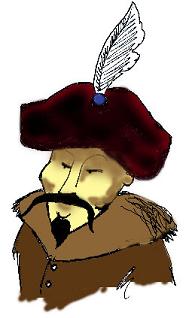
Temur Darkhan, Darugachi of Nur, a Merkit by extraction, whose
exploits had become almost mythical in his own lifetime, suffered death by the
order of the Great Khan Ogodey for, it was alleged, urinating in flowing water,
and thus angering the water spirits. He
had been dragged into the Khan's camp one morning by a number of men with a
wooden collar around his neck and imprisoned in a pit near the Khan's tent.
Explanations that "Well, I had to go." and "When you gotta go,
you gotta go." fell on deaf ears and the darkhan was soon sentenced to
death by the Khan Baty, though he claimed he was carrying out the wishes of the
Great Khan in Karakorum. Some rumors arose that Temur had been arrested while
washing his hands, others that he had been washing his clothes, though those
were only capital offenses in the summer, during the period of fierce
thunderstorms on the steppes, when to wash the hands or clothes was thought to
anger the water spirits living in the thunderclouds.
Most of the Mongols, upon hearing the news, were disturbed by the arrest and execution and sulked away from their herds or from the market place to sit morosely in their yurts, pitched in the shadow of Baty Khan's magnificent Golden Yurt, in the smoldering outskirts of Riazan. The bitter, cold January wind blew fiercely against the felt of their tents as they soberly drank their kumiss and in their private hearts assumed that the real reason the famed military commander, Temur Darkhan, had been killed was because he had simply become too successful and thus was seen as a threat to the family of Genghis Khan.
Temur Darkan had faithfully and successfully served Genghis
Khan and his son Ogodey Khan, as well as Baty, commander of the campaign
against Russia and founder of the Golden Horde, the westernmost successor state
to the Mongol Empire. His fall from
grace occurred just days after Baty's army had crossed the Volga into the
Russian principality of Riazan, that is, in December, 1237, and while no one
had actually seen him do it, they all believed that if he actually did violate
the Mongol taboo, that it was the Volga into which he urinated. He was arrested by Baty's men, and rather
than being taken to be judged by the Great Khan in Karakorum, as was his right
as a member of the Kesig, or imperial bodyguard, and in violation of his rights
as a darkhan to the Ninefold Pardon and the right to directly petition
the Great Khan, he was swiftly killed by being wrapped in a blanket and kicked
to death by Baty's bodyguards in the vicinity of Riazan. That he was executed so swiftly on the
apparent orders of the Great Khan, who was thousands of miles to the east at
the time, and not on the orders of Baty, lead the suspicious to assume that
Baty had received the orders earlier and merely waited for, or perhaps
fabricated, an excuse to carry them out.
The Mongol postal-riders were swift, but certainly not that swift.
Admittedly, Temur Darkhan was not beyond reproach. He had, in fact, already been pardoned on several occasions, but, it was argued,
not the nine times as was his right as a darkhan. He had seen his entire unit slaughtered in the Battle of Parwan
in 1221, where Jalal ad-Din had skillfully defeated Genghis Khan's adopted son
Shigi-khutukhu. Temur Darkhan had kept his position after the battle, as it was
a soldier's duty, on pain of death, not to abandon his unit unless he was victorious. He was not victorious, and was found toward
the end of the battle by the remaining, withdrawing Mongols, squatting among
his dead companions and holding the tether of his mounts along with his bow and
quivers. It was customary among the
Mongols that those surviving from a defeated (and slaughtered) unit would be
executed, but Temur Darkhan, as was his right, was forgiven. This was his first
of what should have been nine pardons.
His second offense, it was told in legend, that he had
stepped on the threshold of the door of Baty's yurt, an offense punishable by
death. He was pardoned, but not after
being forced to ride a cow backwards through the camp while naked, a punishment
usually reserved for jealous women. It
was from this point on, some of the Mongols officers believed, that Baty sought
to rid himself of the Merkit, and bided his time until an opportunity arose,
though again, Temur had transgressed at other times.
At the kuriltai or great assembly of 1237, held to discuss
the campaign against Kievan Rus', Temur Darkhan was arrested, by order of the
Great Khan, for holding a private feast and not attending the assembly. By order of the Great Khan, he was to suffer
decapitation, but he was instead pardoned as was his right. Enemies came forward at this time and
accused Temur Darkhan of having poked at the fire with a dagger, taken meat
from the kettle with a dagger, and hacked meat off a bone near the fire, all
capital offenses since they took the power out of the fire. He had also spit out food, leaned on a whip
used for beating a horse, poured milk on the ground, and had beaten a horse
with its reins, though he denied it, and many said the accusations were unfounded,
merely put forth by jealous and evil men.
These incidents had allegedly occurred while he had been
"pathetically and persistently drunk," according to the Franciscan
friar and papal envoy, John of Plano-Carpini, though Carpini did not know
whether Temur had on the same occasion wet himself while sitting in a
neighbor's yurt - also a capital offense - or whether that was a different
time. The Merkit was, nonetheless,
spared death due to his rank.
However, urinating in flowing water had, apparently, been
quite over the top and the Khan refused to pardon him. The friends of Temur Darkhan tried their
best to help the accused, arguing his case with great skill before the
Khan. They pointed out the long years
of service and the string of victories in China, Central Asia, and Persia, as
well as in the current campaign against the Kumans and the Russians, which the
darkhan had won for the Khan and his family.
They pointed out the ulterior motives of Temur's accusers. They pointed out Temur's rights as a darkhan
and a member of the imperial bodyguard.
The Khan, for his part, was a skilled debater, and pointed out that the
Great Khan was far away. He pointed out
that he had orders in hand, written by the Great Khan himself, to execute Temur
Darkhan, (though whether he ever presented proof of these orders is not
known). He pointed out that he was,
after all, the Khan, grandson of the great Genghis Khan himself. And, perhaps most compellingly, the Khan
mentioned that he had a lot of big, strong men hanging about his tent with sharp,
shiny weapons and a willingness to do his will and punish those who might risk
the Khan's displeasure. At that,
Temur's defense evaporated. His
friend's quietly conceded defeat and he was led away to execution.