1) Which statement regarding the functioning of the cell
membrane of all organisms is not correct?
A) The cell membrane forms a boundary that separates
the cellular contents from the outside environment.
B) The cell membrane is capable of receiving and
recognizing chemical signals.
C) The cell membrane forms a barrier that keeps all
substances that might harm the cell from entering the cell.
D) The cell membrane controls the movement of
molecules into and out of the cell.
2) A biologist observed a plant
cell in a drop of water as shown in diagram A.
The biologist added a 10% salt solution to the slide and observed the cell as
shown in diagram B.
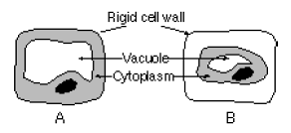
The
change in appearance of the cell resulted from
A)
more salt moving out of the cell than into the cell
B)
more salt moving into the cell than out of the cell
C)
more water moving into the cell than out of the cell
D)
more water moving out of the cell than into the cell
3)
In the diagram below, the dark dots indicate small molecules. These molecules
are moving out of the cells, as indicated by the arrows. The number of dots
inside and outside of the two cells represents the relative concentrations of
the molecules inside and outside of the cells.
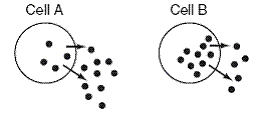
ATP
is being used to move the molecules out of the cell by
A)
neither cell A nor
cell B C) both cell A and cell B
B)
cell B,
only D)
cell A, only
4)
The diagram below represents a cell in water. Formulas of molecules that can
move freely
across the cell membrane are shown.
Some molecules are located inside the cell and others are in the water outside
the cell.
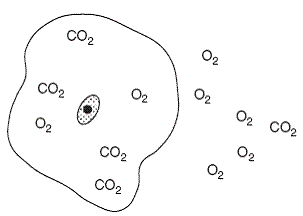
Based
on the distribution of these molecules, what would most likely happen after a
period of time?
A)
The concentration of CO2 will remain the same
inside the cell.
B)
The concentration of CO2 will decrease
outside the cell.
C)
The concentration of O2 will increase
inside the cell.
D)
The concentration of O2 will remain the same
outside the cell.
5)
Which letter indicates a cell structure that directly controls the movement of
molecules into and out of the cell?
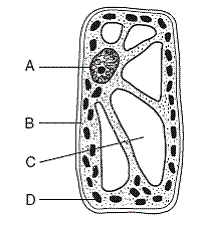
A)
A
B) B C)
C D) D
6) In multicellular
organisms, cells must be able to communicate with each other. Structures that enable
most cells to communicate with each other are known as
A) chloroplasts
B) antibiotics C) receptor molecules D)pathogenic
agents
7)
State one factor
that influences which molecules can pass through the cell membrane
of a human cell.
8)
If vegetables become wilted, they can often be made crisp again by soaking them
in
water. However, they may lose a few
nutrients during this process. Using the concept of diffusion and
concentration, state why some nutrients would leave the plant cell.
9)
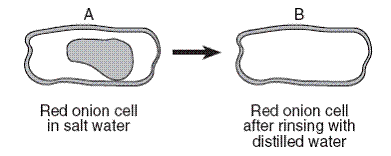
A student prepared a wet-mount slide of some red onion cells and then added
some
salt water to the slide. The student observed
the slide using a compound light microscope.
Diagram
A is typical
of what the student observed after adding salt water.
Complete
diagram B to show how
the contents of the red onion cells should appear if
the cell were then rinsed with distilled water
for several minutes. [1]
10)
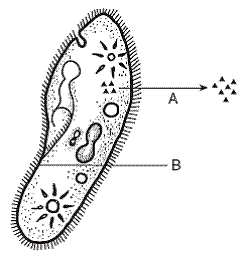
Arrow A represents
active transport. State two ways
that active transport is different
from diffusion.
11)
In cells of multicellular organisms, structure B often contains molecules
involved in
cell communication. What specific term is used
to identify these molecules?