Søren Aabye Kierkegaard (1813-1855)
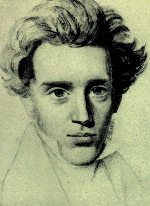 "Being an individual man is a thing that has been abolished, and every
speculative philosopher confuses himself with humanity at large; whereby
he becomes something infinitely great, and at the same time nothing at
all....To be a particular individual is world-historically absolutely nothing,
infinitely nothing -- and yet, this is the only true and highest significance
of a human being, so much higher as to make every other significance illusory....If
initially my human nature is merely an abstract something, it is at any
rate the task which life sets me to become subjective, the uncertaintly
of death comes more and more to interpenetrate my subjectivity dialectically.
It thus becomes more and more important for me to think it in connection
with evey factor and phase of my life; for since the uncertaintly is there
in every moment, it can be overcome only by overcoming it in every moment....An
objective uncertaintly held fast in an appropriation-process of the most
passionate inwardness is the truth, the highest truth attainable for
an existing individual...All knowledge about reality is possibility.
The only reality to which an existing individual may have a relation that
is more than cognitive, is his own reality, the fact that he exists; this
reality constitutes his absolute interest. Abstract thought requires him
to become disinterested in order to acquire knowledge; the ethical demand
is that he become infinitely interested in existing....For an abstract
thinker to try to prove his existence by the fact that he thinks, is a
curious contradiction; for in the degree that he thinks abstractly he abstracts
from his own existence."
"Being an individual man is a thing that has been abolished, and every
speculative philosopher confuses himself with humanity at large; whereby
he becomes something infinitely great, and at the same time nothing at
all....To be a particular individual is world-historically absolutely nothing,
infinitely nothing -- and yet, this is the only true and highest significance
of a human being, so much higher as to make every other significance illusory....If
initially my human nature is merely an abstract something, it is at any
rate the task which life sets me to become subjective, the uncertaintly
of death comes more and more to interpenetrate my subjectivity dialectically.
It thus becomes more and more important for me to think it in connection
with evey factor and phase of my life; for since the uncertaintly is there
in every moment, it can be overcome only by overcoming it in every moment....An
objective uncertaintly held fast in an appropriation-process of the most
passionate inwardness is the truth, the highest truth attainable for
an existing individual...All knowledge about reality is possibility.
The only reality to which an existing individual may have a relation that
is more than cognitive, is his own reality, the fact that he exists; this
reality constitutes his absolute interest. Abstract thought requires him
to become disinterested in order to acquire knowledge; the ethical demand
is that he become infinitely interested in existing....For an abstract
thinker to try to prove his existence by the fact that he thinks, is a
curious contradiction; for in the degree that he thinks abstractly he abstracts
from his own existence."
- Soren Kierkegaard
Biography and Works
Søren Kierkegaard was a Danish philosopher and religious thinker who wrote
literary and philosophical essays that reacted against
Hegelian philosophy and the
state church in Denmark, setting the stage for modern existentialism. Kierkegaard was
born in Copenhagen, the youngest of seven children. He spent his formative years under
the influence of his melancholic and devoutly religious father whose teachings stressed
the suffering of Christ. Kierkegaard went to study
philosophy and theology at the University of Copenhagen, where his personal despair grew,
leading him to the therapeutic decision to become a cleric and marry his fiancée
Regine Olsen, the daughter of a treasury official. Shortly after completing his doctoral
dissertation, The Concept of Irony (1841), he broke the engagement, partly
for fear that he and his fiancée might lack common philosophic interests,
but he gave the impression of acting out of a brutal and indifferent selfishness in order
to make the breach definitive. Thereafter he embarked on a life of seclusion and a writer's
career that produced a constant flow of books over the next ten years with at least
twelve major philosophical essays.
Kierkegaard's early philosophical works were written under pseudonyms. He wished to avoid
giving the impression that the views expressed in the books constituted any definitive
religious position, or even that they necessarily represented his own position. In
Either/Or (1843) he writes that there are two ways of life, the "aesthetic" and the
"ethical." The aesthetic life is based on sensory pleasures, intellectual or physical, which
is based in temporality, and the ethical life is based in moral codes and
the infinite, the eternal. The aesthetic way of life leads to "dread" (angst), the call of
the infinite, and eventually leads to despair. Once this is realized, the individual may
enter the ethical sphere.
In 1843 he also wrote Fear and Trembling, and Repetition.
In Fear and Trembling, the conflict between the
ethical and the religious is shown in the "teleological suspension of the ethical" of
Abraham's decision to sacrifice his son in obedience to God's command. Abraham got his son
back after proving his faith, showing that with God anything is possible. Abraham showed
that one can be forced to disregard ethics if God commands it, which is the paradoxical nature
of religion. Kierkegaard begins to see that there are three spheres, though he doesn't
state it explicitly; the third sphere is the "religious,"
higher than the ethical. He also sees that God can accomplish what to the human mind is
absurd, and by having faith in the absurd, one can recover what was lost. In Repetition
he considers the same theme, describing his relationship with Regine through the pseudonym
Constantin Constantius. Before he finished the book, Regine married another man, and
Kierkegaard came to the conclusion that he was free now, and this is how the book concludes;
Constantin devotes his life to the "idea," his philosophical and literary works.
In 1844 came Philosophical Fragments,
which attempts to present Christianity as he thought it should be. He continues the
theme of the paradox by saying that Christ is the absolute paradox, He is God in time,
both infinite and finite, which humans cannot comprehend. God is infinitely higher than man,
because man lives in sin, and therefore He always appears paradoxical, and Christianity seems
absurd. Stages on Life's Way appeared in 1845, in which he explicitly states that there are
three spheres and divides the book into three parts which deal with each. It is the sequel of
Either/Or with the added explanation of the religious. The ethical is a transition
stage because its laws are impossible to fulfill, so you must believe in the
paradox and enter the religious, which is the fulfillment.
Concluding Unscientific Postscript (1846) attacked Hegelianism because of its
notion of an objective science of the human spirit which he thought obscured the nature of
Christianity. He disliked Hegel's systematizing and his fusion of logic with
existence, claiming that existence cannot be described objectively or logically. The objective
uncertainty of Christianity and one's relation to it is the highest truth for an existing
individual, therefore truth is subjectivity: "Faith does not result from
straightforward scholarly deliberation, nor does it come directly; on the contrary,
in this objectivity one loses that infinite, personal, impassioned interestedness, which
is the condition of faith." This work was supposed to be his last, but he wrote
Works of Love (1847) the next year, a description of the various kinds of love and the
perfection of Christian love. He also writes about the "offense" of Christianity, a theme
that he would continue in Practice in Christianity.
Kierkegaard was also publishing religious discourses during these years, which were always
written in his own name. Between 1843 and 1845 he wrote eighteen of them. He stressed that
these were not sermons, since he
felt he didn't have the authority to preach. The discourses were always addressed to the
"single individual" before God. He continued to write discourses until his death,
including Three Discourses on Imagined
Occasions (1845), Upbuilding Discourses in Various Spirits (1847), Christian
Discourses (1848), Three Discourses At The Communion On Fridays (1849),
Two Minor Ethical-Religious Essays (1849), and The Changelessness of God (1855).
The Concept of Anxiety (1844) and The Sickness Unto Death (1849) are his
psychological works which earned him the title of father of modern psychology. The
Concept of Anxiety, considered in the context of Adam's original sin,
describes anxiety as a stage that is necessary before one makes
the leap of faith into Christianity, the stage where one shudders at one's freedom. Anxiety
can lead to sin, sin compounds the anxiety of freedom, and freedom is lost through sin; this
cycle of sinfulness and anxiety can be broken only by faith. The Sickness Unto Death
brilliantly describes the "self," and how the self "relates itself to itself." The self
is a synthesis of the infinite and finite, temporal and eternal, which can only find
rest in God. A misrelation in the synthesis leads to despair.
He describes different kinds of despair, one of which is the
despair that one has when one does not realize one is in despair, i. e. "ignorance of having an
eternal self"; another the "despair in which
one does not will to be oneself", i. e. wishing to be another self;
another the "despair to will to be oneself", or asserting the self without relation to God.
He further divides these three conditions, but
he concludes that despair is sin, and despair is the sickness unto death. One can also
despair over one's sins, and worst of all one can despair over forgiveness of one's sins when one
refuses forgiveness. To Kierkegaard sin and faith are opposites; either one despairs
or one has faith.
Kierkegaard considered Practice in Christianity (1850) to be his most important book,
in which he attempts to reintroduce Christianity into Christendom ("official Christianity"),
his main theme up to
his death five years later. He examines the offense of Christianity and how the state church
in Denmark attempted to remove the offense, which he thought watered down the message. He
was actually trying to offend his contemporary Christians, hoping the offense would
lead them to a stronger faith. His later works became very blunt, attacking the church
and Christendom for their complacency. He wrote articles in a Danish journal called
"The Fatherland" in which he criticized the state Lutheran church for saying all citizens
were Christians simply by being born in Denmark. In 1855 he wrote This Must Be Said--So
Let It Now Be Said and encouraged people to leave the church because their official
Christianity was a "forgery." The same year he wrote What Christ's Judgment Is On Official
Christianity in which he called the clergy "freethinkers" for their mediocrity.
Few 19th-century thinkers have surpassed Kierkegaard's influence on 20th-century
thought, yet there is no "Kierkegaardian school" of philosophy or theology, largely due
to the fact that he did not develop an all-embracing system. He has had
a strong influence on philosophers Martin Heidegger and Jean-Paul Sartre and on theologian
Karl Barth, and has also been admired as a literary stylist and innovator.
Thought
If you marry, you will regret it; if you do not marry, you will also regret it;...whether you marry or do not marry, you will regret both. Laugh at the world's follies, you will regret it; weep over them, you will regret that; laugh at the world's follies or weep over them, you will regret both...believe a woman, you will regret it, believe her not, you will also regret that; believe a woman or believe her not, you will regret both...Hang yourself, you will regret it, do not hang yourself, and you will also regret that; hang yourself or do not hang yourself, you will regret both...This, gentlemen, is the sum and substance of all philosophy.
-Fear and Trembling
Links
International
Kierkegaard Information
D. Anthony Storm's Website
on Kierkegaard
Kierkegaard on the Internet
The
Kierkegaarden
Kin's Kierkegaard
Page
Kierkegaard
at the Evolution of Philosophy
Realm
of Existentialism on Kierkegaard
Existentialism
and Beyond on Kierkegaard
Kierkegaard
in the Stanford Encyclopedia for Philosophy
Kierkegaard's
biography at Bjorn's site
Kierkegaard's
biography by Garth Kemerling
Kierkegaard's
biography at The Window
Soren
Kierkegaard at Society of Australia
"The
Distancing of Author and Intention" by Matt Carpenter
"Willed
Faith and Belief - an Essay on Kierkegaard" by Christine Jewell
"Comments
on Kierkegaard's 'Eternal Happiness, Subjectivity, and Truth'" by Scott
H. Moore
"Summary
and Comments on Kierkegaard's 'Diary of a Seducer'" by Scott H. Moore
"Words
of Love" by Charles L. Creegan
"Kierkegaard's
Relations with Postmodernism and Feminism" by Charles Creegan
"Wittgenstein and Kierkegaard"
by Charles Creegan
Howard and Edna Hong Kierkegaard Library
"Kierkegaard:
Truth is Subjectivity and Beware of the Crowd" by Gordon L. Ziniewicz
"Marx's
Criticism of Feuerbach and Its Application to Kierkegaard" by Kevin Davids
"Kierkegaard
and Radical Disciplineship: A New Perspective" by Vernard Eller
"The Simple
Life" by Vernard Eller
Kierkegaard
bookshelf at Episteme Links
Kierkegaard
Discussion Lists
The EXISTENTIAL-PHENOMENOLOGY PAGE
Back to Home page |
On to Existentialm |
Camus |
Sartre |
Heidegger |