Gods and Goddesses
Gods:
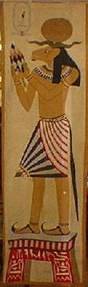
Amun:
Amun-Ra was the king of the gods in ancient
Anibus:
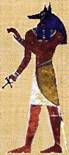 He was the Egyptian god of the dead.
He was regarded in
He was the Egyptian god of the dead.
He was regarded in
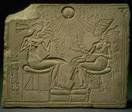 Aton:
Aton:
Sun's disk Aton is the physically
visible sun. Aten had a higher level of worship by the beginning of Akhenaten's
father reign. In Akhenaten's reign he declared that all other names are invalid
and their priests are useless.
Geb:
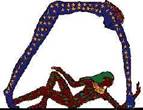 The mountains were said to be his bones.
Geb was the son of Shu and Tefnut. He was the twin brother of Nut, and also her
husband. He was father of Osiris and Isis, Seth, Nephthys. As a vegetation god
he was shown with green plants on his body. As the "Father Earth" god
he was shown below Nut. He was often pictured with a goose on his head or as a
goose. He was called "The Great Cackler". It was said that he laid
the egg from which the sun hatched.
The mountains were said to be his bones.
Geb was the son of Shu and Tefnut. He was the twin brother of Nut, and also her
husband. He was father of Osiris and Isis, Seth, Nephthys. As a vegetation god
he was shown with green plants on his body. As the "Father Earth" god
he was shown below Nut. He was often pictured with a goose on his head or as a
goose. He was called "The Great Cackler". It was said that he laid
the egg from which the sun hatched.
Hapy:
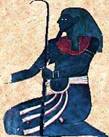 He was the god "Runner". He
was one of the "four sons of Heru". He was equated with the element
of air due to his association with Nebt-het and the direction of east. He was
depicted as the god protecting the throne of Wesir in the underworld. He was
found in the form of a mummified man with a baboon head on the funerary
furniture, especially the canopic jars which were jars that had in it the
organs of the dead.
He was the god "Runner". He
was one of the "four sons of Heru". He was equated with the element
of air due to his association with Nebt-het and the direction of east. He was
depicted as the god protecting the throne of Wesir in the underworld. He was
found in the form of a mummified man with a baboon head on the funerary
furniture, especially the canopic jars which were jars that had in it the
organs of the dead.
Horus:
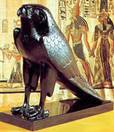 He was the sky god, the god of light and
goodness. He was the son of Osiris and Isis. After Osiris was murdered by his
brother Set, Horus avenged his father's death by killing his uncle. He was in
the form of a hawk headed man or in the form of a fully hawk. He was worshipped
as Mekhenti-irry which meant "He who has on his brow two eyes"; the
sun and moon represented his eyes. In that form he was considered the god of
the blind. Later
forms of him were found as anything from victory personified to the son of the
Lord of the Dead, Horus-Sa-Aset, and that form became the most popular form in
He was the sky god, the god of light and
goodness. He was the son of Osiris and Isis. After Osiris was murdered by his
brother Set, Horus avenged his father's death by killing his uncle. He was in
the form of a hawk headed man or in the form of a fully hawk. He was worshipped
as Mekhenti-irry which meant "He who has on his brow two eyes"; the
sun and moon represented his eyes. In that form he was considered the god of
the blind. Later
forms of him were found as anything from victory personified to the son of the
Lord of the Dead, Horus-Sa-Aset, and that form became the most popular form in
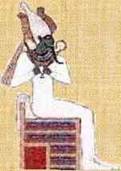
Osiris:
He was the legendary ruler of pre
dynastic
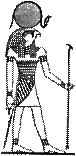 Ra:
Ra:
He was the sun god. He
was in the form of a human body with the head of a hawk and crowned with a
solar disk. His chief symbols were the sun disk and the obelisk. He was the
father of Shu and Tefnut. And he was grandfather of Geb and Nut. He was the
most important god in
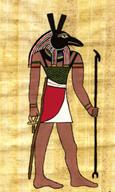
Seth:
He was the lord of

Goddesses:
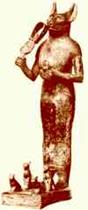
Bastet:
Sun's Bastet the "devouring
lady", she was a cat headed goddess. She was the goddess of joy, music and
dancing. She was the daughter of Re. The town of
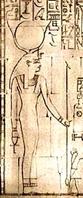
Hathor:
She was the goddess of
the sky, the queen of heaven and the goddess of love and beauty. She was also
the goddess of death; she offers comfort to the newly dead. She was in the form
of a woman with cow's horns between which hangs a solar disk. Sometimes she was
in the form of a cow. And also she was represented as a cow headed woman. She
was the daughter of Ra, and the wife of Horus.
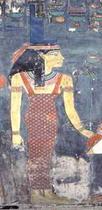
She was the throne goddess
of
Maat:
She was the goddess of
truth and justice. She was depicted as a woman with wings, or as a woman with a
single white ostrich feather bound to her
head. Her symbol was the feather. The word Maat translates "that which is
straight". In ancient Egypt she was the patroness of judges, magistrates
and all court officials. She was sometimes called the "eye of Ra" or
the "daughter of Ra". It also played an important role in the book of
the dead. The person's heart was weighed against the feather of Maat.

 Sekhmet:
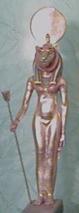
She was a lion headed
goddess. She was the goddess of war and battles; she was the destroyer of the enemies
of Ra and Osiris. She embodied all aspects like light and dark, birth and
death. She was a sun goddess; she represented the burning, destructive heat of
the son. Her name means the "powerful". From her titles "Lady of
the place of the beginning of time" and "The one who was before the
gods were".
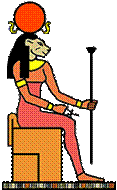
Tefnut:
She was responsible for order, justice,
time, heaven and hell, weather. Sekhmet was in the form of a woman with a
lion's head, and her head there was a solar disk. Sometimes Tefnut was shown as
a fully lion along with her brother. God Atum gave birth to his son Shu and his
daughter Tefnut. She was the sky spittle goddess, she helped support the sky.
Tefnut embodies the concept of airborne moisture, clouds, dew or rain. She was
one of the great nine who sat in judgment of the dead. She was sometimes
equated with Nit and Nut.
