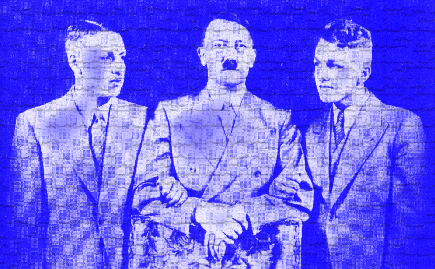
Richard Wagner may have been an accomplished composer and innovator of the theatre, but he is also known as a very controversial figure in history. Therefore, it would be unethical to leave out the fact that Richard Wagner was an anti-Semite. Wagner’s music became the spirit of the Nazis when Adolf Hitler came into power. Yet, there is a strong debate to this day as to how much of Wagner’s music reflects his views towards the Jews. Hitler and the Nazis looked for a model for anti-Semitism and found one in Richard Wagner. The Nazis made assumptions about Wagner’s art that may not have been completely true though. It is clear that Wagner did have a strong resentment towards the Jews, especially since many of his competitors were Jewish. It is also believed that he could have been engulfed with self-hatred since his step-father (believed to be his biological father) was Jewish. His letters and other kinds of work, including his book, Judaism in Music, clearly show his animosity towards the Jews. However, experts argue when it comes to how much of his music expresses his idealogies. His music still stood for German nationalism in the early to mid 20th Century though. That is why, to this day, Hitler’s victims and their descendants refuse to let his music be played in Israel. This ban has been in effect since 1938. Wagner may not have intended for his music to be associated with Adolf Hitler’s ideals, but it still occured. His sense of morality could not overcome his racist ideas.
Richard Wagner's great-grandson has rebelled against his family, who to this day does not acknowledge that Wagner was a racist. This is expressed in a news article found on the Detroit News website:
BAYREUTH, Germany -- Richard Wagner's operas celebrate the triumph and
tragedy of mythical Germanic heroes, with bold and stirring music such
as The Ride of
the Valkyries.
Among those inspired by the Teutonic dramas: Adolf Hitler.
The composer's heirs would rather forget that fact, but his great-grandson
won't let
them.
In a soul-baring autobiography, Gottfried Wagner charges that the family
has yet to
come clean about its anti-Semitic past and warm kinship with der Fuehrer.
The book has rattled the cozy world of Bayreuth, where Wolfgang Wagner,
77,
Gottfried's estranged father, rules the annual Wagner opera festival that
began last week.
Gottfried Wagner, wracked by guilt about the Holocaust, is not alone among
Germans
of his generation to rebel against a father who glided smoothly from the
Third Reich into
the postwar era. It's his family link with a national cultural icon that
has caused the fuss.
"You can't just go out and write one-sided books that say Hitler equals
Wagner,
Wagner equals Hitler," Wolfgang Wagner said, angrily. "I will continue
to go my way."
He called the book "primitive" and said he has banned his son from the
family home in
Bayreuth, where Richard Wagner built a stage for his operas in the 1870s.
Gottfried Wagner traces a line from Hitler and the Holocaust to Richard
Wagner's
anti-Semitic writings -- notably aimed at Jewish rival composers -- and
perceived
anti-Jewish themes in his work.
And Wolfgang Wagner, he says, failed to renounce the virulent anti-Semitism
of his
mother, Winifred, a glowing admirer of Hitler who headed the Bayreuth festival
under the
Nazis in the 1930s.
Such details were suppressed to keep the family enterprise going after
the Nazi defeat
in World War II, Gottfried Wagner argues. He says his father brushed off
questions
about the Nazis and that his 1994 autobiography fails to answer "why he
is repressing his
and the family's past."