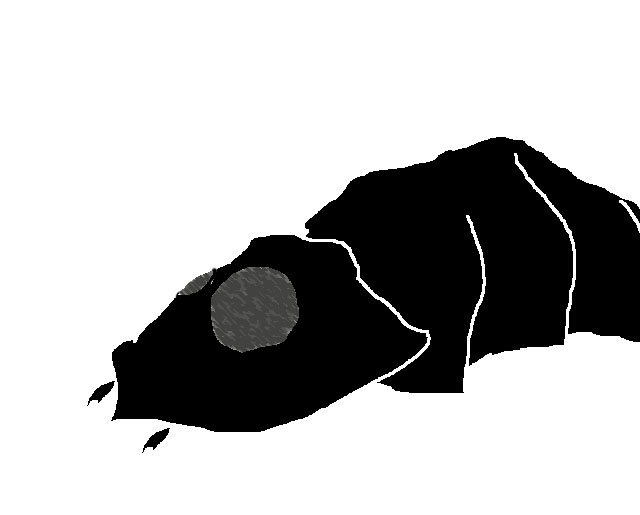
| Well, what can we tell about
this animal from simply just looking at it's fossil? Quite alot really!
Here's a diagram of what it might have looked like
when it was alive:
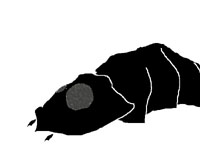
(Click to enlarge)
From this we can tell:
-
It had a hard outer body. This is called it's exoskeleton.
-
The body has joints in it. This allowed the animal to
move around .
-
It had very large prominant eyes. If you look back at
the high contrast photo on the last page (click "Back" on
your internet program, or click here and
then click "Back" to come back to this page) you can see
some interesting things about these eyes! For a start, if you look at
the large eye that is closest to the camera (it's left eye) you can
see that it has a very different surface texture from the head of the
fossil. Also, you can just see the animal's right eye
poking up above the level of its head. In the high-contrast photo, you
can see that this is much more reflective than the rest of the head,
because it appears so much brighter in the photo. From these two facts
- the roughness and the reflectiveness, it's easy to see that the eyes
must be covered in lots of different lenses. This is called a compound
eye, and you can find it on lots of different animals on
earth. Next time you squish a fly, if it's head is not badly squished
you can see that they have this kind of eye.
-
There are some interesting body parts on the front end
of the head. Maybe these are feelers or antennas of some kind? Or
maybe they are mouth parts? It's pretty hard to tell for sure just
from this picture. (in the diagram above, I replaced the feeler on the
right hand side of its head because this seems to be missing from the
fossil in the photo. Maybe it broke off or maybe it's just the angle
that the photo was taken from.)
-
Animals on earth that have hard exoskeletons, body
joints, compound eyes, and antennas are called anthropods.
Some arthropods are - grasshoppers, spiders, flies, lobsters,
crabs, scorpions, and even centipedes. This looks like it is
some similar kind of animal. Because it was found on the moon, perhaps
we can give it the scientific name of Anthropoda Lunarus (scientific
names are taken from Greek. This name means "Moon Anthropod"
when you translate it into English).
-
The only main difference that we can see from the
anthropods of earth is that this one is much, much bigger than any
living earth anthropod. But it's of course possible that anthropods
this size did once live on earth but are all extinct and we just
haven't found their fossils on earth yet.
-
Another interesting thing is the question of where
this animal lived. Was it a land creature or a sea creature? Of course
today, all the moon's seas are all dried up and are just full of dust.
But millions of years ago maybe this was a sea animal like a lobster?
Mmmmm imagine how much meat you could get out of a lobster that
size!!!!!
On the next page, you can see some earth animals (alive
and dead) that are a bit like this one. Click here to continue.
HOME
|