2 january 2008
The Equipment & Presses Gallery
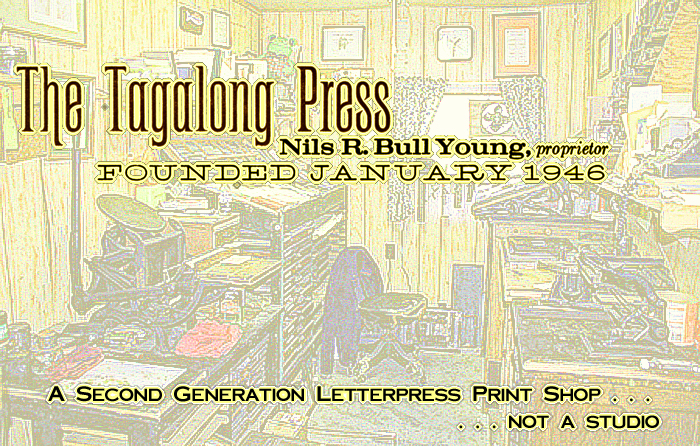
The Press Room

A little more than a month after Dad's death, on 28 February 1983, I dragged the parts of a 9x13 press out of John Renner's basement in Springfield. The physical effort of deconstructing & reconstructing the press, plus having the press in my garage, cost me $500. I figure that's a bargain.
On the main draw bar of the mechanism was a little metal plaque that listed the patent dates, the last one being 16th June, 1874. I didn't think of the expanse of time that the press had been around, but now I feel lucky to have a piece of printing equipment that had been cast into metal back when my mother's father was born or back when my father's mother had been a baby. Today the press is over century and a quarter old. When I think of that I have to smile.
Around 1985 I loaned the press to Tom Ebbert, who was at that time printing QSL cards for ham radio loonies with a side lever Kelsey 6x10, and beautiful work he did with that too. But the Gordon, with better inking, a firmer impression and not having to pull the lever, was a perfect press for Tom to use in his business.
 Back in January 2008 I heard from Tom that he had enough presses and was quite willing to hand the old Gordon back to me. A couple weeks later, Mike Corcoran, one of my friends from work, and I drove over to Columbus, Ohio, to retrieve the press. Mike & Tom & I took the press apart, as I had done 25 years earlier, and brought it back to my garage. Over the next couple weeks I put the press back together, at least those parts that I could wrangle into place and bolt down without hurting my back. Then one afternoon, after work, Mike came by the place and helped me lift the bed frame into place and put the draw bars on it.
I'm getting the rollers recovered by Ramco Roller Products in San Dimas, California at an extremely reasonable price ($55 each).
I worked out getting a treadle for the press with Joel Brown at Hern Iron Works in Coeur d'Alene, Idaho. I wasn't interested in putting a motor on the press & I figured it would do me some good to treadle the press at five strokes per impression. Get some exercise.
And yes, that is a .36 caliber cap & ball revolver laying on the delivery board. I keep it handy because I get Irish Traveler neighbors from time to time. As I have recently come to know, some people are live today only because it's illegal to kill 'em.
 Back around 1984 or so I was talking with the late Bill Tompkins, the shop supervisor of Wright State University's printing operation. He mentioned that he had some press parts in the weeds behind his own shop not far from the university. We arranged an expedition.
What Bill had lying in the weeds was a nearly complete C&P New Series 10x15 press. Some friends & I retrieved all we could find among the weeds and dragged it all back to my garage in my car & a small pickup truck. I spent the better part of that summer and winter getting the press back into running shape. I had the platen leveled and finished by the students at the local vocational school's machine shop. The students and their teacher also fixed me up with a couple pieces that were missing or lost. The pinion gear I found in a press parts place on the east coast.
I printed a couple thousand QSL cards on that press in 1984 and discovered in the process that I did not like doing printing like that for money. It wasn't the work or the way things worked out. It was the kind of folks who expected me to give them a lot for nothing.
The press now has very nearly a million impressions on it. It has new rubber rollers, which I bought from Brown Regrinding before they went out of business. I've printed everything from birth announcements to business cards on it. And I've printed QSL cards for a few ham radio friends.
While I am tempted to spring for a treadle for it, and even if it does turn over easy enough by hand, I prefer to run it on a loosely fitted V-belt over the belt wheel with a 1/2 hp motor that I got surplus for $25 twenty years or more ago.
 I acquired a C&P Pilot Old Style in the process of helping Jack & Henry Schwartz sell two other Pilot presses to a couple hobby printers I knew. The story of the transaction is recorded elsewhere.
I have had very little experience with lever table-top presses and what experience I had before restoring & putting the Pilot into use has been very disheartening. As much as my father tried to get me to use it, I never was happy with the way a Kelsey press worked.
The Pilot is a press so unlike any other table-top press that I've seen that I'd have to say using any other press would likely be a waste of time. And yes, I know that there are many printers who started out on Kelseys and will swear by them to this day. I'm not one of those folks.
The Pilot, for all of its ungainly looks and it's rather fundamental inking system prints with an authority and repetitious register that I never got out of Kelsey. It's the only lever press I use now and it's likely to be the only lever press I'll ever use again.
As a historical marker, I have often though that the number "11" stamped in the top of the bed might mean the press was manufactured in 1911. However I have found out that, aside from the manufacturer keeping no records on when these presses were made, there seem to be no markings of any kind on any Pilot presses that might speak of their date of manufacture. That and the change over from the "Old Style" design in the castings around the first decade or so of the 20th Century leaves this press with a possible date of birth between 1885 and 1920. And because of the marking on the top of the bed, I just take a stab at it and say the press was built in 1911, the year my father was born.
 Every print shop should have a proof press. At least that's the story you hear from folks who have a print shop & want to produce error-free work. Me, I'd love to produce error-free work but at the same time, most of the errors I make are so bizarre that most of them can be taken as artistic license.
That being the case, I still see a need for a proof press. Especially when I don't want to spend the day printing something that's missing a couple words or even a couple lines. And believe me, I've done it.
Even when I had a Poco 0 proofer I did it: printed stuff with dropped lines &c.
At some point early on, and I don't remember even nearly when, I acquired the press shown here. I tried using it as a proofer and had moderate success at using it to find my mistakes. All that said, it's not that great as a press, let along as a proof press.
So what to my surprise should it be to find a site where this little press is finally given a name & a purpose.
It's a Writerpress, one of a series of office machines from the late 19th and early 20th Century, that used specially cast lead type to produce copies of letters and the like. And there were many such presses, the most well-known being the Multigraph presses, which had a specialized type setting system & which seems to have been pretty successful . . . at least until mimeographs & spirit duplicators came along.
At the Early Office Museum website there is a description of a whole series of Multigraph-related machines. And there in the middle of it all is a picture of my proofer being used by three women, two of whom appear to be setting type, with the third standing & running the machine.
I can only guess at how successful they were and wonder at how long it took them to mess their clothes up with the ink and dirty type. I can't imagine making multiple copies on this press. But it came into existence as a Writerpress sometimes between 1908 and 1914.
 Somewhere around 1947 Dad must have bought a 5x8 Kelsey 'cause there's been one in the shop since I was a child. I remember using it when I was probably nine or ten to print the now-fabled business card that looked like the one on the TV show Have Gun, Will Travel. I also use the press to print the business cards for a couple different jazz groups and a hippie band that I was part of for a while.
As presses go I don't think much of the Kelsey. That's already a matter of record. Today the press needs rollers & probably a whole lot more work. When I first got re-inspired with letterpress printing, I tried printing some stuff on the little grey press. It was a very minimalist bit & I'm not sure what happened to however many of whatever it was I printed. Between my green behind the ears printing attempt I also realized that I needed what I'd have to call today a "serious press." And it's with that thought in mind that I ended up with the first of the presses shown on this page.

A little more than a month after Dad's death, on 28 February 1983, I dragged the parts of a 9x13 press out of John Renner's basement in Springfield. The physical effort of deconstructing & reconstructing the press, plus having the press in my garage, cost me $500. I figure that's a bargain.
On the main draw bar of the mechanism was a little metal plaque that listed the patent dates, the last one being 16th June, 1874. I didn't think of the expanse of time that the press had been around, but now I feel lucky to have a piece of printing equipment that had been cast into metal back when my mother's father was born or back when my father's mother had been a baby. Today the press is over century and a quarter old. When I think of that I have to smile.
Around 1985 I loaned the press to Tom Ebbert, who was at that time printing QSL cards for ham radio loonies with a side lever Kelsey 6x10, and beautiful work he did with that too. But the Gordon, with better inking, a firmer impression and not having to pull the lever, was a perfect press for Tom to use in his business.
 Back in January 2008 I heard from Tom that he had enough presses and was quite willing to hand the old Gordon back to me. A couple weeks later, Mike Corcoran, one of my friends from work, and I drove over to Columbus, Ohio, to retrieve the press. Mike & Tom & I took the press apart, as I had done 25 years earlier, and brought it back to my garage. Over the next couple weeks I put the press back together, at least those parts that I could wrangle into place and bolt down without hurting my back. Then one afternoon, after work, Mike came by the place and helped me lift the bed frame into place and put the draw bars on it.
I'm getting the rollers recovered by Ramco Roller Products in San Dimas, California at an extremely reasonable price ($55 each).
I worked out getting a treadle for the press with Joel Brown at Hern Iron Works in Coeur d'Alene, Idaho. I wasn't interested in putting a motor on the press & I figured it would do me some good to treadle the press at five strokes per impression. Get some exercise.
And yes, that is a .36 caliber cap & ball revolver laying on the delivery board. I keep it handy because I get Irish Traveler neighbors from time to time. As I have recently come to know, some people are live today only because it's illegal to kill 'em.
Back around 1984 or so I was talking with the late Bill Tompkins, the shop supervisor of Wright State University's printing operation. He mentioned that he had some press parts in the weeds behind his own shop not far from the university. We arranged an expedition.What Bill had lying in the weeds was a nearly complete C&P New Series 10x15 press. Some friends & I retrieved all we could find among the weeds and dragged it all back to my garage in my car & a small pickup truck. I spent the better part of that summer and winter getting the press back into running shape. I had the platen leveled and finished by the students at the local vocational school's machine shop. The students and their teacher also fixed me up with a couple pieces that were missing or lost. The pinion gear I found in a press parts place on the east coast.
I printed a couple thousand QSL cards on that press in 1984 and discovered in the process that I did not like doing printing like that for money. It wasn't the work or the way things worked out. It was the kind of folks who expected me to give them a lot for nothing.
The press now has very nearly a million impressions on it. It has new rubber rollers, which I bought from Brown Regrinding before they went out of business. I've printed everything from birth announcements to business cards on it. And I've printed QSL cards for a few ham radio friends.
While I am tempted to spring for a treadle for it, and even if it does turn over easy enough by hand, I prefer to run it on a loosely fitted V-belt over the belt wheel with a 1/2 hp motor that I got surplus for $25 twenty years or more ago.
I acquired a C&P Pilot Old Style in the process of helping Jack & Henry Schwartz sell two other Pilot presses to a couple hobby printers I knew. The story of the transaction is recorded elsewhere.I have had very little experience with lever table-top presses and what experience I had before restoring & putting the Pilot into use has been very disheartening. As much as my father tried to get me to use it, I never was happy with the way a Kelsey press worked.
The Pilot is a press so unlike any other table-top press that I've seen that I'd have to say using any other press would likely be a waste of time. And yes, I know that there are many printers who started out on Kelseys and will swear by them to this day. I'm not one of those folks.
The Pilot, for all of its ungainly looks and it's rather fundamental inking system prints with an authority and repetitious register that I never got out of Kelsey. It's the only lever press I use now and it's likely to be the only lever press I'll ever use again.
As a historical marker, I have often though that the number "11" stamped in the top of the bed might mean the press was manufactured in 1911. However I have found out that, aside from the manufacturer keeping no records on when these presses were made, there seem to be no markings of any kind on any Pilot presses that might speak of their date of manufacture. That and the change over from the "Old Style" design in the castings around the first decade or so of the 20th Century leaves this press with a possible date of birth between 1885 and 1920. And because of the marking on the top of the bed, I just take a stab at it and say the press was built in 1911, the year my father was born.
Every print shop should have a proof press. At least that's the story you hear from folks who have a print shop & want to produce error-free work. Me, I'd love to produce error-free work but at the same time, most of the errors I make are so bizarre that most of them can be taken as artistic license.That being the case, I still see a need for a proof press. Especially when I don't want to spend the day printing something that's missing a couple words or even a couple lines. And believe me, I've done it.
Even when I had a Poco 0 proofer I did it: printed stuff with dropped lines &c.
At some point early on, and I don't remember even nearly when, I acquired the press shown here. I tried using it as a proofer and had moderate success at using it to find my mistakes. All that said, it's not that great as a press, let along as a proof press.
So what to my surprise should it be to find a site where this little press is finally given a name & a purpose.
It's a Writerpress, one of a series of office machines from the late 19th and early 20th Century, that used specially cast lead type to produce copies of letters and the like. And there were many such presses, the most well-known being the Multigraph presses, which had a specialized type setting system & which seems to have been pretty successful . . . at least until mimeographs & spirit duplicators came along.
At the Early Office Museum website there is a description of a whole series of Multigraph-related machines. And there in the middle of it all is a picture of my proofer being used by three women, two of whom appear to be setting type, with the third standing & running the machine.
I can only guess at how successful they were and wonder at how long it took them to mess their clothes up with the ink and dirty type. I can't imagine making multiple copies on this press. But it came into existence as a Writerpress sometimes between 1908 and 1914.
 Somewhere around 1947 Dad must have bought a 5x8 Kelsey 'cause there's been one in the shop since I was a child. I remember using it when I was probably nine or ten to print the now-fabled business card that looked like the one on the TV show Have Gun, Will Travel. I also use the press to print the business cards for a couple different jazz groups and a hippie band that I was part of for a while.
As presses go I don't think much of the Kelsey. That's already a matter of record. Today the press needs rollers & probably a whole lot more work. When I first got re-inspired with letterpress printing, I tried printing some stuff on the little grey press. It was a very minimalist bit & I'm not sure what happened to however many of whatever it was I printed. Between my green behind the ears printing attempt I also realized that I needed what I'd have to call today a "serious press." And it's with that thought in mind that I ended up with the first of the presses shown on this page.
Composing Room Equipment & Ancillaries
Sticks

I have nine composing sticks that I know of. The first one in this stack was made by Star Tool Manufacturing. It's not easy to set & I simply don't trust it enough to use on a regular basis. It's maximum setting is 54 picas.
The next stick is a 57 pica Rouse stick that can be set to half pica measures. The stick below that one is the Turtle stick that I got from John Renner when I picked up the Gordon press twenty-five-odd years ago. The Turtle stick was either out of adjustment or the knee had been replaced with a Rouse set. Either way the Turtle was about 2/3 pica off no matter where I set it. I had to add 2 aluminum strip shims to bring it up to correct measure.
Next is the Grover stick, set permanently to 20 picas. The Buckeye stick is set at 15 picals, the two measures I use most often in the hobby journalism printing I do.
To the right of the first five are three sticks, one a 34 pica Rouse stick and the second a Common screw stick, which is also set to 15 picas. Underneath those two is another Rouse stick that I got somewhere, with what looks like a pile of glue on the surface of the composing area. I've never felt like cleaning it up because I have eight other sticks that work just fine.
The Stone
 Very early on in this revival I discovered that I would have problems keeping things level. In other words, I never could find a reasonably priced stone. You know: the stone that one levels type on, sometimes called the composing stone but known to me by some strange quirk of memory (which means I am probably wrong) as the imposing stone. And believe me, the price of such a beast is very imposing.
Being thus left to my own devices, and with a long history of building my own toys, I located a chunk of T-50 aluminum sheet, half and inch thick, which I then bolted to a three inch chunk of particle board, which chunk of particle board, in addition to being cut from a thick fire door, also ate a circular saw in the process of coming to being the base for the aluminum.
This then became "the stone" for the shop. I've never had need to find anything else (so far) and I suspect that it's often a bit out of true. So far, however, it's served & that's that, as is the clutter around it.
The Slug Cutter & Miterer

I don't remember where or when I got the little Golding slug cutter. I've used it for years and have never once felt the need to replace it or get the little cutting blade sharpened. It's probably a hundred years old easy. And it came with the little wooden base upon which it sits to this day.
The miterer/trimmer is another lucky find from Jack & Henry Schwartz's now closed printing parts emporium in Dayton. It's one of those beautifully-made pieces of machinery that I remember as being essential to Dad's way of putting stuff together. Back when I had the C3 caster I used the miterer & trimmer to make boxes up out of rule & ornament slugs that I cast using the few border slides I had.
And yes, again, that's my .36 caliber black powder revolver. I explained it's purpose & need above. Only people without guns are on the endangered species list.
The 23" C&P Paper Cutter
 I feel pretty lucky having this 23" C&P cutter. Dad never had a bulk cutter like this until just a few years before he was forced by bad health to forget about going into the basement to print stuff.
I got the cutter from Bob Cooper, a former line caster machine repairman who lived down the street. He had owned the cutter & a much of other type casting gear in a business that he shared with another old printer in the area. When he closed up the shop after the death of his partner, he ended up with all sorts of stuff in his garage, with which he was eager to part because he had no use for the stuff otherwise.
The cutter came with a spare blade, which I've never used . . . yet.
It's a pretty reasonable machine and certainly fits the loose-and-lazy standards of my printing work. I've chomped many a phone book off its binding to use the paper in the shop as cleanup rags. And I've cut uncounted sheets for various hobby printing jobs.
Type Fonts, Faces & Borders
Too Much Is Always Better Than Not Enough
House Face #1: Kennerley Old Style
I'll admit right now that I have a penchant for Kennerley. It's a very reasonable face. It reads well and scans well and is, even in larger sizes, very easy to set to the measures that I use. And at some point in my early years my father, who talked about Frederic Goudy quite a bit, probably got me to looking at this one type face as a paragon of grace, from a day before it became the common face of many hobby & amateur journalism printers.
House Face #2: Cooper Old Style

That being said, I also became enamored of Cooper Old Style after discovering the copy of the 1920s edition of the BB&S catalog that I didn't even know my father had. Cooper and a pile of other now untouchable faces in the BB&S book are now on my dream sheet.
The Stash

All of the various face and fonts that I have a parcelled out among a handful of miss-matched type cases from a variety of manufacturers. The main cabinet of full-size cases I got years ago from a printer who subsequently got busted for counterfeiting. Closer to the camera is the very nice & complete cabinet of 2/3 cases I bought from a fellow up in Sidney, Ohio. He was into offset & glad to get rid of the type to somebody crazy enough to give him money for it. I think we both thought we were making off with a steal of a deal. That set of cases holds some of the larger fonts in display sizes & a couple fonts of antiques that I am lucky to have in reasonable bulk.
 Between the full size cabinet & the 2/3 cabinet stands a home-brew set of shelving runners for the rest of the small portions type. These are the Franklin Plasticases, available at one time from Quaker City Type as well as Acme & F&S/Barco Type founders.
Opposite those two cabinets is a much abused, wooden double full-size rack that I modified to hold a handful of miss-matched 2/3 cases, five of which I started out with back in 1983. The Cooper collection and a handful of double & triple caps cases hold another section of the antiques and the 2/3 cases hold a few Kennerley Italic fonts as well as small groups of other common variety display faces.
Then there's the antiquities & their modern-day clones that fill up the rest of the type collection. In the spreadsheet you can view below I have something like 94 different fonts of type covering something like nine or ten faces from a bunch of now-defunct foundries & some foundries still extant.
 Among my favorites in the antiquities department are the series of various Clarendon faces and the beautiful Elzevier/French Old Style that I have in just enough fonts to make me wish I could get even more. French OS was also cast & sold by BB&S as French Elzevir. It might not look like a prospective book face to anyone else but I still think it would be beautiful to run. There's a Linotype version of it which, had I the machines & accouterments, I would love to have in caps and lower cases in quantity enough to fill 12 pages without stopping.
NAVIGATION
- Welcome
- Introduction
- Origins & History
- The Press Today
- Gallery & Work
- Links
- Contact
© Copyright 2008 : The Tagalong Press
Quick Links
My Other Websites
La Estancia de los Guajolotes Sonrientes
W8IJN (Ham Radio) Website
My Blogs
The Mandatory Sentence Blog
The Tagalong Press
Late Night Radio
The Consternation of an Apoplectic Spirit
Just Another Dead Language Blog
The Ohio Valley Teratology Net

View Reading List