As seen in the

March 23, 2001
A Dream Car Doubles As a Guardian Angel
By JAMES G. COBB
When automakers roll out
concept cars at auto shows, they are inviting the public to take a peek
into their crystal balls. Here, they say, is what we think the future
may hold.
Historically, the focus was on space-age styling, though concept cars
have increasingly been used to showcase new ways of using interior space
and technologies that are cleaner and more efficient, like fuel cells.
Only rarely have concept cars been designed primarily to show off
safety advancements, an approach taken by Volvo this year. The Volvo
Safety Concept Car, or SCC, made its debut in January at the Detroit
auto show, and will come to the New York show set for April 13-22 at the
Jacob K. Javits Convention Center.
The last Volvo concept car that served mainly as a safety showcase
was the Volvo Experimental Safety Car of 1972, which was filled with a
novelty at the time, air bags. It also had ungainly bumpers and was
prohibitively heavy because its underbody was reinforced with thick
steel plates. But the styling of that car lived on, with a few
alterations, in the Volvo 240 of 1975-93.
The SCC's styling could end up in production, too; despite its
serious mission, the car looks fresh, original and sporty. Volvo
aficionados will note that the back end, where a glass hatch sweeps into
the bumper, evokes the Volvo P1800 ES sports wagon of 1972-73.
Still, the SCC's real purpose is to call attention to the work of
safety engineers at Volvo and at its parent, the Ford Motor Company
. To this end, the SCC has a number of features that are already
available or are just reaching the market, plus some that are original
and even theoretical.
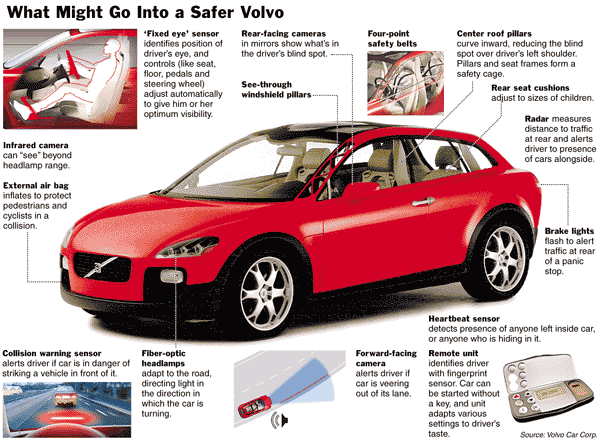
To enhance visibility, Volvo decided to give the driver X-ray vision
through a chief obstruction, the forward roof pillars by the windshield
(known in the industry as the "A pillars"). In the SCC, these
are not thick, impenetrable columns but a see-through honeycomb of steel
and plexiglass.
Another vision impediment are the "B pillars" just behind
the driver and front passenger, which support the middle of the roof but
also contribute to blind spots alongside a car. Volvo curved these
pillars inward, away from the glass, giving the driver a better
over-the-shoulder view. An added benefit is that these pillars, along
with the front seat frames, form a safety cage that offers protection in
rollovers and side-impact crashes.
To reduce blind spots even more, Volvo would use tiny cameras, radar
units and other sensors:
• Cameras that face the rear are integrated into the outside mirrors,
alerting the driver to the presence of cars alongside.
• A radar unit measures the distance to cars at the rear.
• Another radar unit, facing foward, would be a collision-warning
sensor, alerting the driver if the SCC was closing in too fast on
another car.
• A forward-facing camera monitors the position of the SCC on the
road, and sounds an alert if the car veers off course.
• An infrared light enhancer provides a black-and-white image of
objects beyond headlamp range. (The concept is similar to Cadillac's
Night Vision system.)
Vision gets so much attention because, Volvo says, 90 percent of all
crucial driving information arrives as "visual input" through
the windows. To ensure that the driver has the best possible view, Volvo
put into effect a concept called Fixed Eye, in which the interior adapts
to the driver, so the eyes are always at the position where they have
the best visibility, regardless of the driver's size or stature.
When the driver gets in the car, scanners determine the position of the
eyes and begin adjusting the interior to put them where they can see
best. The seat, floor, steering wheel, pedals and gearshift would all
move automatically, though the driver could further fine-tune the
settings.
The SCC also has fiber-optic headlamps that adapt to driving
conditions, by, for instance, increasing the beam as the car goes faster
and sending light in the direction the car is turning. An external air
bag, concealed in the front end, would inflate to protect pedestrians,
and a heartbeat sensor would let the driver know if a child or an animal
had been inadvertently left in the car — or if an intruder was hiding
inside.
The operator would not need a key to get in the car; the remote
transmitter could read fingerprints, and it would set many controls to
each driver's preferences.
|