|
Though it is now a modern appearance,
Barton is a place of great antiquity, and was once surrounded by
a rampart and fosse, traces of which are still seen in the Castle-Dikes,
as the rivulet and mill-race are generally styled. It is mentioned
in Domesday Book, as containing a church, a priest, two mills of
40s. value, a market, and a ferry of £4 value. At the Norman
Conquest, it was a corporate town, with a mayor, aldermen, &c.
; and it was one of the principal ports on the Humber, till the
foundation of Hull, in the reign of Edward I. For the invasion of
France, it furnished Edward III, with three ships and 99 men. The
manor, with part of the soil, belongs to the Crown, and is held
on lease by Charles Uppleby, Esq., of Barrow; but the Barton's,
of Stapleton; the Wray's of London; and the Tombleson, Marriott,
Preston, and other resident families, have estates and neat mansions
in the town; and there are in the two parishes many smaller freeholders
and copyholders. A court leet is held half-yearly, for the cognisance
of offences, committed in the manor; and a court baron, every three
weeks, for the recovery of debts under 40s. A Court of Requests
is also held monthly for the recovery of debts under £5, pursuant
to an Act of the 47th of George III.; and petty-sessions are held
every Thursday fortnight. There are two churches in the town, but
the benefices are untied, and the two parishes support their poor
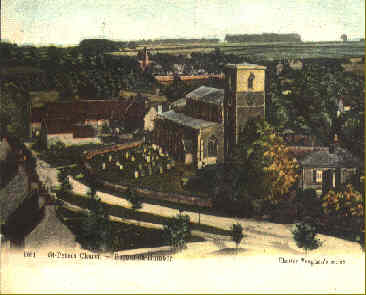
conjointly, as one township. St. PETER'S is considered the mother
church, and is a spacious fabric, chiefly in the decorated style
of English architecture, with a tower, the lower part of which is
Norman, and the upper part Saxon architecture. The body consists
of a nave, with aisles, and a chancel. In the east window, are two
figures in stained glass; one representing a pilgrim, and the other
said to be an effigy of that famous warrior, Lord Beaumont, to whom
Henry II. Granted the manor of Barton. There were several brasses
on the floor, but all are gone except one, inscribed to Wm. Cannon,
who died in 1401. St Mary's is a handsome structure of the fourteenth
century, said to have been built by the merchants of Barton, as
a chapel of ease. It has a nave, a chancel, side aisles, and tower.
The north aisle is divided from the nave by one pointed, and five
circular arches; the latter ornamented with zigzag mouldings and
supported by round massive pillars. The Arches of the south side
are pointed, and supported by alternate clustered pillars.
|
|