|
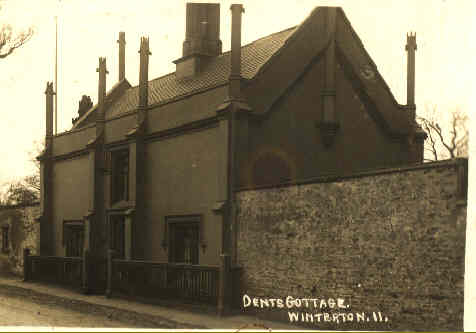
The town is about half mile west of Ermine Street, and has evidently been occupied by the Romans, for, in 1747, three beautiful tessellated pavements were discovered at the foot of the hill on Cliff farm. One of them was 30 feet long and 9 feet broad, and represented a figure of Orpheus playing on a harp, surrounded by beasts, with wine vessels at the corners. One of the others was 44 feet long by 15, and had in its centre a figure of Ceres holding a cornucopia; and on the third was a stag in the act of bounding. The late Mr. Wm. Fowler, of this place, copied and engraved these Roman relics, and also many other antiquities, with such accuracy and skill, that he received the patronage and praise of Sir Joseph Banks, the Society of Antiquaries, the Royal Family, and and of all possessing a taste for antiquities, architecture and the fine arts. About 20 years ago, he published a splendid collection of prints, representing Mosaic pavements, stained glass windows, %c., all drawn form the originals, and engraved and coloured by himself. This was the result of many years indefatigable labour and research. Wm. Teanby, who died about 30 years ago, aged about 90, was for many years the parish schoolmaster; and for a long period before his death, he had in his house his coffin and tombstone, using the former for a cupboard, and the latter for a table. Another eccentric inhabitant of Winterton was Jonathan Dent, Esq., who died aged 91, after amassing a considerable fortune by industry and parsimony. At his own request, he was buried in his garden, where a tomb has been raised to his memory, and the cottage encased with stone, in the of a sepulchral chapel, by his heir, J. Dent Esq., of Ribston Hall, Yorkshire. In the place where the tessellated pavements were found, there were also discovered the foundations of walls, a bath, a large brass eagle, Roman bricks, tiles, &c., and on the Northlands farm, a well, supposed to have been constructed by the Romans, was opened a few years ago, and found to contain a curious horn, and bits of iron and bone. a petrifying spring, called holy Well, near the town, was formerly in repute for great medicinal virtues, and the bushes around it were decorated with rags left by those who partook of the water.
|
|