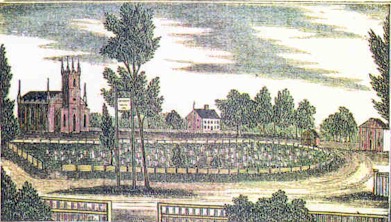
In his will of 1714, the Reverend James Pierpont (1659-1714) of New Haven gave eight acres of land to his neighbors in the Northeast Parish, as North Haven was called "provided those neighbors will set their meeting house there and make their training and burying there."
The first meeting house, completed in 1722, stood on the Green, west of what is now known as the Old Center Cemetery. About half of the original Pierpont gift remains today as the North Haven Green.
Three ministers served the North Haven parish during its first century:
Ezra Stiles enumerated about forty families living in North Haven in the early part of the eighteenth century. All of these people were multipurpose farmers, producing what they needed for themselves and their families.
In 1786, the General Assembly permitted North Haven to incorporate as a town, separate from New Haven. New roads were built to facilitate communication, namely the Hartford Turnpike in 1798 and the Middletown Turnpike in 1813.
The first United States census counted 1236 people in the agricultural community of North Haven in 1790. However, the 1789 Grand List had found 1620 sheep in North Haven with the amount of sheep outnumbering the residents.
By the middle of the nineteenth century, signs of the Industrial Revolution were apparent.
In 1838, the New Haven and Hartford Railroad had laid its tracks along the level sand plains by the Quinnipiac River. In addition, small industries such as the manufacture of agricultural implements in Clintonville began in 1830. On the 1850 census, 62% of the population were listed as farmers. One third of the residents worked in various nonagricultural occupations such as mechanics, brickmakers, and shoemakers.
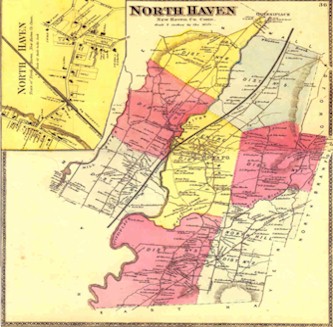
After the Civil War, the expanding production of bricks, especially by the I.L.Stiles Co. brought immigrants to North Haven from Ireland, Germany, Italy, and Poland. By 1880, 11 out of 100 people had been born outside of the United States.
In the1880's, Solomon Linsley, a North Haven architect, built both the Memorial Town Hall and the new District 4 School. Linsley designed and built thirty-two Victorian style houses and public buildings in North Haven.
By 1900, public transportation was important to North Haven residents. Eighteen passenger trains stopped at the Broadway station every day. The Airline Railroad ran through Montowese and Clintonville to Middletown. Trolleys ran from Montowese to New Haven. After 1900, the line was extended north to Wallingford.
          Population Growth in North Haven
Years      1750    1790    1850    1930    1980
Residents   350    1236    1335    5326    22,080