►Addressing
modes
RAM memory locations can be accessed
directly or indirectly.
1. Direct Addressing
Direct Addressing is done through a
9-bit address. This address is obtained by connecting 7th bit of direct
address of an instruction with two bits (RP1, RP0) from STATUS register as
is shown on the following picture. Any access to SFR registers is an
example of direct addressing.
Bsf STATUS, RP0 ;Bankl
movlw 0xFF ;w=0xFF
movwf TRISA ;address of TRISA register is taken from
;instruction movwf
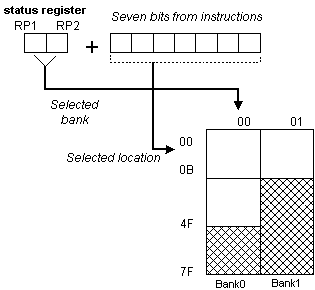
Direct addressing
2. Indirect
Addressing
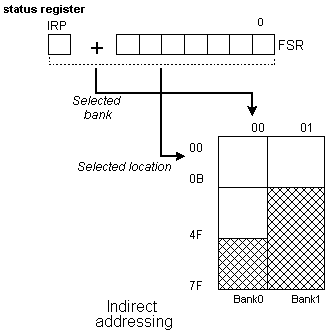
Indirect unlike direct addressing does
not take an address from an instruction but derives it from IRP bit of
STATUS and FSR registers. Addressed location is accessed via INDF register
which in fact holds the address indicated by a FSR. In other words, any
instruction which uses INDF as its register in reality accesses data
indicated by a FSR register. Let's say, for instance, that one general
purpose register (GPR) at address 0Fh contains a value of 20. By writing a
value of 0Fh in FSR register we will get a register indicator at address
0Fh, and by reading from INDF register, we will get a value of 20, which
means that we have read from the first register its value without
accessing it directly (but via FSR and INDF). It appears that this type of
addressing does not have any advantages over direct addressing, but
certain needs do exist during programming which can be solved smoothly
only through indirect addressing.
Indirect addressing is very
convenient for manipulating data arrays located in GPR registers. In this
case, it is necessary to initialize FSR register with a starting address
of the array, and the rest of the data can be accessed by incrementing the
FSR register.
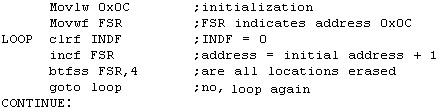
Such examples include sending
a set of data via serial communication, working with buffers and
indicators (which will be discussed further in a chapter with examples),
or erasing a part of RAM memory (16 locations) as in the following
instance.
Reading data from INDF
register when the contents of FSR register is equal to zero returns the
value of zero, and writing to it results in NOP operation (no operation).
Reading from
EEPROM Memory
Setting the RD bit initializes transfer
of data from address found in EEADR register to EEDATA register. As in
reading data we don't need so much time as in writing, data taken over
from EEDATA register can already be used further in the next instruction.
Sample of the part of a program which reads data in EEPROM, could look
something like the following:
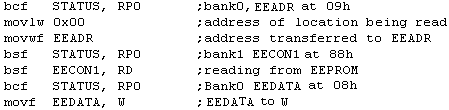
After the last program
instruction, contents from an EEPROM address zero can be found in working
register w.
Writing to
EEPROM Memory
In order to write data to EEPROM
location, programmer must first write address to EEADR register and data
to EEDATA register. Only then is it useful to set WR bit which sets the
whole action in motion. WR bit will be reset, and EEIF bit set following a
writing what may be used in processing interrupts. Values 55h and AAh are
the first and the second key whose disallow for accidental writing to
EEPROM to occur. These two values are written to EECON2 which serves only
that purpose, to receive these two values and thus prevent any accidental
writing to EEPROM memory. Program lines marked as 1, 2, 3, and 4 must be
executed in that order in even time intervals. Therefore, it is very
important to turn off interrupts which could change the timing needed for
executing instructions. After writing, interrupts can be enabled again .
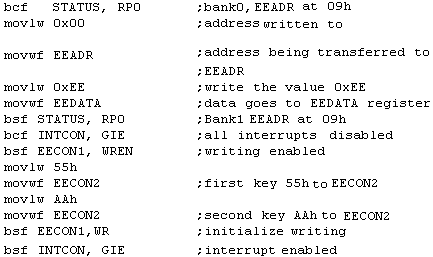
Example of the part of a program which writes data 0xEE to first location
in EEPROM memory could look something like the following:
|
 PIC 16F84 - Page 5/6