
Day 14 Thoughts
Education is considered to be of great importance to the Japanese people. We were told that for a man to be considered "successful" in Japan he must get a good job in a successful company. In order for a man to receive a "good job" he has had to attend a top university. In order to get into a top university he must receive high scores on a test taken at the end of high school. For that reason, students have tried to get into the best high schools. Once again, in order to get into a top high school, students needed to receive high scores on a test taken at the end of middle school. Education, even at the elementary level is of extreme importance to the Japanese because it has been such an important factor in determining the "success" of individuals. The Japanese are now looking at altering this system. I will attempt to explain the proposed changes in the next report, as I would like to describe what I noticed in the elementary school I visited. Kita Elementary School serves students in grades 1-6. I will address some of the differences I noticed between my school and this school. First, students receive breaks of between 10 and 20 minutes between classes. During these break times, teachers leave the rooms and students are free to play and talk in the hallway, the classroom and in the recess area without supervision. A buzzer sounded to inform students that the next class was about to begin. Students took their seats, placed the items they needed for class on their desks and were prepared by the teacher entered the room. Everyone in the class stands at the beginning of class. One students says something in Japanese and all of the other students recite something and then sit in their seats. I thought that they were greeting the teacher, but someone told us that they say that they will try to do their best work. In the classes I attended, almost every student listened carefully to the teacher, worked dilligently when assigned work and sat quietly. I did not notice a teacher speak to a child about behavior problems, nor did I notice the need for this to happen. Every child had sharpened pencils in a pencil case on his/her desk and a textbook. Students are assigned to work groups. Each group has a job and the jobs are rotated routinely. One group serves lunch to the other students in the class. The meals are prepared in the cafeteria by adults. Students each lunch in their classroom. The lunches we ate consisted of milk, soup, and the makings of sushi - spinach sheets, rice, fish and meat. After lunch students brush their teeth in the classroom (reminded me of the Tufts Dental Health Program I participated in at Cheverus as a child). Groups of students must then clean the classroom, the hallway and the bathrooms. Furniture is moved, as students sweep and later wipe the floor while on their hands and knees. The schools do not have custodians or a cleaning staff that clean the buildings.

Name:
Anne O'Brien
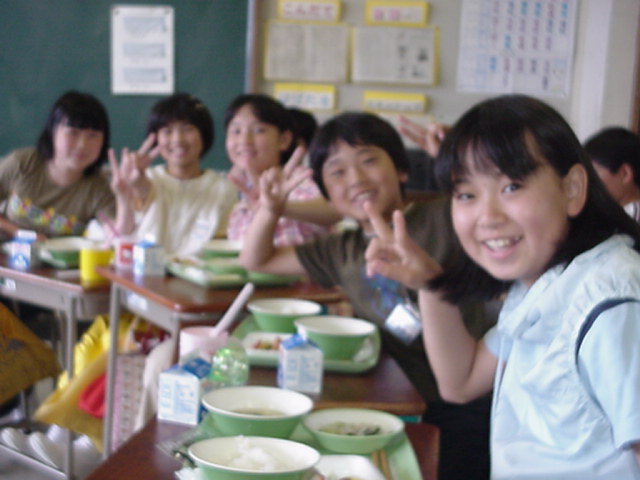
Students eat lunch in their own classrooms. Notice that glass dishes are used instead of styrofoam.