Home
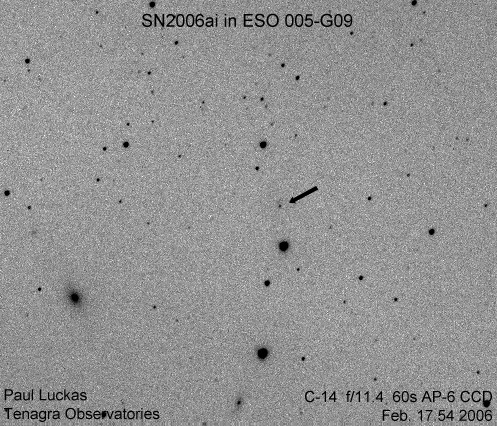
Supernova 2006ai in ESO 005-G09
RA: 7h 29m 53.77s.. DEC: -84° 02' 18.7" ( J2000 )
|
ESO 005-G09 in Octans
Dist. ?? million l.y. (?)
Supernova Mag 16.2CR
Date : Feb. 17.54 2006
Exposure time : 60 sec.
0.35m f/11.4 AP-6 CCD
|
|
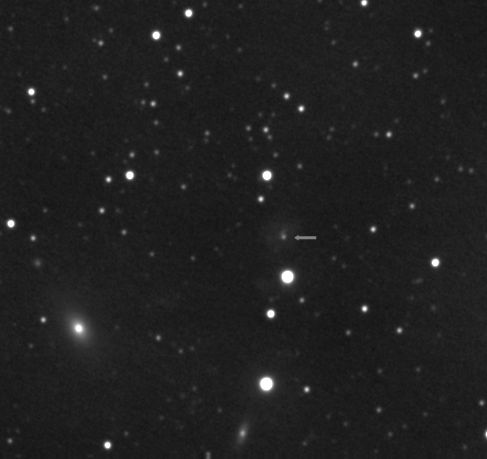
Supernova Mag 16.0CR
Date : Feb. 19.52 2006
Exposure time : 7 x 2min.
|
Photometry reference image.
IAU Circulars & Type determination for SN 2006ai
                    Electronic Telegram No. 406

  Central Bureau for Astronomical Telegrams
  INTERNATIONAL ASTRONOMICAL UNION
  M.S. 18, Smithsonian Astrophysical Observatory, Cambridge, MA 02138,
  U.S.A.
  IAUSUBS@CFA.HARVARD.EDU or FAX 617-495-7231 (subscriptions)
  CBAT@CFA.HARVARD.EDU (science)
  URL http://cfa-www.harvard.edu/iau/cbat.html


  SUPERNOVA 2006ai IN ESO 5-G9
      P. Luckas, Perth, W. Australia; O. Trondal, Oslo, Norway; and
  M. Schwartz, Patagonia, AZ, report the discovery of an apparent
  supernova on unfiltered CCD frames taken with the 0.35-m Tenagra
  telescope at Perth on Feb. 17.54 (at mag 16.2) and 19.52 UT (mag
  16.0) in the course of the Tenagra Observatory Supernova Search.
  SN 2006ai is located at R.A. = 7h29m52s.16, Decl. = -84o02'20".5
  (equinox 2000.0), which is 2".5 west and 1".8 south of the center
  of ESO 5-G9 (which itself has position end figures 29m53s.77,
  02'18".7).  Nothing was visible at the position of 2006ai on an
  image taken by Luckas on 2005 Dec. 16.79 (limiting magnitude about
  18.5).


  NOTE: These 'Central Bureau Electronic Telegrams' are sometimes
       superseded by text appearing later in the printed IAU Circulars.

                          (C) Copyright 2006 CBAT
  2006 February 19                 (CBET 406)               Daniel W. E.
  Green


                           Circular No. 8674

  Central Bureau for Astronomical Telegrams
  INTERNATIONAL ASTRONOMICAL UNION
  Mailstop 18, Smithsonian Astrophysical Observatory, Cambridge, MA 02138, U.S.A.
  IAUSUBS@CFA.HARVARD.EDU or FAX 617-495-7231 (subscriptions)
  CBAT@CFA.HARVARD.EDU (science)
  URL http://cfa-www.harvard.edu/iau/cbat.html  ISSN 0081-0304
  Phone 617-495-7440/7244/7444 (for emergency use only)


  SUPERNOVAE 2006ae, 2006af, 2006ag, 2006ah, 2006ai
      Several apparent supernovae have been discovered on CCD images
  (all unfiltered except for the spectroscopic SDSS discoveries):
  2006ae and 2006af by M. SubbaRao and the Sloan Digital Sky Survey
  (SDSS) collaboration (cf. IAUC 8668, CBET 400; magnitudes below are
  estimated r-band values; both objects at center of their host
  galaxies); 2006ag and 2006ah on Palomar NEAT survey images via the
  "Nearby Supernova Factory" collaboration (details on CBET 402); and
  2006ai by P. Luckas, O. Trondal, and M. Schwartz (cf. IAUC 8668).
  SNe 2006ae, 2006af, and 2006ah all appear to be type-Ia supernovae
  within a weak of maximum light upon discovery, while 2006ag is a
  type-IIn event.  Additional approximate magnitudes of 2006ai in ESO
  5-G9:  2005 Dec. 16.79 UT, [18.5; 2006 Feb. 19.52, 16.0.

  SN      2006 UT      R.A.  (2000.0)  Decl.    Mag.     Offset
  2006ae  Feb.  2.51  14 48 23.27  +21 47 51.5  20.7      -
  2006af  Feb.  4.38  10 33 57.18  +20 20 25.7  19.5      -
  2006ag  Feb.  9.4   12 00 17.12  +28 36 22.0  17.9      -
  2006ah  Feb.  9.6   13 46 13.71  - 9 07 50.6  18.6      -
  2006ai  Feb. 17.54   7 29 52.16  -84 02 20.5  16.2  2".5 W, 1".8 S


  GRB 060218 = SUPERNOVA 2006aj
      A. Soderberg, California Institute of Technology; E. Berger,
  Observatories of the Carnegie Institution of Washington; and B.
  Schmidt, Australian National University, report that a spectrogram
  (range 320-1000 nm) of GRB 060218 (cf. Cusumano et al., GCN
  Observation Report Circ. 4775; R.A. = 3h21m37s, Decl. = +16o51'58",
  equinox 2000.0), obtained with Gemini-South telescope (+ GMOS) on
  Feb. 21.024 UT, shows that underlying a power-law continuum are
  features consistent with a broad-lined type-Ib/c supernova
  (designated 2006aj) near maximum light, confirming the findings of
  Masetti et al. (GCN 4803).  The Gemini-South spectrum also confirms,
  from several narrow emission lines, the redshift of z = 0.033
  (Mirabal, who reported r = 17.6 on Feb. 19.1438 via GCN 4784, and
  who notes a pre-outburst extended object at the GRB location via
  GCN 4783).  Marshall et al. provide a precise position of the
  optical counterpart of GRB 060218 from images obtained with the
  Swift UltraViolet and Optical Telescope:  R.A. = 3h21m39s.71, Decl.
  = +16o52'02".6 (estimated 1-sigma error about 1".0; cf. GCN 4779).
  Zheng et al. report (on GCN 4802) the following R magnitudes for
  the optical counterpart of GRB 060218:  Feb. 18.4522, 17.8; 20.4471,
  18.2.

                       (C) Copyright 2006 CBAT
  2006 February 21               (8674)            Daniel W. E. Green


                     Electronic Telegram No. 422

  Central Bureau for Astronomical Telegrams
  INTERNATIONAL ASTRONOMICAL UNION
  M.S. 18, Smithsonian Astrophysical Observatory, Cambridge, MA 02138,
  U.S.A.
  IAUSUBS@CFA.HARVARD.EDU or FAX 617-495-7231 (subscriptions)
  CBAT@CFA.HARVARD.EDU (science)
  URL http://cfa-www.harvard.edu/iau/cbat.html


  SUPERNOVAE 2006Y AND 2006ai
       N. Morrell and G. Folatelli, on behalf of the Carnegie Supernova
  Project, report that spectroscopy (range 380-930 nm) of SN 2006Y (cf.
  IAUC 8668), obtained on Feb. 27.14 UT with the Las Campanas 2.5-m du
  Pont telescope (+ WFCCD spectrograph), showing it to be a type-II
  event, nearly one month after explosion.  A spectrum of the apparent
  nucleus of the host galaxy was also obtained, from which is derived a
  recession velocity of 10074 km/s (redshift 0.0336 +/- 0.0001).  From
  nebular emission lines superimposed on the supernova spectrum, a
  slightly different redshift of 0.0333 +/- 0.0001 is derived; using
  this value, an expansion velocity of 7650 km/s for this supernova is
  derived from the minimum of the H_beta absorption.  A redshift of
  0.0341 +/- 0.0002 was also measured for ESO 207-G27 (a galaxy located
  southeast of the supernova host).
       A spectrum of SN 2006ai (cf. IAUC 8674), obtained on Mar. 5.12 with
  the same instrumental configuration, shows it to be a type-II supernova,
  at least one month after explosion, for which an expansion velocity of
  8050 km/s is derived from the minimum of the H_beta absorption,
  considering a redshift of 7426 km/s (z = 0.0158 +/- 0.0001) measured
  from emission lines in the spectrum of the host galaxy.


  NOTE: These 'Central Bureau Electronic Telegrams' are sometimes
        superseded by text appearing later in the printed IAU Circulars.

                           (C) Copyright 2006 CBAT
  2006 March 7                     (CBET 422)               Daniel W. E.Green
