Campaigns in North Africa
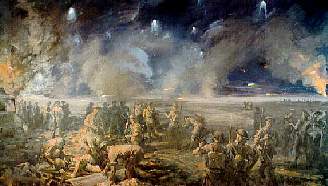
It was 1940, and things looked hopeless for the British Western Desert Force. It numbered only 36,000 men, and it appered to be able to do nothing to halt an Italian offensive into Egypt by the Italian 10th Army. But the cautious Italian commander stopped only after advancing 60 miles, and his lines were dangerously exposed. Richard O'Connor, the commander of the Western Desert Force, did not waste his opportunity. He began Operation Compass on the Italian camps on December 9. Three days later already 38,000 Italians had surrendered. Once the Italians were out of Egypt, he didn't stop there, but continued his campaign. Further advances brought 130,000 prisoners at a cost of 2000 casualties. But O'Connor's efforts were about to be wasted; O'Connor was stopped from making further advances by Churchill's demands to transfer troops to Greece.
The Germans were alarmed by the sudden Italian defeat in Africa. They responded by sending the Deutches Afrika Corps under General Erwin Rommel. The firstunits arrived on 14 February, 1941. Rommel decided to take the offensive when he learned that the British supply lines were overstretched. He attacked in late March. He missed no opportunities and on 31 March, Rommel attacked Mersa el Brega and Agedabia. Benghazi, Barce and Derna were easily take, as was Gazala. On 6 April O'Connor was captured. Two main Axis columns linked up near Gazala, and there was nothing that the British could do but withdraw. Rommel by then was stretching his supply lines, and he became obsessed with capturing the valuable port of Tobruk. Despite constant Axis attacks, the Germans never captured the port and it held out until releived by the British. On 15 May, the British launched a counterattack codenamed Operation Brevity. It made some headway, but the offensive failed when Rommel made countermoves. As both sides brought up reinforcements, the battle degenerated into a stalemate.
As a result of the arrival of valuable supplies, aand 400 tanks, Wavell, commander Middle East, decided it was time for an offensive. His attack, Operation Battleaxe, failed miserably. It also cost Wavell his job and he was replaced by General Sir Claude Auchinleck. The Western Desert Force, now renamed Eighth Army, was placed under the command of General Sir Alan Cunningham. While both sides dallied, collecting reinforcments, Tobruk remained under seige. The Australians defending the city were replaced by Polish, British, Indian, and South African troops. Eighth Army's next goal was to releive Tobruk. While the XIII Corps pinned German troops down at the border, the 453 tanks of XXX Corps would loop around to the left and advance toward Tobruk. They would then tempt the 272 tanks of the 15th and 21st German Panzer Divisions into a set-piece battle. Once the German tanks had been defeated, the Germans would be squeezed between the two British columns, and an advance would be made into Tobruk itself. The attack began on 19 November and Rommel was slow to react. A series of mistakes by Rommel led to the linking up of British troops with the Tobruk garrison. By then General Niel Richtie was in command of the Eighth Army. Rommel's positions were by now dangerously exposed. He withdrew, and the Axis forces had yet again suffered a major defeat.
But the tide of battle reverse once again as Rommel, strengthened by reinforcements, prepared to attack Auchinleck's forces, which were nearing the end of their supply lines. While Italian forces tied up British forces on the front, the 15th and 21st Panzer Divisions would move in a wide movement to encircle the Eighth Army. But the attack did not go according to plan. It began on May 26. Italian attacks were defeated, and the German and Italian tanks encountered unexpected opposition. Two days later, Rommel was on the defensive. But Rommel was allowed to recover, and many attacks were launched from Rommel's positions. Tobruk fell on 21 June. Auchinleck took personal command on Eighth Army, and withdrew to El Alamein, deep inside Egypt.
Rommel attacked British defense lines at El Alamein on 1 July, hoping to exploit a gap. But British tanks halted the German attack and drove it back. Auchinleck then took the time to prepare for an offensive of his own. Auchinleck had short supply lines and 400 tanks available, while Rommel's supply lines were overstretched and he had ony 100 tanks available. The attack began on 10 July. The Italians literally ran away, and Rommel had to commit his German forces to hold back the Allies. In effect, as one disaster piled up after another, the British offensive failed. The Germans had been stopped but not held back; and at a heavy price. Auchinleck lost his job and was replaced by General General Sir Harold Alexander in August. Eighth Army went to General Benard Montgomery. The British intelligence picked up Rommel's plans for his next offensive. His plan was familiar: Attacks on the front would pin the British down while the panzers would outflank the Eighth Army and encircle it. The British planned to counter that by placing strong defenses at the Alam Halfa Ridge, directly in the panzers' path. Rommel's attack began on 30 August and failed miserably. Rommel suffered heavy losses and by September 2nd the Germans had retreated.
At that point, Rommel shifted to the defensive. Montgomery prepared for yet another attack. It would focus in the north with the XXX Corps and the X Corps. In the south, the XIII Corps would mount diversionary attacks. The attack, Operation Lightfoot, began late in the evening on October 23rd, 1942. By 28 October, Montgomery launched a new offensive, Operation Supercharge. Despite heavy casualties, the offensive made much headway and the German losses were nearly double that of the British. rommel then began a massive retreat. On 13 November, Tobruk was taken. On 23 January, Tripoli, a valuable port, was taken. Rommel withdrew to Tunisia.
Operation Torch began on 8 November, 1942. American and British troops landed on a wide front. The landings succeeded, although immediate success was not acheived. rommel responded by landing reinforcments of his own, and established a strong defensive line. The Americans at Kasserine Pass suffered heavily when they were attacked by Germans. But Rommel failed to exploit his advantage quickly, and soon the advantage was gone.
rommel soon mounted a panzer counterattack (big surprise) but British intelligence expected it and the 15th and 21st Panzer Divisions suffered heavily. Hitler then replaced Rommel with General Jurgen von Arnim. Montgamery planned an attack on 20 March, 1943, but mud halted his attacks. A breakthrough soon did occur, however, and George S. Patton's II Corps linked up with the Eighth Army on April 7th. Despite heavy casualties, further advances were made. The final offensive commenced on 6 May. On 12 May the German forces remaining in Africa surrendered.
Previous|Home|Next