Russia 1941-1943
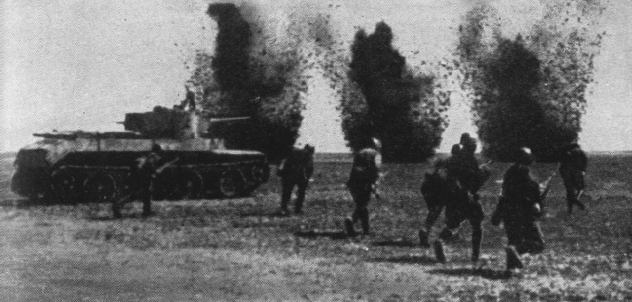
Despite other campaigns, Hitler's main goal was always to conquer Russia. As quoted from Mein Kampf, "When we speak of living space for the German people, we must think principally of Russia and the border states subject to her. Destiny itself seems to wish to point the way for us here." Hitler knew that the only way to conquer Russia was with war. As early as 1940 directives for the preparation of the invasion of Russia were issued. The invasion was code-named Operation Barbarossa. A total of roughly 180 divisions (80% of the German Army), were stationed at the Russian border, divided between 3 army groups. The invasion was scheduled to take place on June 22, 1941. Map of Operation Barbarossa
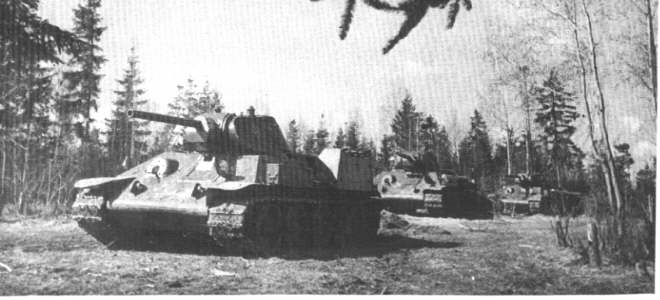
From the Russian stanpoint, conditions were far less favorable. Although the Red Army was strong, it had been disabled by Stalin's purges, and therefore contained few experienced commanders. There were 20,000 tanks in the Red Army, but most of them were outdated and usless against the German panzers. The same was true of the Red Air Force; while strong, most of the planes were outdated. They had a new tank, better than the German panzers, the T-34, but there were very few and the T-34 had yet to make its appearance. Their only hope was "General Winter". If they could defend Moscow long enough for winter to set in, they might have a chance to regroup their forces.
The attack opened at 3:00, June 22nd, with a gigantic artillery bombardment, and the Luftwaffe (the German Air Force) destroyed 2000 aircraft in the first 48 hours. When the German troops crossed the border, Soviet resistance could have been much stronger, but they were on low readiness because Stalin did not want to provoke the Germans, but to no avail. To put it bluntly, too bad for Stalin.
The German panzers advanced remarkably quickly, trapping over a million Soviet soldiers. However, the chance to capture Moscow was squandered by Hitler to divert the panzers to the Ukiraine ind Leningrad, leaving Moscow to the infantry, as soon as Smolensk had been cleared. On the first of September, 1941, the seige of Leningrad began, not to stop until January 1944. Even more Soviet troops were captured at Kiev. Hitler then began plans for operation Typhoon, a final thrust, panzers included, to Moscow, which was to be the final campaign. But there were problems as well as advantages. The rail system was in disrepair, forcing the Germans to use such methods of transport as horse-drawn carts for supplies, and the decision to divert panzers to the north and south gave Stalin a much-needed respite. Map of Operation Typhoon
Operation Typhoon began on 30 September with a gigantic armored pincers movement. Over 630,000 Soviet soldiers were captured. In desperation, Stalin appointed General Georgi K. Zhukov as the commander of the Moscow defense. It later proved a wise move. But that did not help the situation, with German units positioned, in some cases, a mere 15 miles from the Kremlin. But winter was setting in. Russian equipment was adapted to the cold, but German equipment was not. Engines and guns froze, making them worthless. Also, the Germans lacked sufficient winter clothing for their forces, and frostbite was soon commonplace. However, this did not make the Germans pull back, and they remained at the gates of Moscow. But that was soon to change. Map of Russian Counteroffensives Winter 1941-1942
Having now brought up reinforcements that boosted the army up to 580,000 men, Zhukov saw a chance for a counteroffensive. And he was just he one to take that chance. On 5 and 6 December, the attacks commenced on a front from Leningrad in the north to the Ukiraine in the south. German units were not prepared and crumbled, forcing Hitler to accept withdrawl. As an effect of the attack, Hitler threw out his commander-in-cheif, Brauchitsch, and replaced him with himself.
But Zhukov had orders from Stalin to continue the offensive, despite the facts that the Russians had suffered heavy losses, and the Germans were now better prepared. The Germans threw back attempted encirclements everywhere, and even trapped Soviet troops. Over 70,000 Soviets were killed and 200,000 were wounded, and the onset of spring brought mud and rest to their forces, leaving them to plan their campaigns for summer. Map of Operation Blau, Summer and Autumn 1942
With the destruction of significant forces in the south of Russia, the area was vunarable and, therefore, Hitler was planning a major offensive in that region. It's objective was to capture the rich oilfields of the Causcaus-the oil which Hitler needed to sustain the war. Also, they might be able to advance through the Middle East, once the Causcaus had been captured, and link up with troops coming out of Africa. The whole operation was codenamed Operation Blau (Blue). Blau began on 28 June, 1942.
Army Group South took Stevastopol, in the Crimea, on 2 July and Voronezh on 5 June. Army Group South was split into Army Groups A and B on July 9. After seizing the Donets Basin, it was to head sowthward into the Causcaus, its main objectives Batumi and Baku. Army Group B advanced south to Stalingrad. Althougth there was much confusion, initial progress was good, and the German VI Army and the IV Panzer Army, under General Friedrich Paulus, reached the suburbs of Stalingrad on August 23 and 24. So began a battle which would become legendary. Map of The Battle of Stalingrad
Paulus did not know what was in store for him at Stalingrad. Although Russian forces were in disarray, they were well prepared for urban fighting. On 7 September, Paulus advanced through the center of the city, aiming for the Volga. Hoth's Fourth Panzer Army came up through the south three days later. The Sovies were split in two. But that very day, General Vasili Chuikov was named commander of the 62nd Army, which was a brilliant move. Soviet armies fought for every inch of the city, and both sides suffered heavy casualties. The Germans advanced almost continuously, and the armies defending Stalingrad were given few reinforcements. Chuikov knew something big was up. True enough, early on 19 November, Russian guns signaled the beginning of a huge Russian offensive-Operation Uranus. Operation Uranus
Chuikov had not received many reinforcements because Stalin and other high commanders had been building up forces for the new offensive, codenamed Operation Uranus. It was an ambitious plan, intending to encircle the German VI Army and the German IV Panzer Army. When the Soviet Fifth Tank Army and the Fifty First Army linked up, they trapped over 250,000 men in the pocket. Goering promised that the Luftwaffe would supply the men with what they needed, 600 tons a day. Hitler agreed. But unfortunately the Luftwaffe was not capable of this task, only delivering 100 tons a day when the weather was good, and at the same time the Soviets consolidated their new positions.
Operation Winter Storm, intended to releieve beseiged Stalingrad, began on the twelfth of December, with the 230 tanks of the LVII Panzer Corps.The forces got to within 30 miles of Stalingrad, but Soviet offensives elsewhere made it imopssible to continue without risking their own encirclement. Paulus pleaded with Hitler to allow a breakout, but Hitler refused, ordering Paulus to stand fast. On 26 January, 1943, the pocket was split in two. On the day that he was promoted to Field-Mashall, 31 June, he officially surrendered. The last Germans laid down their arms on February 2. Soviet offensives following the battle of Stalingrad
Prev|Home|Next