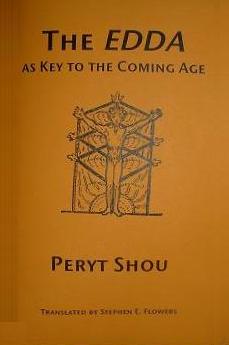
 ("The Edda as Key to the Coming Age" by Peryt Shou (1920), as pictured below is available here, here and here in an English translation.)
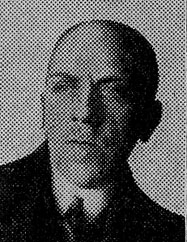
Peryt Shou
(Albert Christian Georg Schultz)
April 22nd, 1873 - October 24th, 1953
("The Edda as Key to the Coming Age" by Peryt Shou (1920), as pictured below is available here, here and here in an English translation.)
Peryt Shou, whose legal name was Albert Christian Georg Schultz, was born the son of an innkeeper on 22 April 1873 in Kroslin near Wolgast in Pommerania. Schultz studied in Berlin and devoted himself to poetry, painting and eventually the secret sciences. During the course of his career he authored some forty books, most of which have been forgotten and lost in obscurity. However, he remains one of the most important esotericists of the 20th century Germany. This is main;y because his works, although obscure, were nevertheless extremily influential on other German occultists and esotericists o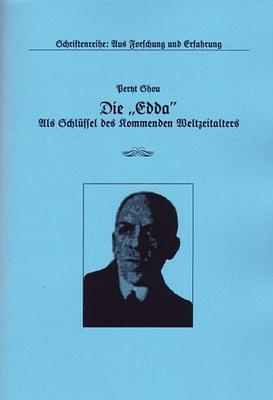 f the day.
Those directly influenced by Peryt Shou include Ludwig Schmitt, Alfred Strauss, G.W. Surya (= Demeter Georgiewitz Weitzer), Rudolf von Sebottendorf, Hans Sterneder, Arnold Krumm-Heller, A. Frank Glahn, Herbert Fritsche and Karl Spiesberger.
In the early years of Shou's writing and teaching career he concentrated on works relating to the East and to works devoted to a more universalistic view of his major concepts and working theories of cosmic hieroglyphics and "practical Logistics" (praktische Logistik).
 Writing in his Latrosophie (1962, p. 93), Herbert Fritsche (1911-1960) identified these two foundational experiences which awakened Shou to his inner work, i.e. "the reading of cosmic hieroglyphics and awakening in the Logos, rebirth in the Word."
By the same token Shou was greatly influenced by the works of Guido von list, as the text of "The Edda as Key to the Coming Age" shows. This book, the German title of which is "Die "Edda" als Schlussel des kommenden Weltalters!", was the first volume of a series to be entitled Esoterik der Edda, published by Linser-Verlag. This volume was first published in 1920. This Armanic influence in the work of Peryt Shou can be most clearly traced from the initial influence of Arnold Krumm-Heller, who published some of Shou's works immediatly following the First World War. Throughout the 1920's Shou's work was increasingly under the influence of the growing Ariosophical wave, upon which he converely exercised his own influence. By the end of the 1920's Shou was in close contact with the leading Ariosophical thinkers, e.g. Rudolf John Gorsleben, Werner von Bulow and Karl Maria Wiligut.
It is interesting to note that Aleister Crowley, while in Berlin showing his paintings, wrote in his diary for February 11th, 1932: [Krumm-Heller] here with Peryt Shou.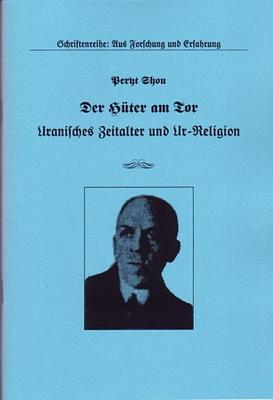
It appears that Shou lived throughout the National Socialist regime without being molested. This, no doubt, speaks to his good connections.
He lived as a private teacherand writer, and continued to fulfill this role after the war.
Shou's work on the Edda is of interest on many counts. It gives a larger context to some of the more difficult sections of the book Rune Might, first published in 1989, and recently republished by Runa-Raven (2004).
The whole tenor of Sou's work, although imbued with the general Volkish spirit so prevalent in much of German occultism of the 1920's, nevertheless cannot be classified as a work rooted in "right-wing" extremism. Clearly Shou's larger sympathies are with universal ideas and patterns, and are not unsympathetic to the idea of "communism" - albeit of a spiritual and not orthodox Marxist-materialist kind. But just as clearly this work is born of the distressing national circumstances his country found itself in during the years immediatly following World War I. It is in this national and historical context that some of the has to be understood. However, it's larger validity can transcend those particular circumstances and related to any and all societies and individuals who find themselves in distress, and who are searching for a way to overcome those difficulties by means of esoteric, spiritual techniques and exercises.
When Shou wrote his book in 1920 , Germany seemed as if it had been "crucified" by the events of the "Great War," This feeling must have only increased when, after the country had seemed to be "resurrected" in the Third Reich - as Shou's text seems to foreshadow - it was once more devastated in 1945. When Shou died on 24 October 1953 his country was in fact on the eve of a much more permanent and stable ressurection.
Flowers, Texas, 2004.