
| In the frontier days, a "grocery" was the name for a tavern. A license was required to sell liquor in quantities less than a quart, and consumed on the premises. Only when one was licensed would one be engaging in the occupation of grocery-keeping as a tavern.
---Illinois History, February, 1995.
|
|
The Ballad of Whiskey Straight
Let dreamers whine ---19th-century Kentucky poem.
|
Abner "Uncle Ab" Nichols ran a hostelry in Mineral Point known as the "Mansion House." Reportedly, Uncle Ab's establishment was "known far and wide as the best place in the lead mining district to pass a night or obtain a meal, and as for the landlord, he was the embodiment of the perfect host..." Uncle Ab kept most of his liquor in a "grocery," located conveniently near his establishment, "where all sorts of amusements were indulged in."
To begin... here are some of the views of the 1820s and 1830s regarding groceries and their products:
Quantity.
In those days the people drank vast quantities of whiskey and other liquors; and the dispensation of liquors, or "treating," as it was called, by candidates for office was an indispensable element of success at elections. In many counties the candidates would hire all the groceries at the county seats and other considerable villages, where the people could get liquor without cost for several weeks before the election.---Thomas Ford, History of Illinois, p. 104.
A part of the rural sport in pioneer times enjoyed at a wedding, was running for the bottle. The bride and the bridegroom had parties volunteer to run for the stake. A bottle was filled with whiskey, and embellished with ribbons. This was held by the judges, and all that pleased entered the horses to run for the bottle. A mile, or more, was the distance when it was won, it was presented, with much backwoods' taste and politeness, to the party by whom the victory was achieved.---John Reynolds, My Own Times, p. 41
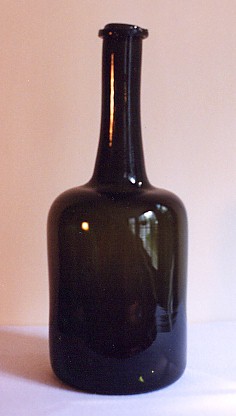
It was often amusing to hear a Kentuckian relate his adventures on flat-boats, "the old Broad Horn," to New Orleans. At times a bottle, called "Black Betty," filled with Monongahela whiskey, would make its appearance at these "houseraisings," and then was told the "hair-breadth escapes" and adventures of the pioneers.---John Reynolds, My Own Times, p. 41
The most common game of cards at that day was called Loo; and in this game, and in many others, I was frequently engaged like other folks of that time. I have lost or won considerable amounts in an evening. I never considered card-playing as the most innocent amusement; but I yielded to the customs and habits of the country.---John Reynolds, Own Times 52
One small, tricky game for whiskey was often played in these keg groceries, which was called "Finger in danger." Every one that pleased put his finger down in a ring, and then some "knowing one" counted the fingers until the count reached some number agreed on, and the finger at that number, when it was touched was withdrawn, and so on until the last finger in the ring was left, and then it had to pay for the treat.---John Reynolds, My Own Times, p. 52
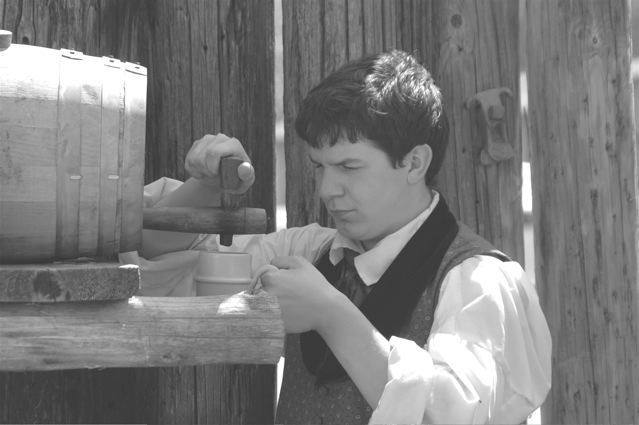
John Murdick, a ranger of singular sagacity, and one who was also intemperate in the use of liquor, conceived a plan to procure a bottle of whiskey from the sutler without money. Murdick obtained two black bottles, and filled one with water. He put them both under his hunting-shirt, which was belted around him, and gave the empty bottle to the sutler and wanted it filled with whiskey. When it was filled, he had no money to pay for it. The only thing that could be done, after much parleying, was to pour back the whiskey into the bung-hole of the barrel — but Murdick poured the water out of his extra bottle into the barrel, and walked off with the whiskey, muttering aloud that "it was hard to be poor." He was celebrated for these tricks.---John Reynolds, My Own Times, p. 96
The custom, at that day, was to obtain the liquor to drink by measure, and not by drams, as is the practice at present. Murdick observed the landlord put the twelve and a-half cents in a teacup, which stood on a high shelf in a cupboard; when the grocery-keepeer turned his back, Murdick would take the same piece of money, and with it he would buy another half-pint. He continued this scene until the company were all boozy, and the landlord had only the first piece of coin Murdick commenced with.---John Reynolds, My Own Times, pp. 96-7
Wm. I. Sterling [a pioneer settler of Richland County] informs me that Black Hawk crossed Pine River in Richland Co., just below the natural bridge; Atkinson left two baggage wagons laden with medical stores at Pine River. The medicines consisted principally of whiskey, which Atkinson used to excess. The Winnebagoes afterwards burned these wagons.---Dr. C. V. Porter, DeSoto Chronicle, January 29, 1887.
There was... one good tavern [in Mineral Point] kept by Abner Nichols and one or two other small affairs of similar pretentions, together with groceries and "tiger dens," those very necessary adjuncts to the perfection and good fellowship of a mining camp.---History of Iowa County, Wisconsin.
[Antoine] Brickler kept a saloon in his house at Gratiot's Grove [and] sold whiskey at four drinks for a quarter (25 c) mostly to the furnace men, miners and travellers.---Recollection of A. C. Chetlain, Wisconsin Historical Society.
Mead's Grocery-- Shullsburg, Wisconsin.
--Submitted by George McDonald.
"Your subsection on 'Groceries' caught my attention and brought to mind a story regarding one of my ancestral Uncles by the name of Morris Meade. The Meades were another early lead region family of Irish descent, coming from Youghal, County Cork. Morris Meade ran a grocery in Shullsburg before moving to Galena area. The following story was related in the Shullsburg Pick and Gad newspaper by one of the Townsend family, I believe Absolam. Unfortunately I do not have the original copy at hand, and don't remember when he wrote it (I think it was around 1920.) It is interesting to note that the Thomas James who was the Justice of the Peace (and later a member of the Wisconsin Constitutional framing committee) was Morris Meade's brother-in-law.
Morris Meade had opened up a grocery in a building which stood a few rods west of the sub-station on the north side of the road. In his store, besides liquor, he also kept a supply of family goods, medicines, etc.A small log school house had been built and stood on the present site of the First National Bank. It answered the purpose of school house, town hall,lecture hall, Justice of the Peace courtroom and occasionally church....
The time arrived when it seemed necessary to do something to break the hold which Old Satan seemingly had on many of the residents. For this purpose a series of meetings was gotten up at the old school house in the Spring of 1843 under the leadership of a Rev. Simpson. These meeting were soon attended by large gatherings each night... This naturally created alarm among the old veterans in His Satanic Majesty's Service, so to put a check on this "getting Religion" they resolved to try and break up the meetings. Accordingly some of them met at Meade's Grocery and after due deliberation a plan was agreed upon.That night as the meeting was in progress they marched up to the school house with a jug of whisky with which they were going to go in and treat the minister and his congregation. For some reason this plan was abandoned, perhaps as a waste of good whisky. The jug was set to the side, and the besiegers proceeded to march round and round the building singing unholy songs. This failing to have the desired effect it was agreed to separate. A party was to climb to the roof while a portion were to remain below to observe the proceedings through the logs where the chinking had been removed. Those on the roof beat a savage tattoo on the shingles with an occasional war whoop thrown in for good measure. One of those on the ground concieved the idea of cooling the religious ardor by throwing water on the congregation through those places between the logs from which they had removed the chinking.No sooner said than done. It occured that one of those recieving this unceremonious baptism was the wife of the one who threw the water. The meeting was closed. Those on the ground informed those on the roof it was time to adjourn, and they began a precipitous flight. One large, heavy man on the roof slipped and fell to the ground with a great crash, but without serious injury. They were all recognized. Next day they were all politely invited to attend another little meeting in the same school house in from of Justic of the Peace Thomas James, Esq., whereupon all answered the complaint, paid their fines, and filed off down to Meade's Grocery to smoke, drink and talk over the affair as a good joke.
Large droves of cattle and hogs were driven up from central Illinois to settlements here and nearby and were fed on the praries until all sold out. A farmer by the name of Higley would come up with cattle from near Rockford and nearly every Saturday he would put up a beef to be shot for, the beef being put up in quarters and all the money for the game being taken from those who took chances at 25 cents per shot. These shooting matches were held in the bottom in front of Morris Meade's Grocery. They were patronized extensively, people coming to compete from as far as ten miles distant. The place selected for these shooting matches was very convenient to "refreshments."

It is now many years since the writer of this essay was first made to reflect, with some intensity, on the vice of drunkenness, whilst endeavoring to apply a remedy, in a small corps, to that greatest source of disease and insubordination in the rank and file of an army. Having the attention so awakened, and subsequently being much accustomed to change of place from one extreme of the Union to another, he has been led to observe, with a more than usual keenness, the ravages of the same habit among the more numerous classes of the community. The conviction has thus been forced upon him that, of all accidental evils, this is the most disastrous to our general population.Insanity from other causes is, for example, exceedingly rare. The yellow fever only visits, occasionally, some of our larger cities on the seaboard — the small-pox, once the terror of the world, has disappeared before the benign influence of vaccination — but the virus of intemperance still circulates everywhere, and saps the foundations of morals, health, and happiness! For, not minutely to dwell, in this place, on the innumerable disorders, both domestic and public, which hourly result from the earlier progress of intoxication — happily, in some few individuals never carried to excess, nor ripened into fixed habit — and such ills alone constitute a frightful aggregate — how few are the families that have not been, within the memory of the living, plunged into the deepest affliction by this baleful vice! — that have not had a son blighted in the vigor of youth and genius by its pestilential breath — a fond husband alienated by the syren — or a father laid in an untimely grave by the destroyer, leaving a tender offspring destitute and forlorn. Lives there a person who believes this picture overcharged? Let him go forth from his corner and inquire of the first man of observation in his way, whether such calamities do not almost daily occur within the sphere of his knowledge? There can be no doubt that magistrates, lawyers, physicians, divines, and others, much in the world, or much connected with its business and sufferings, would universally concur in one mournful reply —
'Tis quenchless thirst
Of ruinous ebriety that prompts
His every action and imbrutes the man —
Who starves his own; who persecutes the blood
He gave them in his children's veins, and hates
And wrongs the woman he has sworn to love.'Is there, then, no antidote for this evil — no kind preventive to the mother-vice which augments, in a thousand ways, the general sum of human wretchedness?
 How Bourbon Whiskey Got Its Name.
Abraham Lincoln in Bourbon Country.